The best city builder games in 2026
There is no single best city building game, which is why every ranked list of them reads slightly wrong. The phrase covers about six different appetites. Here is the genre sorted by which one you have.
Somebody who wants to spend a weekend routing a motorway interchange and somebody who wants a quiet medieval village that survives its first winter are both searching for the best city builder games, and almost nothing will satisfy both of them. That is the real problem with the question. The genre stopped being one genre around 2018 and nobody updated the listicles.
So this is organised by appetite rather than by score. Every entry says what it does well, and every entry says where it will annoy you, because the second half is the part the marketing pages leave out. Dates and studios have been checked. Where a game is still moving, that is noted rather than smoothed over.
How this list is organised
Five appetites, in the order people usually arrive with them. The deep simulations, where the city is a systems puzzle with a hundred dials. The historical ones, where the setting does real work. The survival ones, where the map is trying to kill you. The calm ones, where nothing is trying to kill you at all. And the ones that run without an install.
A game can sit in two of those. Anno sits in the first two and would happily sit in a third. The categories are a way of finding your entry point, not a taxonomy anyone should defend.
The deep city builder simulation games
These are the heavyweights: the city builder PC games that want a real machine, forty hours before you understand the economy, and a second monitor for the wiki. If your ideal Saturday involves a spreadsheet, start here.
Cities: Skylines II
The obvious pick, and for two years the awkward one. Colossal Order and Paradox launched it in October 2023 in a state that could not run properly on the machines people owned, and the Steam score sat around fifty per cent while the studio patched. In late 2025 Paradox and Colossal Order parted ways, and development moved to Iceflake Studios, an internal Paradox team, from the start of 2026.
That handover has gone better than anyone expected. Recent reviews turned positive over the course of 2026, reaching the mid seventies over a rolling month by summer, which for a game with this launch history is a genuine recovery. The simulation underneath was always the most detailed in the genre: individual citizens with jobs and commutes, a road tool nothing else matches, land value that actually propagates.
The honest caveats have not all gone. Stability is still uneven between machines, and some players report clean performance while others hit crashes on the same patch. The DLC cadence has outpaced the fixing in a way that irritates the people who bought it at launch. If you have a strong PC and you want the largest, most modern city sandbox that exists, buy it. If your laptop is four years old, read the recent reviews first rather than the score.
Anno 1800
Still, seven years on, the best-made game in the genre. Ubisoft Blue Byte released it on 16 April 2019, and a console version followed in March 2023. It is an industrial-revolution production chain game dressed as a city builder: you are not zoning, you are laying out supply lines from ore to steel to steam engines while your population tiers demand goods you have not learned to produce yet.
The interface, the art and the pacing are all a class above the competition. The catch is the DLC, of which there is a mountain, and the fact that the full experience now costs considerably more than the base game implies. It also gets genuinely difficult to hold in your head around the fourth population tier, in a way that some people find glorious and others find like homework.
Tropico 6
Limbic Entertainment's 2019 entry, and the friendliest of the deep sims because it is funny. You run a Caribbean island as a dictator across four eras, balancing factions who hate each other, rigging elections, and taking foreign aid from both superpowers at once. The city building is shallower than Anno and the political simulation is broader.
It is the one on this list you can play badly and still enjoy. Also worth knowing: Kalypso announced Tropico 7 in August 2025, developed by their in-house Gaming Minds Studios, with a closed beta that ran in March 2026 and a release currently dated for 28 January 2027. If you are new to the series, Tropico 6 is discounted constantly and there is no reason to wait.
The historical and ancient city builders
Where the setting is not wallpaper. These are the ones people get attached to, and the corner of the genre with the deepest back catalogue.
Anno 117: Pax Romana
The biggest release the genre has had in years. Ubisoft launched it on 13 November 2025 across PC, PS5 and Xbox Series simultaneously, the first Anno to do that, and it became the fastest-selling game in the series, passing 1.17 million players by April 2026.
Critics liked the building and the presentation and were unkind about the story. Steam users have been more mixed, sitting around sixty-five per cent positive, which mostly reflects launch technical complaints and the usual Ubisoft account and storefront friction rather than the design. As a Roman city builder it is excellent. As a purchase it depends on how you feel about buying a Ubisoft game at full price in its first year.
Manor Lords
The one everybody heard about. Slavic Magic, essentially one developer with publishing from Hooded Horse, put it into early access on 26 April 2024 after collecting over two million Steam wishlists, and the medieval village layout, the ox carts, the strip fields and the weather are all as good as the trailers promised.
It is still in early access in the second half of 2026, with no announced 1.0 date. Major Update 5 landed in December 2025 and was substantial, but the patch cadence through the first half of 2026 was slow enough that the community has spent a lot of time speculating about the schedule. What is there is beautiful and the battles are more decorative than deep. Buy it for the building, treat the campaign as unfinished, and expect to put it down and come back in a year. There is more on where it sits among its peers in medieval city builder games.
The Impressions classics: Caesar III, Pharaoh and Zeus
Four games in one engine family, made between 1998 and 2002, and still the reference point for an entire style of city builder. Caesar III (1998) is the hardest and the most respected. Pharaoh (1999) added monument construction. Zeus: Master of Olympus (2000) added gods, heroes and monsters and is the friendliest of the four. Emperor: Rise of the Middle Kingdom (2002) closed the run.
What they share is the walker. You lay a road, put a building beside it, and a small person comes out and walks. Everything the city does happens along those routes, which means a badly looped road can starve a district while the granary two hundred tiles away sits full. Nothing modern has replaced that specific pleasure, which is why people are still searching for it a quarter of a century later.
All four are cheap and all four are old. Expect low resolutions and interfaces that assume a printed manual. We have written at length about the family in the Impressions city builders, about the Greek one in Zeus: Master of Olympus, and about what comes closest today in games like Zeus and games like Caesar III.
Pharaoh: A New Era and Nebuchadnezzar
Two answers to the same nostalgia, from opposite directions. Triskell Interactive rebuilt Pharaoh from the ground up for Dotemu and released Pharaoh: A New Era on 15 February 2023: the 1999 design with modern resolution, zoom and quality of life, and it is the cleanest way to experience that generation without fighting your operating system.
Nepos Games went the other way with Nebuchadnezzar on 17 February 2021, building a new game in the Impressions mould set in Mesopotamia, with monuments you lay out brick by brick. It is a small team's game and the campaign is short, but the core is correct and it was made by people who clearly loved the same things you did. Between them they cover most of what the ancient city builder corner has to offer.
The survival city builders
Here the map is hostile and the question is not what to build but what to sacrifice. These are the ones that produce stories.
Frostpunk 2
11 bit studios released it on PC on 20 September 2024 and on consoles a year later, on 18 September 2025. It is a much stranger sequel than people expected. The first Frostpunk was about one generator and three hundred freezing people; the second is about districts, factions and law, at a scale where you are governing rather than placing individual huts.
That change divided the audience honestly down the middle. If you loved the intimacy of the original, the zoom-out costs you something real. If you wanted the moral pressure applied to politics rather than to a single furnace, it delivers hard. Two DLC packs have followed, Fractured Utopias and Breach of Trust, with a third promised for later in 2026. Play the first game first if you have not, because it is still the better introduction.
Against the Storm
A roguelite city builder, which sounds like a marketing collision and turns out to be one of the smartest designs of the decade. Eremite Games left early access in December 2023. Each settlement is temporary: you build it under permanent rainfall, race a hostility meter, hit your goals and then abandon it, carrying upgrades forward onto a world map.
The reason it works is that a normal city builder gets boring at hour six when the city is solved. Against the Storm never lets you reach hour six. The Keepers of the Stone expansion arrived on 26 September 2024 with frogs, two new biomes and a stack of buildings, and sits around eighty-two per cent positive. The cost is that you never get to admire anything you made, which for some people is the entire point of the genre.
Banished
Luke Hodorowicz released it alone on 18 February 2014 and then largely stopped, and it is still worth playing. A small medieval settlement, no combat, no tech tree in the usual sense, and a population that will die of a bad harvest and a cold winter because you built one too many houses. It is the ancestor of half the games above.
It is also dated, small, and finished in the sense that nothing more is coming. Two evenings and a few pounds. If it grabs you, the whole colony sim shelf opens up from there.
The calm ones
No famine timer, no invasion, no faction about to riot. Building as the whole activity.
Timberborn
Beavers, dams and water physics. Mechanistry spent four and a half years in early access and released 1.0 on 12 March 2026 across Steam, Epic and GOG, adding automation on the way out. The hook is that the water is genuinely simulated: you dam a river, redirect it across a plateau, and irrigate farmland that would otherwise dry out in the drought season.
It is the most inventive builder of the last five years and the one most likely to make you build something ugly and then rebuild it because you thought of a better aqueduct. Drought and badtide put pressure on you but never quite threaten you, which is why it lands here rather than in the survival section.
Foundation
Polymorph Games spent six years in early access and released 1.0 on 31 January 2025. Its distinguishing idea is that there is no grid. You paint zones and the medieval town grows into organic, wandering streets, and you design your own monasteries and castles piece by piece with a building editor.
The simulation is thinner than Manor Lords and the challenge is mild. What you get instead is the prettiest town in the genre and something closer to a painting tool than a management game. Some people bounce off it hard for exactly that reason.
City builder strategy games, where building is only half of it
A separate appetite worth naming, because the search results mix it in. Some people want the city to be the staging ground for a war, not the whole game. That is a different shelf: the borders, the armies and the neighbours matter as much as the road layout.
Anno and Tropico both have a version of this. So do the Impressions games, mildly. If it is the main thing you want, we have gone through that corner properly in city builders with combat and in games like Age of Empires, and the very small category where another human is on the other side of the map is covered in multiplayer city builder games.
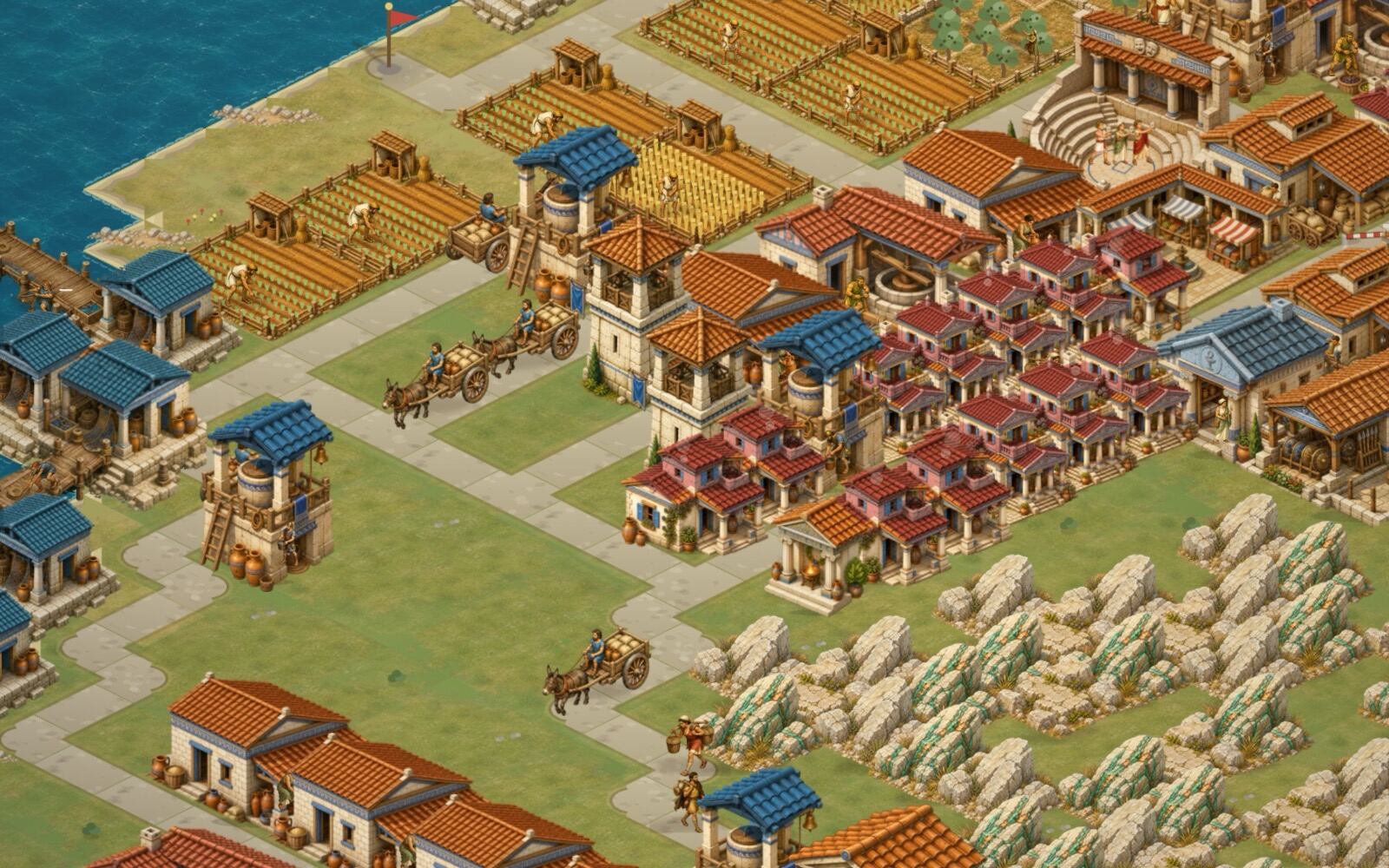
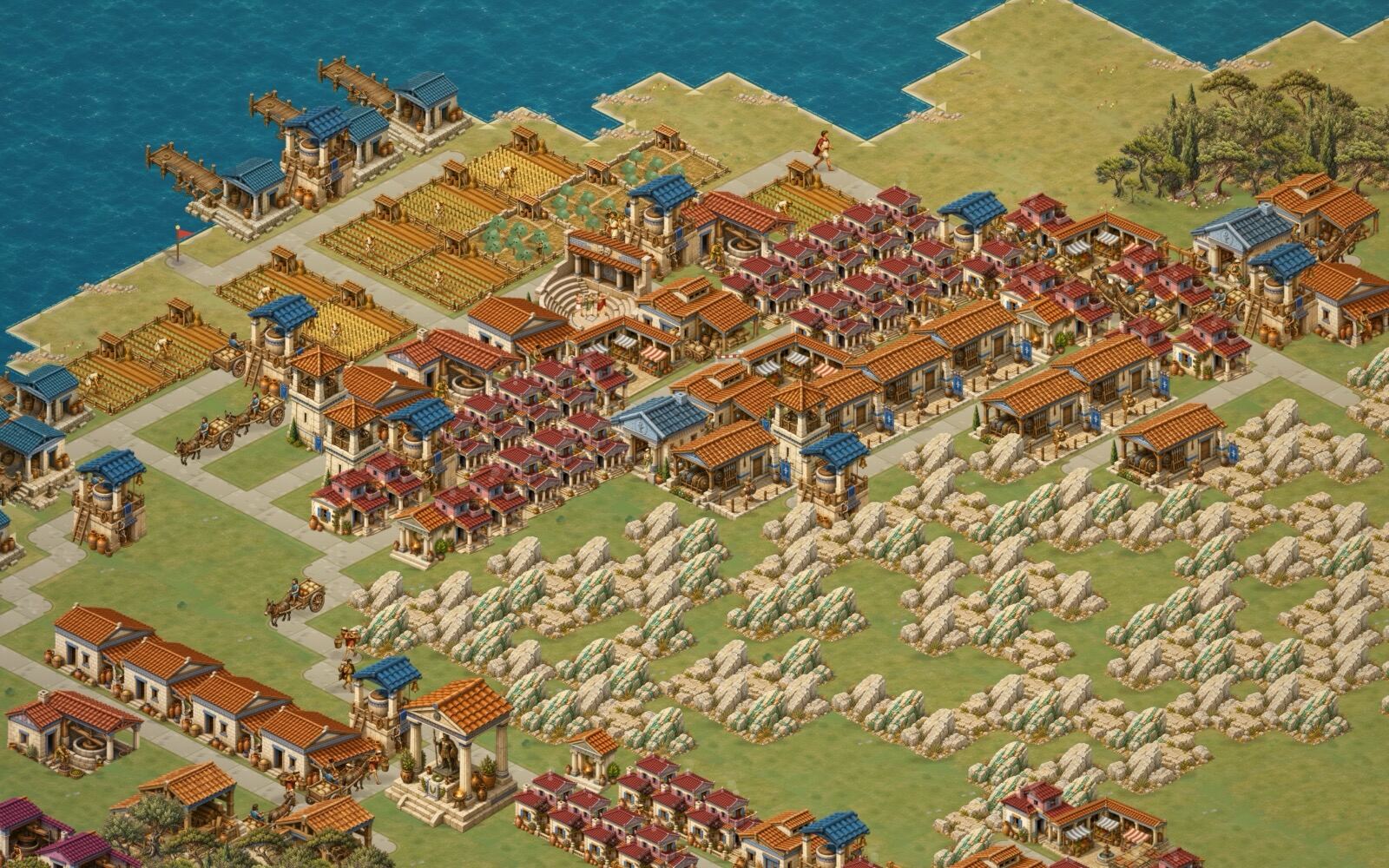
Cities of the Aegean
This is our game, so treat what follows accordingly.
It exists because the walker design the Impressions games used never got a modern home, and because nobody had tried to put a full city builder in a browser tab. You found a polis on an Aegean shore, lay roads, and the simulation runs on people walking: farm carts hauling wheat to granaries, and agora vendors carrying food out to houses, which is the only way food reaches a home. Houses climb from huts to great estates as water, food, olive oil and fleece reach them, and slide back down when a supply chain breaks. The classic failure is the classic failure, a district starving beside a full granary because the coverage never reached it.
Some of it is ours rather than borrowed. The year runs in four Mediterranean seasons, and summer is the dead season when the wheat all but stops, so banking a surplus is a real strategic decision rather than a background number. Six rival cities sit on an Aegean world map, trading with you, demanding tribute and fighting each other, so a neighbour you ignored for thirty years can turn up having swallowed two of the others. Gods answer their temples and walk the streets in person. There are monsters, and heroes to call up against them, which is the part of Zeus people describe most fondly and the part nobody else has rebuilt. If that is what you came for, there is more in Greek mythology games.
Also here: a story campaign as well as a sandbox, several founding shores, city walls with gatehouses, hoplites, expeditions overseas, an endless siege mode, an asynchronous one-against-one mode played by exchanging a code, a weekly challenge on a shared island, and a public gallery of other people's cities.
Where it falls short, plainly. It is a two-dimensional isometric game built from pre-rendered sprites, so it will never look like Manor Lords, and it is not trying to. The city scale is a Greek polis rather than a metropolis, which is deliberate but is a real ceiling if you wanted a million citizens. It is one small team's work, so there is less content than Anno has in a single expansion. And it is a browser game, which some people will not take seriously on principle.
What it does have is the shortest distance between deciding to play and playing. There is no download, no launcher, no account and no build timers, the first fifteen minutes are free, and the city you start in them carries straight on into the real game if you buy it. If you want the build order before you start, the beginner's guide covers the first hour.
It runs in the browser. No download, no account, no launcher.
The first fifteen minutes are free, then €4.99 + VAT once, forever.
New city builder games worth watching
The genre is in better health than the 2023 to 2024 stretch suggested. Anno 117 landed in November 2025 and sold better than any Anno before it. Timberborn finished a long early access in March 2026. Cities: Skylines II has a new team and a rising review score. Tropico 7 is dated for early 2027. Manor Lords is the one open question, still unfinished and still selling.
The pattern worth noticing is that the interesting new city builder games are almost all coming from small studios. The genre's best ideas of the last five years, the roguelite loop in Against the Storm and the water physics in Timberborn, both came from teams you could fit in a minibus.
The best city building game for what you actually want
- The biggest, most modern sandbox, and you have the hardware: Cities: Skylines II.
- The best-made game in the genre, and you like production chains: Anno 1800.
- Rome, on modern hardware, right now: Anno 117: Pax Romana.
- A medieval village that looks like a painting: Manor Lords, accepting that it is unfinished.
- Hard decisions with weight behind them: Frostpunk 2, after playing Frostpunk.
- Something you can play in forty-minute sessions forever: Against the Storm.
- Something to build and admire with nothing chasing you: Timberborn or Foundation.
- The original walker design, cheap, if you can live with 2000: Zeus, Caesar III, Pharaoh.
- The same design restored: Pharaoh: A New Era.
- Nothing to install and nothing to pay to find out: ours, or the wider browser category. If the budget is the constraint rather than the install, start with free city builder games instead.
The gap nobody has filled
For all the good releases above, one thing is still missing. Nobody has made a large modern game built on the walker simulation, where the city is a machine of paths and dependencies that you diagnose when it fails. Cities: Skylines simulates individual citizens but abstracts the failure into statistics. The survival builders replace diagnosis with pressure. The calm builders remove the failure altogether.
The closest anyone has come are two remakes and a handful of small games, one of which is ours. Given how many people search for that exact feeling every month, it remains a strange hole in a genre that is otherwise doing very well for itself.