Zeus: Master of Olympus in 2026: how to play Zeus + Poseidon
The good news is that you can still buy it, it still installs, and it still works. The rest of this is the small print: which version, what to patch, whether to bother with the expansion, and the cheat codes you half remember.
| Zeus at a glance | Details |
|---|---|
| Released | October 2000 (North America) |
| Developer | Impressions Games |
| Publisher | Sierra Studios; Activision publishes today's digital release |
| Designer | Chris Beatrice |
| Music | Henry Beckett and Keith Zizza |
| Expansion | Poseidon: Master of Atlantis, June 2001 (25 June in North America) |
| Where to buy | Steam, as Zeus + Poseidon (not sold in Germany); GOG, as Zeus + Poseidon (Acropolis) |
| List price | Around €9 to €10, or $9.99, in October 2026 |
| Runs on | Windows, with Windows 10 and 11 verified by GOG. No Mac, Linux or mobile version |
Impressions Games released Zeus: Master of Olympus in North America in October 2000, published by Sierra Studios. It scored 87 on Metacritic, a 9.1 from IGN and a 9 from Eurogamer, and the criticism it did attract was aimed almost entirely at its combat. Twenty-six years later it is still the benchmark for a city builder in which the gods of Olympus are a functioning municipal system, and the game new Greek builders, Theos included, get measured against.
This piece is for the reader who wants to play Zeus itself, tonight. The deeper dives have pages of their own.
More Zeus guides
- Poseidon: Master of Atlantis: the expansion, its six adventures and how Atlantis plays differently
- Zeus: Master of Olympus cheats: the full list of codes, and what to do when one does nothing
- Zeus: Master of Olympus housing blocks: the classic common and elite layouts
- Theos: Cities of Myth: the new Greek city builder from the Pharaoh: A New Era team, out on 4 November
- Games like Zeus: Master of Olympus: for when you have finished it and want what comes next
What you are buying: the Zeus + Poseidon bundle
There is only one version worth considering, and it is sold as Zeus + Poseidon, also called the Acropolis bundle. It packages the original game with its 2001 expansion, Poseidon: Master of Atlantis, in a single install. Activision publishes it now, Sierra having long since been absorbed.
It is on GOG and on Steam, and both sell the same combined install. GOG put the Acropolis bundle up in May 2012; Steam listed it on 15 December 2016. In October 2026 the list price is around €9 to €10, or $9.99 in the US, on either store. One catch: Steam does not sell it in Germany.
The GOG copy is the one to prefer. It is DRM-free, which matters for a twenty-six-year-old game you may want working long after the storefront has moved on, and GOG maintains it against current Windows: it verified the game for Windows 10 and 11 in November 2024 and badges it Windows 11 verified. It also includes the original manual as a PDF, which this game rewards reading. Buy the Steam copy if you prefer everything in one library; there is no gameplay difference and the fixes below support both.
Does it run on Windows 10 and 11?
Usually, and with less fuss than most games of its vintage. Neither store version needs DOSBox or a fan installer, and on most machines you buy it, install it and it starts. GOG lists it as verified for Windows 10 and 11, while Steam's system requirements still stop at Windows 10. When it does misbehave, a long troubleshooting guide on GOG's forum covers the usual suspects: compatibility mode or running it as administrator if it will not start or save, and switching off overlays such as Discord's or Nvidia's if it freezes on a blank menu.
Two things will annoy you, and both have fixes. The first is resolution. Zeus offers exactly two options, 800×600 and 1024×768 (F6 and F7 switch between them), and that is the whole list. F5 puts the game in a window, but only if your desktop runs at a higher resolution than the game. On a modern monitor the result is either a small square in the middle of your screen or a stretched one filling it, and neither is pleasant.
The second is subtler and catches people out. On modern CPUs some of the animation timing runs wrong. The gods take an age to appear and act, urchin collectors gather in fits and starts, and at the other extreme trading piers and hippodrome spectators move far too fast. It is not a crash and it will not break a save, but once you notice it you cannot unnotice it. The slow gods have a fix, below; the over-eager piers and spectators have none.
Widescreen, HD and the resolution patch
The tool to use is the Zeus & Poseidon Resolution Customiser, written by XJDHDR and hosted on Nexus Mods, with its source on GitHub under a modified BSD licence. It supports the GOG and Steam releases specifically, which is exactly the situation most people are in.
The way it works is a nice piece of pragmatism. Rather than adding a new resolution option to a game that cannot accept one, it repurposes the existing 1024×768 entry to run at whatever resolution you supply. You then select 1024×768 in the game's menu and get your actual screen resolution. It resizes the interface elements and the background images to match, so you do not end up with a correct viewport and a menu bar sized for 2000.
It also offers two optional patches, and both are worth taking while you are in there. One fixes the slow gods and the urchin quay. It is the work of Bianca van Schaik, known to Zeus players as Pecunia, who first released it on Zeus Heaven in 2018 and who also wrote Julius, the open-source Caesar III engine. The other keeps the game's own windowed mode working after you change the resolution. The customiser writes a modified copy of the executable rather than editing your installation in place, so a mistake costs you nothing.
Two caveats. PCGamingWiki warns that at 4K the text and graphics get very small and the city view stops short of the bottom of the screen. And if you try the older route, the Full HD+ mod for Zeus and Poseidon on ModDB, which comes in English and French versions, know that a 2022 GOG forum guide found JackFuste's 2012 widescreen patch could lock the game in full screen, and named the Customiser as the cure.
Mac, Linux, Steam Deck and mobile
There has never been a Mac build. Both store versions are Windows only, and the GOG page says so plainly. Mac players run it through a compatibility layer, and the documented route is Porting Kit, a free Wine-based wrapper, with GOG's offline installer. Porting Kit's author reported Zeus + Poseidon working on all Apple Silicon Macs in November 2022, and AppleGamingWiki rates it Playable that way. Skip Whisky, which older threads still recommend: it was discontinued in 2025. AppleGamingWiki lists CrossOver's rating as unknown, so we would not call that the easy route either.
Steam Deck is officially a no: Valve rates Zeus + Poseidon Unsupported. Players have had better luck than that suggests. ProtonDB, which collects reports of Windows games running through Steam's Proton layer on Linux and the Deck, rates it Gold, from 28 reports at the time of writing, and trending towards Platinum. Treat a handheld install as an experiment with good odds, and note that a 2000-era mouse interface does not love a trackpad. On a Linux desktop the same Proton route applies, and eZeus, the open-source engine covered below, can be built there from source.
There is no phone or tablet version either. Neither game has ever been released for iOS or Android, and the Gods of Olympus you will find on the app stores is an unrelated strategy game.
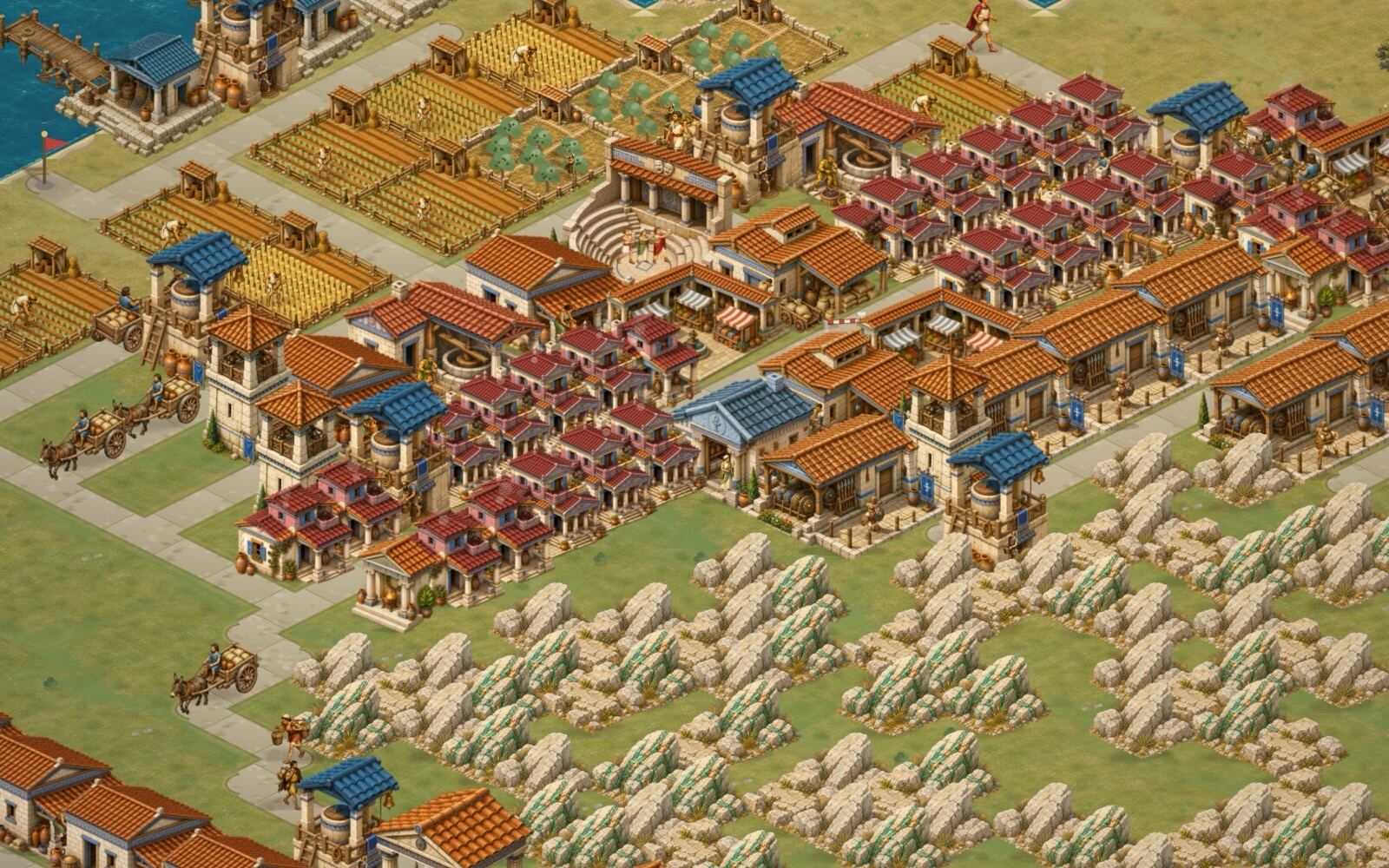
Should you play with Poseidon?
Poseidon: Master of Atlantis arrived on 25 June 2001 in North America and scored 84 on Metacritic. You do not get a choice about installing it, since the bundle is one package, but you do get a choice about where you spend your time.
It adds six adventures, four played as Atlanteans and two as Greeks. In the Atlantean ones, houses grow on science rather than culture, from the Bibliotheke, the Laboratory, the Observatory and the Museum. Two gods also join the pantheon, Hera and Atlas. Our Poseidon: Master of Atlantis guide covers the adventures, the new gods and heroes, and the Atlantean economy in detail.
Play the Zeus adventures first, all the way through. The Atlantean material is good, but it changes enough of the supply chain that starting there means learning two economies at once, and Zeus already has a steep first hour. Come back for Atlantis when you can lay out a Greek city without thinking about it. If an episode stalls you, Zeus Heaven hosts Impressions' official walkthroughs for both campaigns.
What the design actually got right
Being precise about this matters, because "they don't make them like they used to" is not an argument and Zeus has specific virtues.
The first is walkers. Zeus does not simulate demand with an invisible radius. It sends a person out of a building to walk down a road, and things happen where that person goes. A granary fills because a cart driver reached it. A house grows into a manor because a vendor with the right goods walked past. Lay a road badly and a district starves while a granary a hundred tiles away sits full, and diagnosing that is the actual game. It is the reason the loop still feels alive and the reason people remember it. We wrote about that particular failure state at length in full granaries, starving citizens, and it is the whole reason Zeus players design housing blocks around how far each walker goes.
The second is the sanctuary. A temple in most games is a building you place. In Zeus it is a construction project you feed with marble, wood and sculpture, which artisans from their guild raise block by visible block, and when it is finished the god moves in and walks around your city. That single decision, making the god a resident rather than a status effect, is the thing every later Greek builder should have copied.
The third is monsters and heroes as an economic problem. A monster arrives and your army struggles with it. Enough elite soldiers might bring one down, as the manual allows, but the reliable answer is a hero, and the hero will not come until you have built his hall and stocked the specific goods he demands. It turns a disaster into a logistics puzzle with a deadline, which is a far more interesting thing for a city builder to do with a myth than a cutscene.
Set against that, the combat is weak. Contemporary reviews said so and time has not been kind to it. Raiding parties and rival cities exist mainly as a tax on your attention, the tactical layer is thin, and most players end up treating war as something to survive rather than play. The interface also assumes you have read the manual. GOG includes it as a PDF and the Sierra Help Pages host a copy, so read the opening chapters before you start, because the tutorial is of its era. Give it an hour before you judge it.
The cheat box, in brief
To cheat in Zeus, press Ctrl + Alt + C during play, type the code exactly as
printed, capitals and spaces included, and press Enter. The two everyone wants are
Delian Treasury, which adds 1,000 drachmas, and Ambrosia, which wins
the current episode.
Both come with small print. Zeus Heaven, the long-running fan site, says Delian Treasury stops working once you hold 15,000 drachmas. Ambrosia only takes effect when the next month, sometimes two, ticks over, which is why people assume it is broken, and when it does the episode is over, so save first.
The traditional move is to enable Bowvine and Arrows (some lists print
Bowvine and Arrow, so try both) and then Fireballs from Heaven, at which
point you can rain cows out of the sky onto any tile you click, which is not a strategy but is a
memory. Every other code, and a checklist for when one will not take, is on our
full list of Zeus: Master of Olympus
cheats.
There is no remake, but there is finally a successor
There is no official Zeus remake: as of October 2026, nobody, Activision included, has announced a remake or remaster of Zeus: Master of Olympus. The nearest thing is Theos: Cities of Myth, a new Greek city builder from the team that made Pharaoh: A New Era, which launches on Steam on 4 November 2026.
For years the honest answer to "will there be a modern Zeus" was simply no, while its stablemates got the attention: Pharaoh was rebuilt as Pharaoh: A New Era in 2023, and Caesar III gained the Julius and Augustus open-source engines. Theos, revealed by Dotemu and Triskell Interactive on 1 June 2026, is an original game rather than a remake: seven patron gods, each city built around one god's sanctuary, and walkers whose patrol routes the game generates for you and you then reshape by dropping patrol flags along the roads.
It is Windows only, through Steam, with no price on the store page yet. A free demo has been out since 13 October and is part of Steam Next Fest from 19 to 26 October. You will see Theos called the spiritual successor to Zeus almost everywhere, but that framing comes from the press: Dotemu's own material never mentions Zeus: Master of Olympus. Our Theos: Cities of Myth guide covers the release date, the demo and how it compares with Zeus.
Zeus has also, quietly, gained an open-source engine of its own. eZeus, started by Maurycy Liebner in 2021 and licensed under the GPL, plays the original adventures using your own copy's files: it needs both Zeus and Poseidon installed and supports only English and Polish game data. The official downloads are Windows builds, the latest a beta from September 2026, and it does not claim to be an exact copy. Treat it as a project to follow rather than a replacement for the store version, but it is very much alive.
If what you actually want is the original looking sharp on a modern screen, that is a patch job rather than a remake, and it is covered above: the Resolution Customiser, or the older Full HD+ (EN/FR) mod. A remake of Zeus itself, with the sanctuaries and the monsters and the heroes intact, still does not exist.
Cities of the Aegean, the browser-native heir
Our game, so read this with the appropriate scepticism.
We built it because we wanted the Zeus loop without an install, a launcher or a compatibility layer. It runs in a browser tab. You found a polis on an Aegean shore, lay roads, and the walkers do the work: farm carts hauling wheat to granaries, agora vendors carrying food out to the houses they pass. Houses climb from huts to great estates as water, food, olive oil and fleece reach them, and fall back down when the supply breaks. The characteristic failure is the Zeus one, a district starving beside a full granary because nobody walks that far.
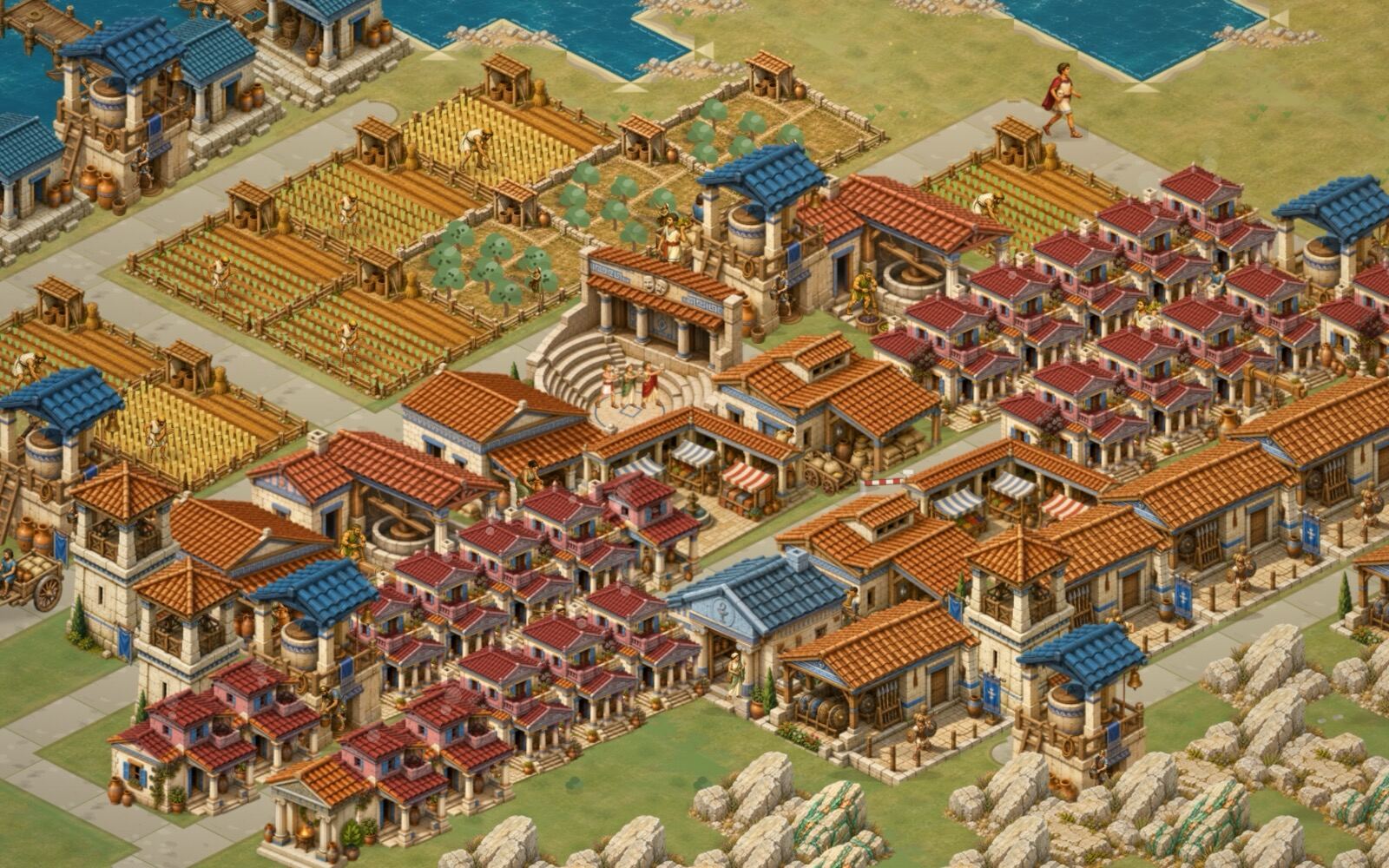
The myth layer is the part we cared most about getting right, because it is the part of Zeus people describe most fondly. Eight Olympians have temples, each raised as a supplied construction site rather than placed finished. A completed temple switches on its god's blessing across the city, and all eight gods then walk the streets and fight for you: Zeus with a thunderbolt, Poseidon with the trident, Hades hurling bolts from the underworld while Cerberus prowls the streets, Artemis with her bow, and Ares, who also marches his own host out with your expeditions. Each temple also arms an invocation you cast yourself, paid in silver, with the god unwilling to answer again for over a month.
Monsters come, as they should. From the middle of the third year a Minotaur, then a Cyclops, then a Gorgon, then the Hydra takes up residence and starts flattening houses, and your towers and hoplites do nothing to it. The answer is a Hero Shrine with a real price, and Theseus, Odysseus, Perseus or Herakles arriving to settle it in person, unless one of your gods drives it off first. Around that runs a four-season year in which summer is the dead season, and six rival cities that trade with you, demand tribute and conquer each other while your back is turned.
It is not a remake, and it is small next to a studio production, but it has the same walker grammar, in a tab, with no patch to apply and nothing to configure. If you want the full field of alternatives rather than just ours, the Zeus alternatives piece covers everything from Nebuchadnezzar to the open-source Caesar III engines, and the Greek mythology games guide widens it beyond city building. If you would rather just start, the beginner's guide is the fastest way in.
The heir runs in the browser. No download, no account, no launcher.
The first fifteen minutes are free, then €4.99 + VAT once, forever.
Questions people ask
What is Zeus: Master of Olympus?
A city-building game set in ancient Greece, made by Impressions Games and published by Sierra Studios in October 2000. You lay roads and housing, keep walkers supplying your citizens, raise sanctuaries so the Olympian gods move in, and call heroes to deal with monsters. Its 2001 expansion, Poseidon: Master of Atlantis, is sold with it today as Zeus + Poseidon.
Is Zeus + Poseidon on Steam?
Yes. Steam has sold Zeus + Poseidon, the base game and its expansion in one install, since 15 December 2016, and in October 2026 it lists at $9.99. It is Windows only, and Steam does not sell it in Germany. GOG sells the same bundle as Zeus + Poseidon (Acropolis), DRM-free and with the manual included as a PDF.
Does it run on Windows 11?
Yes. GOG verified its release for Windows 10 and 11 in November 2024, and most installs start without any tweaking; Steam's listed requirements only go up to Windows 10. If it will not start, a long GOG forum guide suggests compatibility mode, running it as administrator and switching off overlays such as Discord's. Widescreen needs a fan tool, the Resolution Customiser.
Can you play it on a Mac?
Not natively. There has never been a Mac version, and both stores sell Windows builds only. The documented route is Porting Kit, a free Wine-based wrapper, with GOG's offline installer: its author reported the game working on Apple Silicon Macs in 2022, and AppleGamingWiki rates it Playable that way. Whisky, still recommended in older threads, was discontinued in 2025.
Is there a mobile version?
No. Neither Zeus nor Poseidon has ever had an official iOS or Android release, and both store versions are Windows only. There is no official way to play it in a browser or online either. The Gods of Olympus you may find on the app stores is an unrelated strategy game, and Theos, the new Greek city builder, is a Windows game too.
Is there a Zeus remake?
No official one: as of October 2026, nobody has announced a remake or remaster. The nearest thing is Theos: Cities of Myth, an original Greek city builder from the team behind Pharaoh: A New Era, out on Steam on 4 November 2026 with a free demo available now. Fans also have eZeus, an open-source engine that runs on the original game's files.
The short version
Buy Zeus + Poseidon on GOG, or on Steam if you are not in Germany. Run the Resolution Customiser before your first city and take the animation fix while you are there. Play the Zeus adventures first and save Atlantis for later. Keep Ctrl + Alt + C for when an episode has stopped being fun rather than for when it has started being hard. It is a ten-euro game that will hold you for a hundred hours, and in 2026 that is still an unusually good trade.