The best colony sim games
Colony sims and city builders get shelved together and they are not the same genre. The difference is simple enough to state in one line, and stating it will save you a refund.
A colony sim knows your people's names. A city builder does not.
That sounds glib, so take it literally, because everything else follows from it. In a city builder the population is a resource with a number attached. A house holds a family, the family wants food and water, and your job is to make the flows reach them. When it goes wrong you get a systems problem you can diagnose: this district starved because the vendor's route never reached the eastern block, and the granary two hundred tiles away stayed full the whole time.
In a colony sim you have a small fixed cast. Each one has a name, a set of skills, a mood, a backstory, opinions about the others and a body that can be injured in specific places. When that goes wrong you get a story. A cook had a breakdown during a raid, set fire to the kitchen, and the doctor bled out in the corridor because your only other medic was asleep on the far side of the base.
Here is the practical test. Think about the last thing you told a friend about the game. If it was about a person, it is a colony sim. If it was about a layout, it is a city builder. Both can be brutal, but colony sims are brutal at you personally, and that is either the appeal or the reason you bounce off them.
A lot of the best games in this space live in the gap between the two, so the list below says where each one actually sits.
RimWorld
The genre's centre of gravity. Tynan Sylvester's game hit 1.0 on 17 October 2018 after five and a half years in development, and Ludeon Studios has been adding to it ever since.
The thing that separates RimWorld from its competitors is that it is not really trying to simulate a colony. It is trying to generate a story about one. An AI storyteller sits above the simulation deciding what happens next based on how comfortable you have become, which is why the raid arrives the week after your defences are finally finished. Colonists have traits that contradict each other, form relationships, hold grudges and remember things. A pyromaniac in a wooden base is a plot, not a stat.
There are five expansions now. Royalty, Ideology and Biotech came first, Biotech in October 2022 with children, genetics and mechanoid manufacturing. Anomaly followed on 11 April 2024 and pushes the game into outright horror, which not everyone wanted. Odyssey arrived on 11 July 2025 alongside the 1.6 update and is the most transformative of the set: new biomes and landmarks, and a gravship that turns your colony into something you can pick up and fly somewhere else.
The honest problems are the price of the full set, an interface that has been extended rather than redesigned for eight years, and a modding scene so good that it is now effectively part of the game. Nobody recommends vanilla RimWorld to a returning player. That is a strength and a warning at the same time.
Dwarf Fortress
The ancestor. Tarn and Zach Adams have been building it since 2002, and the reason RimWorld exists in its current shape is that Dwarf Fortress did it first and in more detail than anyone has matched since.
The paid Steam edition, published by Kitfox Games on 6 December 2022, is the version to buy. It is the same simulation with a tileset, a mouse, music and menus that do not require a wiki open on a second monitor. Adventure mode, where you leave the fortress and walk the same world as a single character, opened in beta on the Steam version on 17 April 2024. Development has not stopped; the latest version as of late 2025 was 53.02.
Nothing else generates history like this. The world is created before you arrive, with centuries of wars, migrations and dead civilisations underneath it, and your fortress is written into the same record. Dwarves carve their own regrets into the furniture.
It is still the steepest game in this list by a wide margin. The Steam release fixed the presentation and left the depth exactly where it was, which was the correct decision and does not make the first fortress any easier.
Banished
Luke Hodorowicz released Banished on 18 February 2014, working alone, and it is the game most people mean when they search for a survival city builder. A wagon of exiles arrives in a valley with a handful of tools. There are no enemies. There is no combat. You will still lose towns.
It sits in the gap between the two genres and is worth understanding as such. Banished tracks every citizen individually, with a name, an age, a profession and a home, but it never lets you inside their heads. There are no moods, no relationships, no stories about a specific person. What you get instead is demographics as a weapon. Build too fast and everyone in your town is born within the same decade, and twenty years later they all become too old to work in the same decade, and the fields go unharvested because there is nobody of working age left. No disaster caused that. Your growth curve did.
The interface is twelve years old and the tech tree is thin. The Colonial Charter mod is the standard answer to both and is very large. For anyone searching for games like Banished, the honest first answer is usually Farthest Frontier, which we covered in the medieval city builder guide.
Frostpunk, and Frostpunk 2
11 bit studios released Frostpunk on 24 April 2018, and it is the clearest example of a game deliberately walking away from the colony sim. The studio said outright that it was about issues faced by a society rather than by individuals, and the design agrees: you never learn a name that matters, you set the working hours, you decide whether children go into the mines, and the discontent and hope meters answer you.
That focus is why it works. The famous moments are all policy decisions with no clean option. Three paid expansions followed, of which The Last Autumn, released 21 January 2020, is the one most people rate highest: a prequel scenario about building the generator before the cold arrives, where the enemy is a labour dispute.
Frostpunk 2 came out on 20 September 2024 for PC and reached consoles a year later, and it zoomed out much further. You are no longer placing individual huts around a generator; you are drawing districts for thousands of people and negotiating with factions in a council that can overrule you. 11 bit has kept supporting it, with the Fractured Utopias expansion in December 2025 and Breach of Trust on 23 June 2026.
Be clear about what you are buying. A lot of people searching for games like Frostpunk want more of the first one, and the sequel is not that. It is a political simulation with a city attached, and the intimacy of the original is deliberately gone. If that is what you want back, the studio announced Frostpunk 1886 in April 2025, a full remake of the original in Unreal Engine 5 with new mechanics and mod support, due in 2027.
Oxygen Not Included
Klei's game left early access on 30 July 2019, and it is a colony sim where the antagonist is thermodynamics. Your duplicants have names and a few traits, but the thing that kills them is heat moving through a wall you did not insulate, or a gas you did not think about accumulating in a room with no exit.
It is the most technical game in this list and the most satisfying if you like that. The Spaced Out expansion in December 2021 broke the map into multiple asteroids and made logistics a spaceflight problem, and Klei has kept adding smaller planet packs since, most recently the Prehistoric Planet Pack on 12 June 2025.
The honest caveat is that the duplicants are closer to tools than to characters. Nobody tells stories about a duplicant. They tell stories about a cooling loop. If you came here for the narrative side of the genre, this is the wrong end of it.
Songs of Syx
The most ambitious thing anyone is currently building in this space, made by one developer under the name Gamatron. It starts as a colony sim with a few dozen settlers and does not stop, scaling into a city of tens of thousands with slavery, religion, standing armies and a world map to conquer. Nothing else makes the transition from individual people to a population and keeps both layers running.
It is still in early access. Version 71, subtitled Reign of Terror, landed on 15 June 2026 and added a scenario about holding power while loyalty and happiness pull against each other, and the developer is aiming to reach 1.0 before the end of the year.
The barrier is the presentation. The art is functional, the interface is a dense grid of numbers and icons, and the game explains almost nothing. It rewards people who enjoy that, and it will waste an evening for anyone who does not.
Timberborn
Mechanistry's beavers left early access on 12 March 2026 after four and a half years, with a 1.0 that added automation, a visual overhaul and achievements. It has sold over a million copies and holds one of the strongest ratings in the genre.
Structurally it is a city builder rather than a colony sim: your beavers are a population, not a cast. What earns its place here is the drought. Water is simulated as actual fluid moving over terrain, and the seasonal cycle takes it away on a schedule, so your settlement lives or dies by dams, levees and reservoirs you engineered several seasons before you needed them. The post-apocalyptic setting is decoration; the water physics is the game.
There is no combat and no antagonist beyond the dry season, which suits some people exactly and leaves others waiting for a threat that never comes.
Against the Storm
Eremite Games and Hooded Horse released this on 8 December 2023, and it solves a problem the rest of the genre has by refusing to have the problem. A settlement lasts sixty to ninety minutes. The rain eventually takes it whichever way things were going, and what carries forward is the progress of your capital between runs.
It is a roguelite wearing a city builder's clothes, and the tension is real: the villagers are three species with different needs and tastes, the map is redrawn every time, and a run turns on which production chain the forest was willing to give you. The Keepers of the Stone expansion in September 2024 added frogs and two new biomes.
The trade-off is the obvious one. You never get to keep anything. If the pleasure you want is a city you return to for forty hours, this will feel like being interrupted repeatedly, however good the individual runs are.
Three more worth knowing
Going Medieval (Foxy Voxel, 1.0 on 17 March 2026) is a proper colony sim with a small cast of named settlers and fully three-dimensional building, cellars and upper floors included. It is the friendliest entry point to the RimWorld style of game.
Stranded: Alien Dawn (Haemimont Games and Frontier Foundry, 1.0 on 25 April 2023) is the same idea rendered in 3D by the studio behind Tropico. A handful of survivors, real needs, real injuries, and considerably more polish than the genre usually manages. It is also gentler and generates less chaos.
Norland (Long Jaunt and Hooded Horse, early access since 18 July 2024) is a medieval colony sim where the cast that matters is a noble family, with marriages, plots and murders above a settlement. Rough, unfinished, and doing something nobody else is. Both it and Going Medieval get longer treatment in the medieval city builder guide.
Where Cities of the Aegean fits
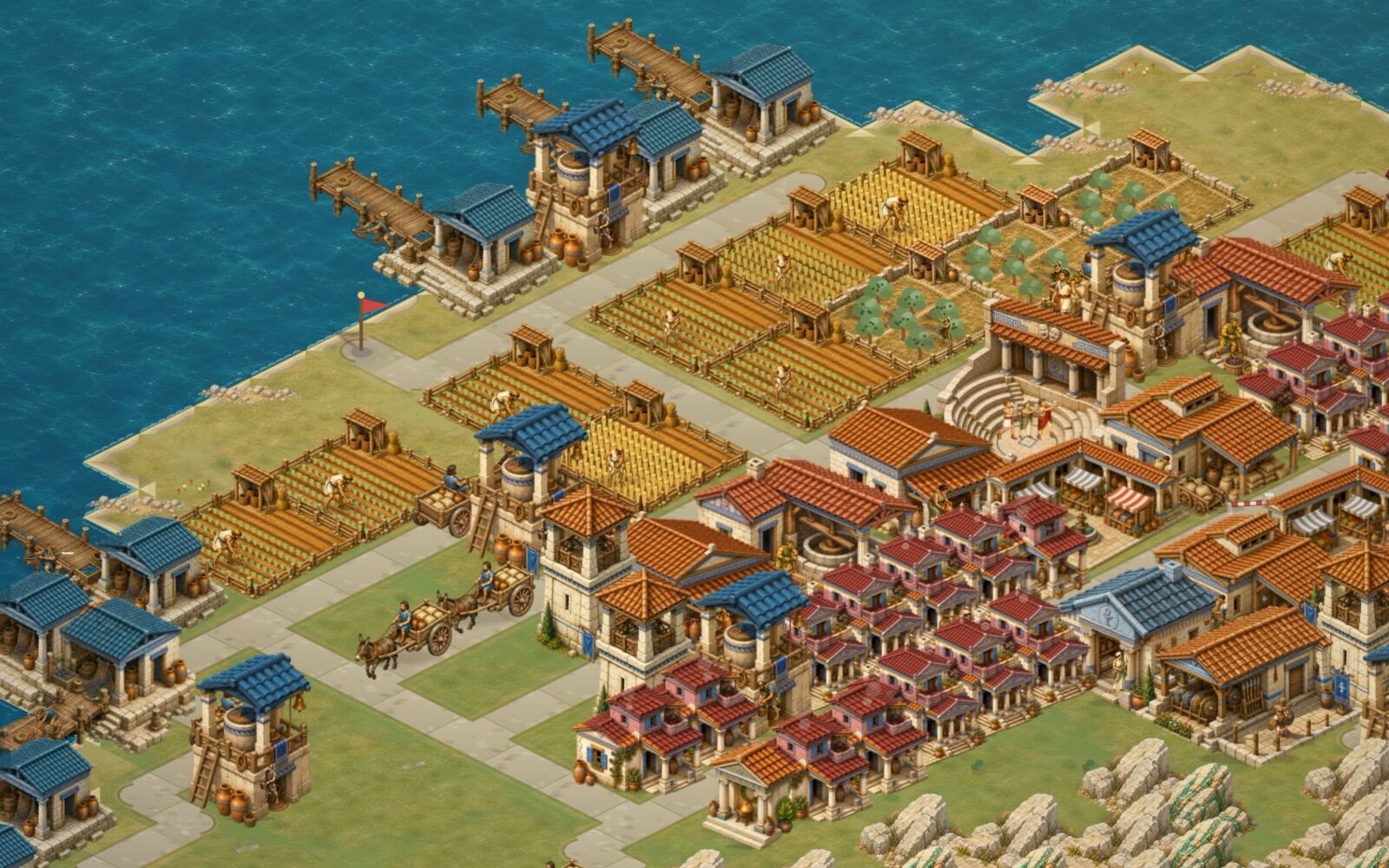
This one is ours, and the honest placement is at the city-builder end of the scale. It does not know your citizens' names. Houses hold families, districts have coverage, and the failure you will actually hit is a systems failure rather than a personal tragedy.
The reason it belongs in this conversation at all is that the survival pressure is real and it is seasonal. The year runs in four Mediterranean seasons and summer is the dead season, when the wheat nearly stops and the city eats whatever you banked in spring. Winter closes the sea, so imports are not a year-round answer either. Fishing wharves work all year, which makes the coast a genuinely different strategic proposition from the inland meadows. Getting a granary surplus into July is the whole planning problem, and it is the same nerve Banished and Timberborn press with their winters and droughts.
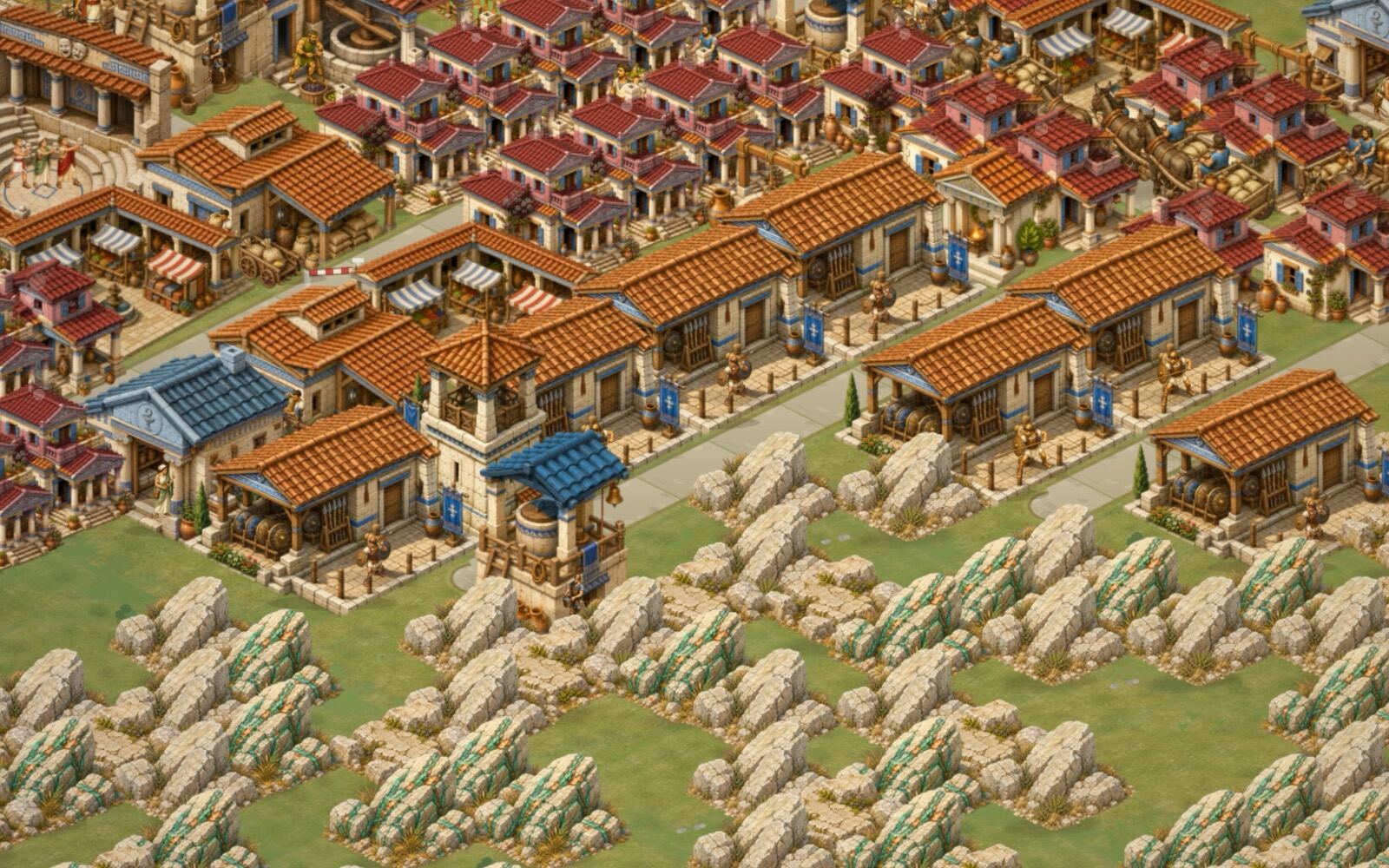
The other colony-sim-grade threats are fire and sickness. Roofs gather kindling over time and crowded houses breed illness, and neither gives you an advance warning, which was a deliberate decision and an unpopular one. You answer them structurally, with a Fire Watch and an Infirmary placed before you needed them, or you watch a district burn. Beyond the walls there are six rival cities that trade, feud and conquer each other, raids to defend against, and gods who walk the streets when their temples are honoured. (If the raids are the part that interests you, we sorted the whole genre by how well it does war in city builders with combat.)
We wrote up one of our own failures in that food system in full granaries, starving citizens, which is the closest thing we have to a colony sim story: the city had plenty and starved anyway, and the bug was in how the surplus moved rather than in how much of it there was.
It runs in the browser. No download, no account, no launcher.
The first fifteen minutes are free, then €4.99 + VAT once, forever.
The short version
If you want stories about people: RimWorld first, then Dwarf Fortress when RimWorld stops being enough, then Going Medieval or Stranded: Alien Dawn if you want it gentler.
If you want to be defeated by a system rather than by a person: Oxygen Not Included for engineering, Banished for demographics, Timberborn for water.
If you came from Frostpunk and want the same weight: The Last Autumn, then Frostpunk 2 with clear eyes about how different it is, and keep an eye on the 2027 remake.
If you have forty minutes rather than forty hours: Against the Storm.
If you want the systems side without an install, a launcher or a login, ours opens in a tab, and the first fifteen minutes cost nothing. There is a wider survey of the genre in the best city builder games, and a tour of what runs without downloading anything in city builder games you can play in a browser.