Games like Age of Empires
Age of Empires is three games in a trench coat, which is why recommendations for it go wrong so often. Work out which of the three you are missing and the answer becomes obvious.
Somebody who loved Age of Empires II in 1999 might have loved the twenty-minute rush to Castle Age and the click-perfect siege that followed. Somebody else remembers advancing through ages, unlocking a technology tree, and watching a settlement thicken into a walled town. A third person mostly remembers villagers chopping wood and carrying it home, and the little world running itself while they decided where the mill went.
Those are three different genres now. Recommend a 4X to the first person and they will be bored in an hour. Recommend a competitive real-time strategy game to the third and they will spend the whole match wishing they could pause and look at their town. So here is the fork, with honest assessments in each branch.
Branch one: you want the real-time strategy
If the memory is the fight, start with the two current Age games, because both are actively supported and the franchise is in a healthier state than it has been in twenty years.
Age of Empires II: Definitive Edition
Still the reference point. The 2019 definitive edition of the 1999 game has been getting expansions continuously ever since, and its concurrent player numbers on Steam remain in the same league as its own sequel's, which is a strange and rather lovely fact about a game older than most of the people playing it.
The most recent expansion, The Last Chieftains, arrived on 17 February 2026 with three South American civilisations, the Mapuche, Muisca and Tupi, a rework of the Inca, and a naval combat overhaul that went out free to everyone. It also had the roughest launch in the game's history, including a period where the game would not start for players who had not bought the expansion, and its user rating sits at the bottom of the DLC list as a result. The base game is not the problem. Buy the definitive edition, take the expansions slowly and on sale.
Age of Empires IV
The 2021 sequel took a while to find its people and now has them. It is more forgiving than Age of Empires II, its civilisations are more asymmetric, and its campaigns lean on documentary footage in a way that either charms you or does not. World's Edge is shipping two expansions in 2026: Yue Fei's Legacy in May, an eight-mission campaign following the Song dynasty general, and Raiders of the North in the autumn, which finally adds the Vikings along with the Scots. The co-operative Crucible mode is being extended at the same time, which is unusual for a strategy game of this size and worth knowing about if you play with a friend.
Age of Mythology: Retold
The one to reach for if what you liked about Age of Empires was the setting rather than the economy. World's Edge, Forgotten Empires and Tantalus rebuilt the 2002 original and released it on 4 September 2024 to an 83 Metascore and near-universal agreement that this is how a remake should be done. Greek, Egyptian, Norse and Atlantean pantheons, god powers, and mythological units in among the hoplites.
It is also still growing. An expansion pass announced in December 2025 brings four content packs through 2026, including Demeter as a new Greek major god and The Obsidian Mirror, which adds the Aztecs with a twelve-mission campaign. If you want more Greek myth specifically, we have a whole post on Greek mythology games.
Outside the franchise
Tempest Rising (Slipgate Ironworks and 2B Games, published by 3D Realms and Knights Peak, April 2025) is the best straight Command & Conquer successor in years, and it shipped as a complete game rather than a roadmap. Reviewers liked the pace and the asymmetry between its factions, with the usual early complaints about balance and the skirmish AI.
Beyond All Reason is free, open source, and enormous: thousands of units, Total Annihilation lineage, a community that has kept it running with no monetisation at all. In June 2026 the team signed a publishing deal with Hooded Horse to fund a paid premium edition on Steam with a single-player campaign, while committing to keep the existing multiplayer and content free. If your Age of Empires memory is really about the scale of the battles, this costs nothing to try.
Stormgate, the free-to-play successor from StarCraft II veterans, is the cautionary entry. It has struggled to hold players since launch and the reception has been rough. It is not the recommendation, but it is on every other list, so you should know why it is not on this one.
Branch two: you want to build a civilisation across history
If the ages were the point, and what you remember is the arc from a hut to a wonder, then you want a 4X. This branch has been busy and mostly bruising for the last two years.
Civilization VI, still
The awkward truth of the genre in 2026 is that the default recommendation for someone new is still Civilization VI, released in 2016. It is finished, deeply modded, endlessly patched, and the Anthology bundle that collects everything goes on sale for a fraction of its list price several times a year. Through mid 2026 it has generally been out-playing its own sequel on daily player counts.
Civilization VII
Firaxis released Civilization VII on 11 February 2025, and it had the hardest launch in the series' history. Two design decisions split the audience: the Ages system, which hard resets the game into three eras, and civilisation switching, which forced you to change civilisation at every transition. Add a widely criticised interface and thin launch content, and it landed with the lowest Metascore of any mainline Civilization, with critic scores ranging from an 8 out of 10 down to Eurogamer's 4.
The repair job is the interesting part. On 19 May 2026 Firaxis shipped Update 1.4.0, called Test of Time, a free expansion-sized overhaul that lets you keep a single civilisation across all three ages, reworks the victory conditions, and adds a system for adopting rivals' abilities. Steam sentiment moved from roughly half positive to a little over half, and the game stopped having bad days. That is a genuine recovery and not yet a triumph. If the Ages structure appeals to you, buy it now. If it never did, the update does not remove it.
Old World
The underrated one, and the closest of these to the classical world. Old World is by Mohawk Games, founded by Soren Johnson, who was lead designer on Civilization IV, and it crosses the Civilization structure with a Crusader Kings layer of dynasties, characters and events. Its Orders system replaces the usual one-move-per-unit rhythm with a pool of actions each turn, and it is the smartest thing anyone has done to the formula in a decade. Published by Hooded Horse, on Steam since 19 May 2022, Metacritic 80, PC Gamer's strategy game of the year for 2021, and seven expansions deep by 2026 including Heroes of the Aegean and Empires of the Indus. If you want the classical Mediterranean specifically, this is the 4X to buy.
The challengers
Humankind (Amplitude Studios, 2021) is the civilisation-switching idea done first: you combine cultures era by era rather than picking one nation. It reviewed well and then struggled to keep players, largely on late-game balance. Amplitude separated from Sega in a management buyout announced in November 2024 and is independent again, which is worth factoring into how much future support you expect.
Millennia (C Prompt Games for Paradox, 27 March 2024) is the most systems-heavy of the group, with alternate history ages that can send your timeline somewhere strange. It received mixed reviews on release, mostly around how expansion works, and sits around two thirds positive on Steam. There is a good game in it for people who like reading spreadsheets in a good mood.
Ara: History Untold (Oxide Games for Xbox Game Studios, 24 September 2024) is the friendliest of the recent lot. Reviewers landed on it being lighter than the genre's heavyweights but much cleaner, with crafting chains that make the production side more tactile than Civilization's, and interface work that does not assume you already know the genre. A reasonable first 4X.
Branch three: you want the town, not the war
This is the branch that gets served worst by search results, and it is the one a lot of people actually mean. What you remember is villagers walking, resources arriving, a settlement thickening around a road, and nobody attacking you for forty minutes. That is a city builder.
Manor Lords
The obvious modern recommendation. Manor Lords, made largely by one developer under the name Slavic Magic and published by Hooded Horse, went into Early Access on 26 April 2024 and had sold more than four million copies by August 2026. It gives you a medieval village that grows organically along the terrain, an unusually detailed supply and trade layer, and set-piece battles when you want them.
It is still in Early Access with no announced 1.0, and the honest caveat is that the late game thins out. Development is genuinely continuing, though: the August 2026 update added oats, apples for cider, honey for mead and cheesemongers, which tells you exactly what kind of game it wants to be. We put it in context alongside the rest of the field in medieval city builder games.
The Impressions lineage
If the villagers are what you miss, the games that did it best came out between 1998 and 2002 and have never quite been replaced. Caesar III, Pharaoh, Zeus: Master of Olympus and Emperor were built by Impressions Games around the walker: you lay a road, put a building beside it, and a person walks out and does the work. Where they walk, things happen. Where they do not, a district starves next to a full granary.
Caesar III is best played today through Augustus, a free open-source reimplementation that reads your original files and gives you widescreen and modern handling. Pharaoh: A New Era, the Triskell Interactive remake from February 2023, is the polished modern option. Zeus is on GOG for the price of a coffee and is the friendliest of them. We have longer pieces on games like Caesar III, games like Zeus, and the studio itself in the Impressions city builders.
Anno 117: Pax Romana
Ubisoft's Roman entry, released 13 November 2025, is the big-budget answer to this branch. It is a production-chain city builder rather than a walker one, and it is the only major title here with proper co-operative multiplayer: up to four players sharing a single empire. If building with somebody else matters to you, we surveyed that whole small category in multiplayer city builder games.
Cities of the Aegean
This is our game, so weigh what follows accordingly. It sits squarely in branch three, with a bit of branch one attached.
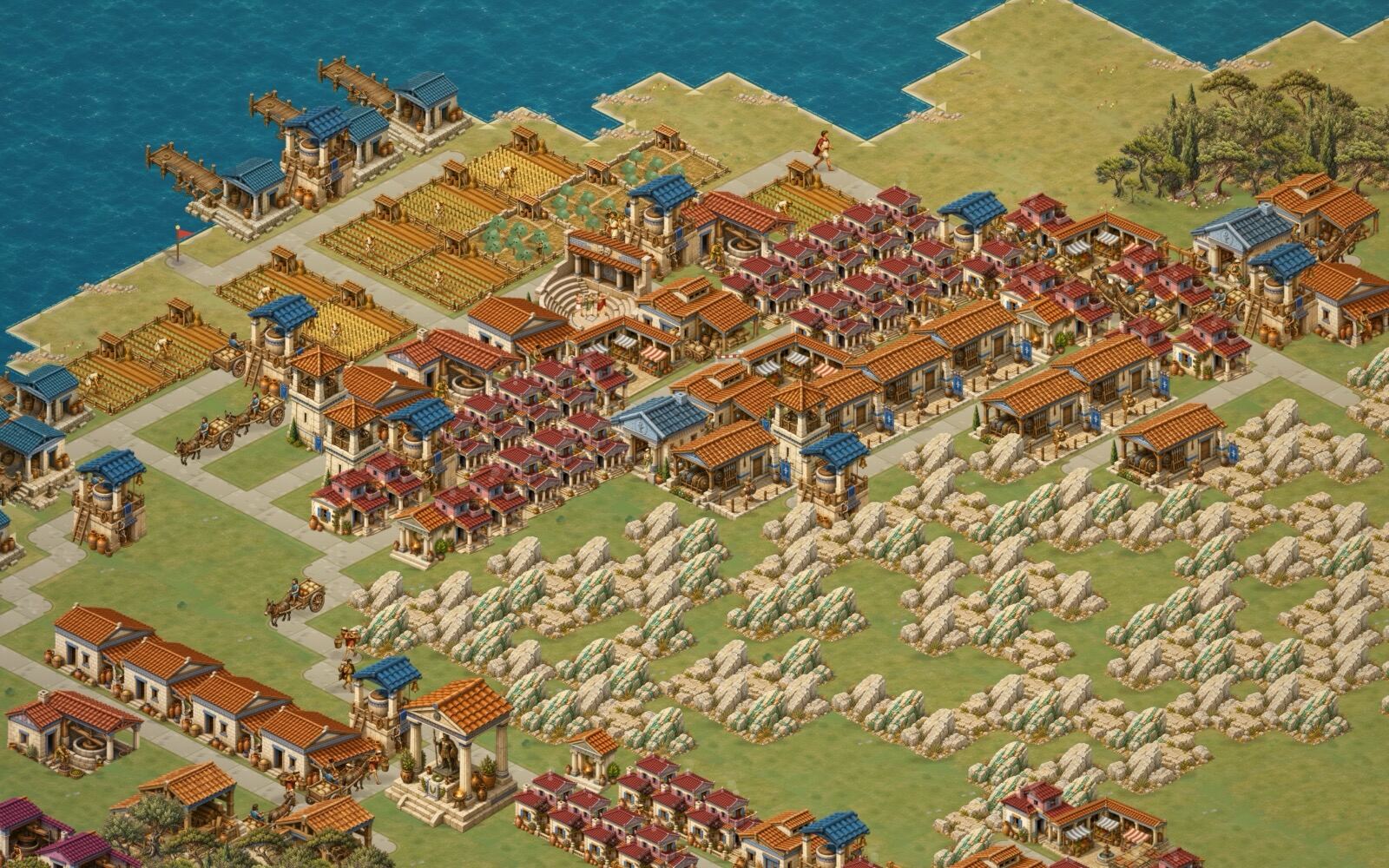
We built it because we wanted the Impressions loop in a browser tab, with no launcher and no install. Roads carry walkers, walkers carry goods, and coverage is geographic rather than a global number. Farm carts haul wheat to granaries, agora vendors carry food out to houses, and houses climb from huts to great estates as water, food, oil and fleece reach them, then fall back down when a supply chain breaks.
Some of it is ours rather than borrowed. The year runs in four Mediterranean seasons and summer is the dead season, so banking a surplus before the fields stop is a real strategic problem. Six rival cities sit on an Aegean chart, trade at their own prices, demand tribute, and conquer each other whether or not you are involved. Gods answer temples and walk your streets, monsters come down out of the hills, and heroes have to be housed and equipped before they can deal with either.
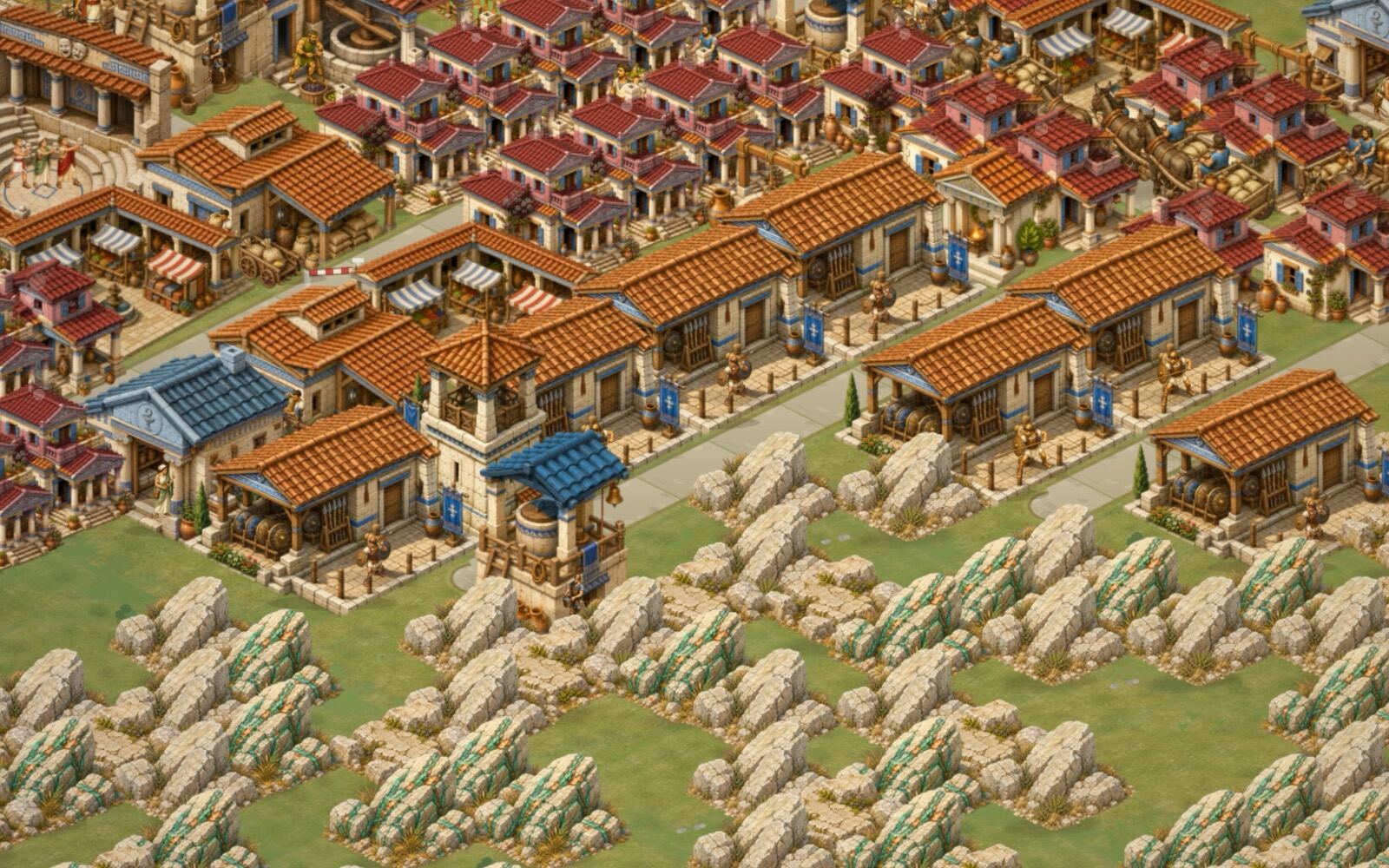
The war is there too, at city-builder scale rather than real-time strategy scale. Raiders land on your beaches and march on your gates, walls and gatehouses change how they get in, staffed towers shoot and unstaffed ones do not, and hoplites you raise and armour can be shipped out to march on a rival city and take it as a vassal. It is closer to Zeus than to Age of Empires II, which is to say you are managing a defence rather than microing a battle.
Two honest caveats. It is smaller than any boxed game on this page, and it is a browser game that runs on your machine rather than a server, so if you want two hundred hours of campaign then Civilization VI and Age of Empires II are the right answers. There is a story campaign and a sandbox, and no timers or energy of any kind.
It runs in the browser. No download, no account, no launcher.
The first fifteen minutes are free, then €4.99 + VAT once, forever.
The short version
- You miss the fighting. Age of Empires II: Definitive Edition, or Age of Empires IV if you want the modern one. Age of Mythology: Retold if the setting mattered more than the economy.
- You miss the ages and the tech tree. Civilization VI on sale, or Old World if you want antiquity and the best design ideas of the past decade.
- You want the newest 4X and can take the arguments. Civilization VII, much improved by the Test of Time update.
- You miss the villagers. Manor Lords for medieval, Anno 117 for Rome with co-op, Augustus or Pharaoh: A New Era for the originals done properly.
- You want it in a browser tab right now. Ours, above.
Further reading: the best city builder games covers branch three in full, city builders with combat is for people standing between branches one and three, and ancient city builder games by civilisation works through Rome, Egypt, Mesopotamia, China and Greece.