The best Greek mythology games
Greek myth has been in games since games began, so the shelf is crowded and wildly uneven. The useful question is not which one is best overall. It is which one is best for the thing you actually came for.
Most lists of Greek mythology games treat a roguelike, an open-world RPG, a real-time strategy game and a twenty-six-year-old city builder as interchangeable recommendations. They share a cast and almost nothing else. Someone who wants to fight Ares with a spear and someone who wants to build a sanctuary Ares will move into are not looking for the same game, and handing either of them the other one is how you waste a weekend.
So this is organised by appetite rather than by score. Each section says what the game actually is, what it does with the myth, and where it disappoints, because most of these have a real flaw and pretending otherwise helps nobody.
If you want the myth as a fight: Hades and Hades II
Supergiant's Hades is the one nearly everyone lands on first, and the reputation is earned. It left early access in September 2020, holds a 93 on Metacritic, took Best Game at the 2021 BAFTA Games Awards along with four other trophies, and became the first video game to win a Hugo Award. You play Zagreus trying to leave the underworld, and the trick of the design is that dying is not a failure state but a narrative beat: you come home, your father is disappointed again, and someone in the house has something new to say.
What makes it a genuine mythology game rather than a game wearing mythology is that the Olympians are relatives. Athena, Poseidon and Aphrodite turn up as a meddling extended family offering help you did not ask for, and the pantheon's politics is the reward structure.
Hades II went to 1.0 on 25 September 2025 on Windows, macOS, Switch and Switch 2, and reached PS5 and Xbox Series consoles on 14 April 2026, on Game Pass from day one. It reviewed even better than the original at 94 on Metacritic, sits Overwhelmingly Positive on Steam, and its launch weekend peak more than doubled the first game's all-time concurrent record. You play Melinoë, the witch sister, going the other way: up, at Chronos.
The honest caveat applies to both. They are roguelikes. If run-based structure genuinely does not agree with you, no amount of writing quality converts you, and you will bounce off the best reviewed game on this page.
If you want to be the one the gods are afraid of: God of War
The Greek half of God of War runs from 2005 to 2013: the original, God of War II in 2007, God of War III in 2010, and the prequel Ascension in 2013, with three portable-born entries around them. Kratos works his way up the pantheon and by the end has done to Olympus roughly what Olympus did to him. It is the loudest, least reverent treatment of the material on this list, and it is very good at being that.
The practical problem is platform. The Greek games have never come to PC. The PC ports are the Norse ones, God of War (2018) arriving in 2022 and Ragnarök in 2024, which means a PC player who searches for a greek mythology game pc and lands on God of War is being pointed at the wrong half of the series. Sony announced a remake of the original trilogy on 12 February 2026, with T. C. Carson returning to voice Kratos for the first time since Ascension, but it was described as very early in development. Treat it as a thing that will exist eventually rather than a reason to wait.
If you want to command the pantheon: Age of Mythology: Retold
The strategy answer, and the one that has aged into a genuinely healthy live game. Age of Mythology: Retold shipped on 4 September 2024 from World's Edge with Forgotten Empires and Tantalus, nearly twenty-two years after the original, and landed at an 83 average on OpenCritic with 86 per cent of critics recommending it.
It is a rebuild rather than a reinvention: the same Greek, Egyptian and Norse pantheons, the same choice of a major god at the start and a minor god at each age-up, the same god powers and myth units. Sending a hydra into an enemy town centre still works exactly as well as it did in 2002. The modernisation is graphical and quality-of-life, and reviewers largely agreed that the changes only improve it. If the historical half of that family is what you are after, we covered the wider field in games like Age of Empires.
The expansions have been steady and have travelled a long way from the Aegean. Immortal Pillars added the Chinese pantheon on 4 March 2025, Heavenly Spear added the Japanese pantheon on 30 September 2025, and 2026 brought the New Gods Pack featuring Demeter in February and Obsidian Mirror, which adds the Aztecs, in April. If you specifically want a game about Greek myth, note that the base game is where Greece lives and everything since has been somewhere else. That is a good deal for a strategy player and a slightly odd one for a mythology enthusiast.
If you want to walk around in ancient Greece: Assassin's Creed Odyssey
Ubisoft Quebec's Odyssey arrived in October 2018 and is still the largest, most carefully built Greece anyone has put in a game. The spine is the Peloponnesian War rather than the myth, and the mythological content is mostly optional: the creatures are in there, gated behind long side chains, and you can play thirty hours without meeting one.
The reason it belongs on the list anyway is Discovery Tour: Ancient Greece, added on 10 September 2019 and free to owners. It strips out combat entirely and turns the map into a guided museum of the period. If what you want is ancient Greece more than you want Greek mythology, that mode is the best thing on this page for the purpose, and nothing else comes near it.
The flaw is the familiar Ubisoft one. It is enormous, and a good chunk of that size is repetition. Go in expecting to leave content unfinished and you will enjoy it much more.
The lighter one: Immortals Fenyx Rising
Also Ubisoft Quebec, released 3 December 2020, and it is Odyssey's tonal opposite: a comic retelling with Zeus and Prometheus narrating over your shoulder while you fix a world Typhon has broken. Mechanically it borrows Breath of the Wild's grammar of climbing, gliding and physics-led puzzle shrines, and does so competently enough that the borrowing is the main thing most reviews wanted to talk about. It reviewed generally favourably, in the high seventies to low eighties depending on platform.
It is also finished business. Ubisoft cancelled the sequel, which was reportedly heading for a Polynesian setting, and moved the team onto Assassin's Creed. That makes the game a self-contained one-off, which is not a bad thing, and it goes on deep discount constantly, which is a good one.
Two indies that treat the myth differently
Apotheon, from Alientrap, released on 3 February 2015 for Windows, macOS, Linux and PS4, and it is the best-looking game in this whole category. The entire thing is drawn in the style of ancient Greek black-figure pottery, with figures animated like shadow puppets that flip rather than turn, because foreshortening would break the illusion. You play Nikandreos, backed by Hera, working through Olympus. It scored 78 on Metacritic, and the fighting is the weaker half of it, but the art is a genuine achievement rather than a gimmick.
Okhlos, by Buenos Aires studio Coffee Powered Machine and published by Devolver Digital, gives you a mob instead of a hero. You play a philosopher leading a growing crowd of ancient Greeks, absorbing peasants and heroes as you go, and you point the crowd at the gods. It is funny and stylish and, by most accounts including the friendly ones, it runs thin before it ends. The revised Okhlos: Omega is the version on sale.
If you want to build instead of fight
This is the shortest shelf in the category, and the reason is historical rather than mysterious: almost nobody has tried.
Zeus: Master of Olympus
Impressions Games and Sierra released it in October 2000, and it is still the only game that has properly made Greek myth into a city-building system rather than a skin. Sanctuaries are monuments you assemble block by block over years, and when one is finished the god physically moves in and walks your streets. Heroes turn up with shopping lists of goods before they will agree to fight your monster. It scored 87 on Metacritic with a 9.1 from IGN, and the criticism it did take was aimed squarely at the combat.
It is still on sale, bundled with its expansion as Zeus + Poseidon, for around ten euros and frequently half that. We wrote a full guide to playing Zeus: Master of Olympus today, covering the widescreen patch and what to buy, with separate pages on the Poseidon expansion, the cheat codes, and what to play instead if you have already finished it.
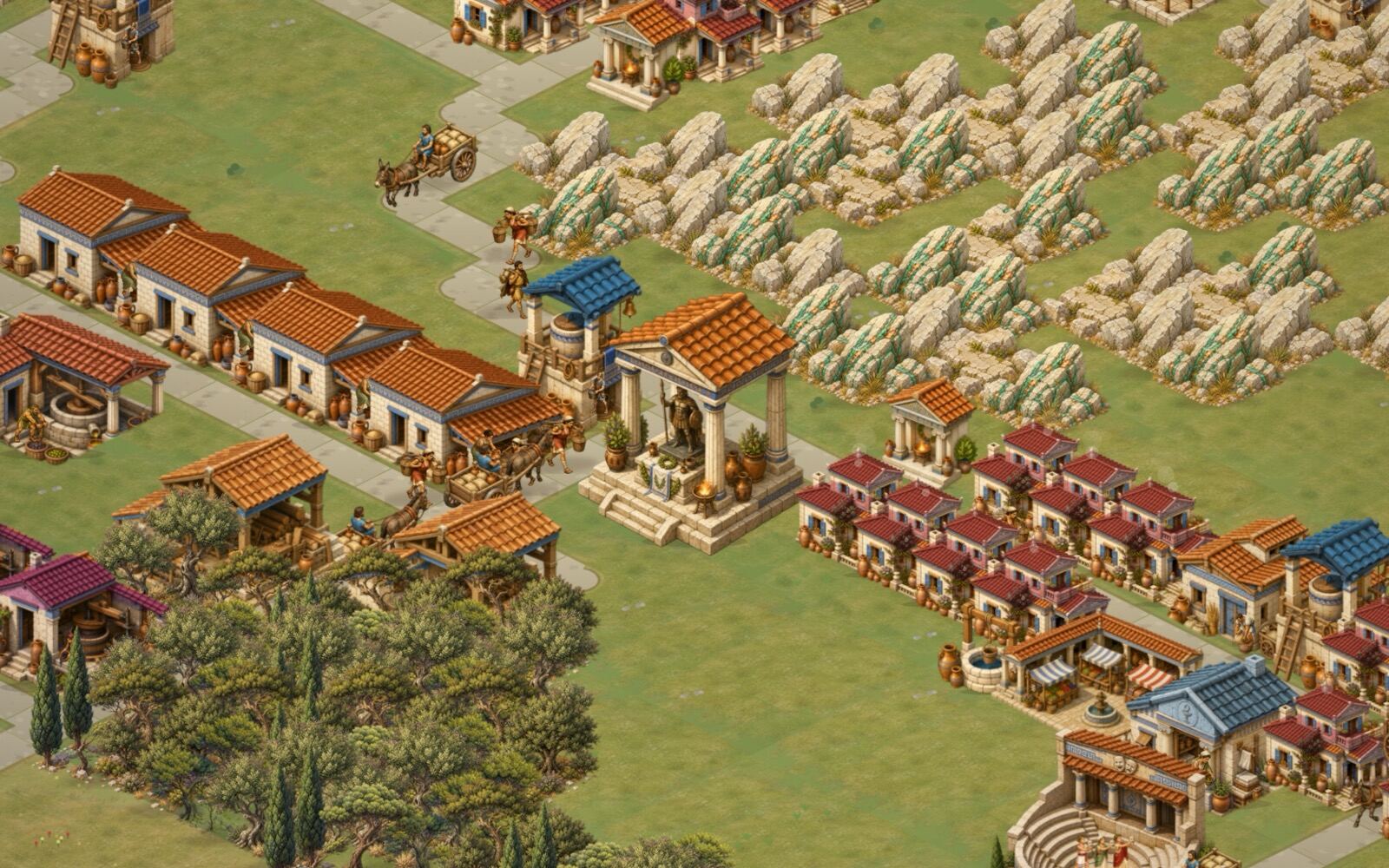
Theos: Cities of Myth
Revealed on 1 June 2026 at the MIX Summer Game Showcase, from Triskell Interactive and Dotemu, the same pairing that made Pharaoh: A New Era. It is a Greek city builder built around seven patron gods, and press coverage at the reveal framed it as a spiritual successor to Zeus rather than a remake, although the official material never mentions Zeus: Master of Olympus. Walkers return: the game drafts their routes and you adjust them with patrol flags, instead of praying the pathfinding cooperates.
It launches on Steam on 4 November 2026, for Windows, and a free demo has been up since 13 October. Until reviews land it is a thing to try rather than a recommendation, and it is the most interesting thing coming to this corner of the genre. We keep everything confirmed about Theos in one place, including how it compares with Zeus.
The browser tier, and what it really is
Search for a greek mythology game online and Grepolis comes up almost immediately. InnoGames is still running it, with new worlds opening through 2026, so the recommendation is at least live, which is more than can be said for most browser games of its generation.
Be clear about what it is before you invest, though. Grepolis is a real-time strategy MMO with construction timers, alliances and other players raiding you while you sleep. Myth units exist and the gods grant powers, but the loop is closer to Travian in a chiton than to anything on the rest of this page. Nobody's fondest memory of Greek myth involves waiting four hours for a barracks. We went through that whole category, including where the good ones hide, in city builder games you can play in a browser.
Cities of the Aegean
This one is ours, so weigh it accordingly.
We built it because the myth layer in Zeus was the part people talked about for twenty-six years and nobody had rebuilt it. It is a walker-based city builder that runs in a browser tab, and the gods are systems rather than decoration.
Eight Olympians have temples. A temple is a construction site before it is a building: you pay the silver at placement, then your own porters haul wood, marble and sculptures to the site while a workshop crew raises it, and a site that runs dry simply stops until you fix the supply. When it completes, the god's blessing switches on across the island. Athena's temple lifts the olive harvest, Dionysus' the grapes, Poseidon's the fishing wharves, Hades' cuts how fast sickness gathers in crowded housing, Aphrodite's shortens the gap between waves of immigrants.
All eight then take the field in person, each patrolling out of its own temple. Zeus throws a thunderbolt, Poseidon closes in with the trident, Hades hurls bolts from the underworld while Cerberus prowls the streets, Athena strikes at spear range, Artemis at bow range, and Aphrodite and Dionysus with divine strikes of their own. Ares also drills your hoplites faster, cuts your tower reload and quietly adds his own host to any expedition you send out. They are deliberately a supplement rather than a garrison: raiding hosts land more than a hundred men, so your towers and companies still have to do the work. A god who catches a monster drives it off after three blows, but each patrols its own temple's streets, so the Hero Shrine is still the dependable answer.
You can also call a god down directly. Each completed temple arms one invocation, paid for in silver, with the god unwilling to answer again for over a month afterwards. Zeus' Thunderstorm and Poseidon's Sea's Wrath and Hades' Mouth of Tartaros kill raiders outright; Ares' War-Cry speeds your towers and squads for a spell; Athena's Aegis puts out fires and repairs raid damage; Dionysus, Aphrodite and Artemis grant a vintage, a wave of newcomers and a hunt.
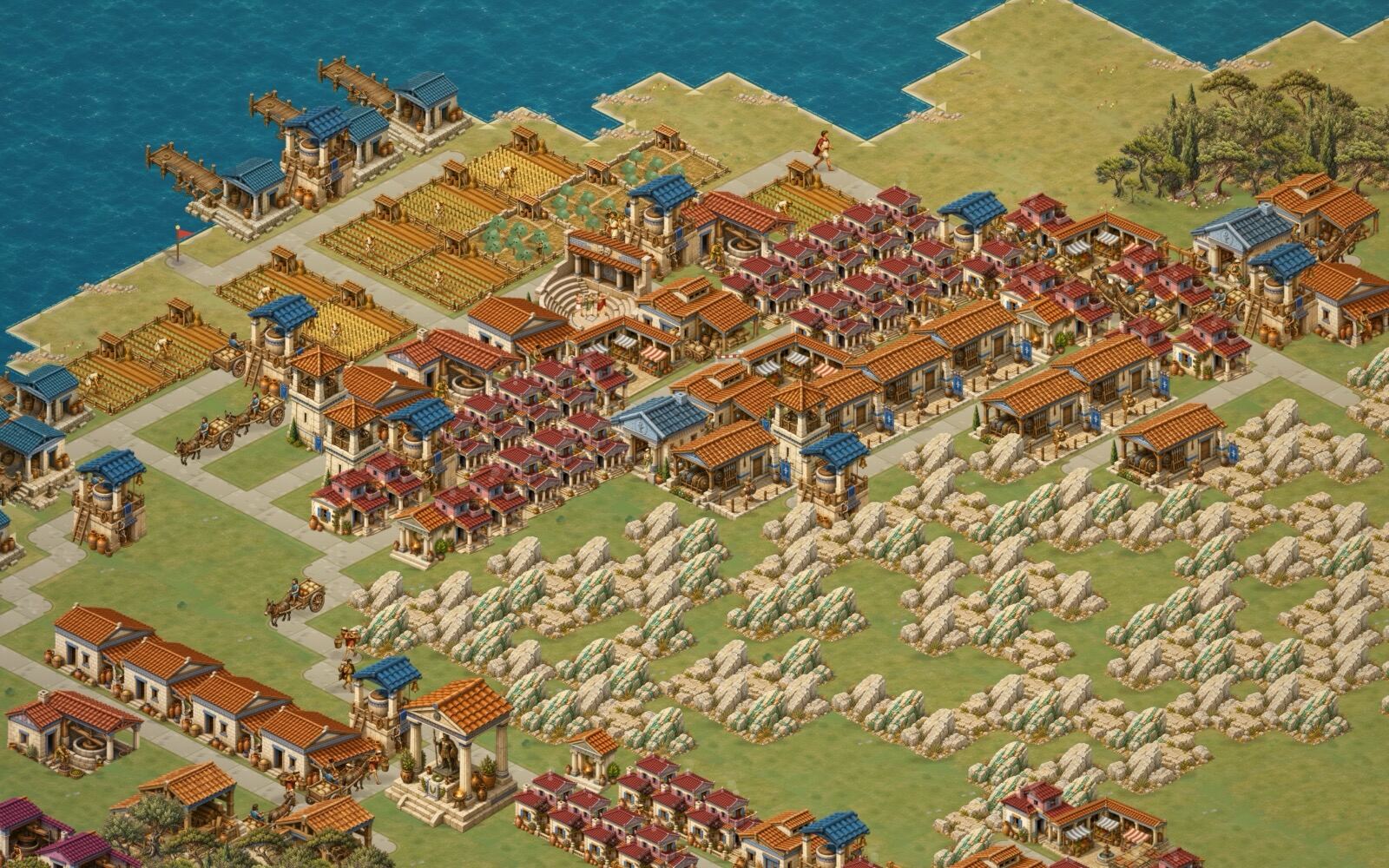
Then there are the monsters. From the middle of the third year, once the city is large enough to be worth punishing, an omen arrives and a creature takes up residence: a Minotaur, then a Cyclops, then a Gorgon, then the Hydra. It roams a small territory, tears down whatever it reaches, and kills the people in the way. Your towers and hoplites do absolutely nothing to it, which is the point. The answer is a Hero Shrine, a monument with a rotating and expensive price in silver and proof, and raising it summons Theseus or Odysseus or Perseus or Herakles to go and settle it with a sword. A hero who survives stays available to march on your later expeditions.
Around all that sits an ordinary and fairly demanding city sim: four Mediterranean seasons with summer as the dead season, so banking grain is a real problem; six rival cities on an Aegean map that trade with you, demand tribute and conquer each other whether or not you are paying attention; walls, gatehouses, towers and hoplites for when they come for you. If the war side is what interests you, we compared the field in city builders with combat.
The flaws are real and worth stating. It is a browser game with art generated in code at load time, so there are no hand-painted cutscenes and there is no 3D. The myth layer is a mid-game reward, which means your first hour is farms and roads and nothing divine at all. And it is small next to anything else on this page, because it is not made by fifty people.
Ours runs in the browser. No download, no account, no launcher.
The first fifteen minutes are free, then €4.99 + VAT once, forever.
Picking one
For the best game on the list regardless of setting, play Hades II, or the first Hades if you want the story in order. For strategy and the pantheon as a toolkit, Age of Mythology: Retold and stop before the expansions if Greece is the point. For the place rather than the legends, Odyssey, and use Discovery Tour. For something you have not seen before, Apotheon, on the art alone.
And for the myth as something your city has to live with rather than something you stab, the shelf is Zeus, whatever Theos turns out to be, and ours. That is a thin shelf for a category this old. There is a fuller history of the tradition it comes from in ancient city builder games, by civilisation.