Games like Zeus: Master of Olympus
Zeus came out in 2000. Twenty-six years later people are still searching for something that scratches the same itch, which tells you how specific that itch is.
If you have landed here you probably already know what you are missing, but it is worth naming precisely, because it explains why so many recommendations disappoint.
Zeus, made by Impressions Games and published by Sierra, was not a city builder about zoning and traffic. It was a city builder about walkers. You laid a road, put a building beside it, and a little person came out and walked. Where they walked, things happened. A granary filled. A house grew from a shack into a manor. If your road looped badly, the walker wandered off and a whole district quietly starved while your storehouses sat full a hundred tiles away.
That is the mechanic people are actually nostalgic for. Not Greece specifically, and not the isometric art. The feeling that a city is a machine you assemble out of paths and dependencies, and that the machine can fail in ways you have to diagnose.
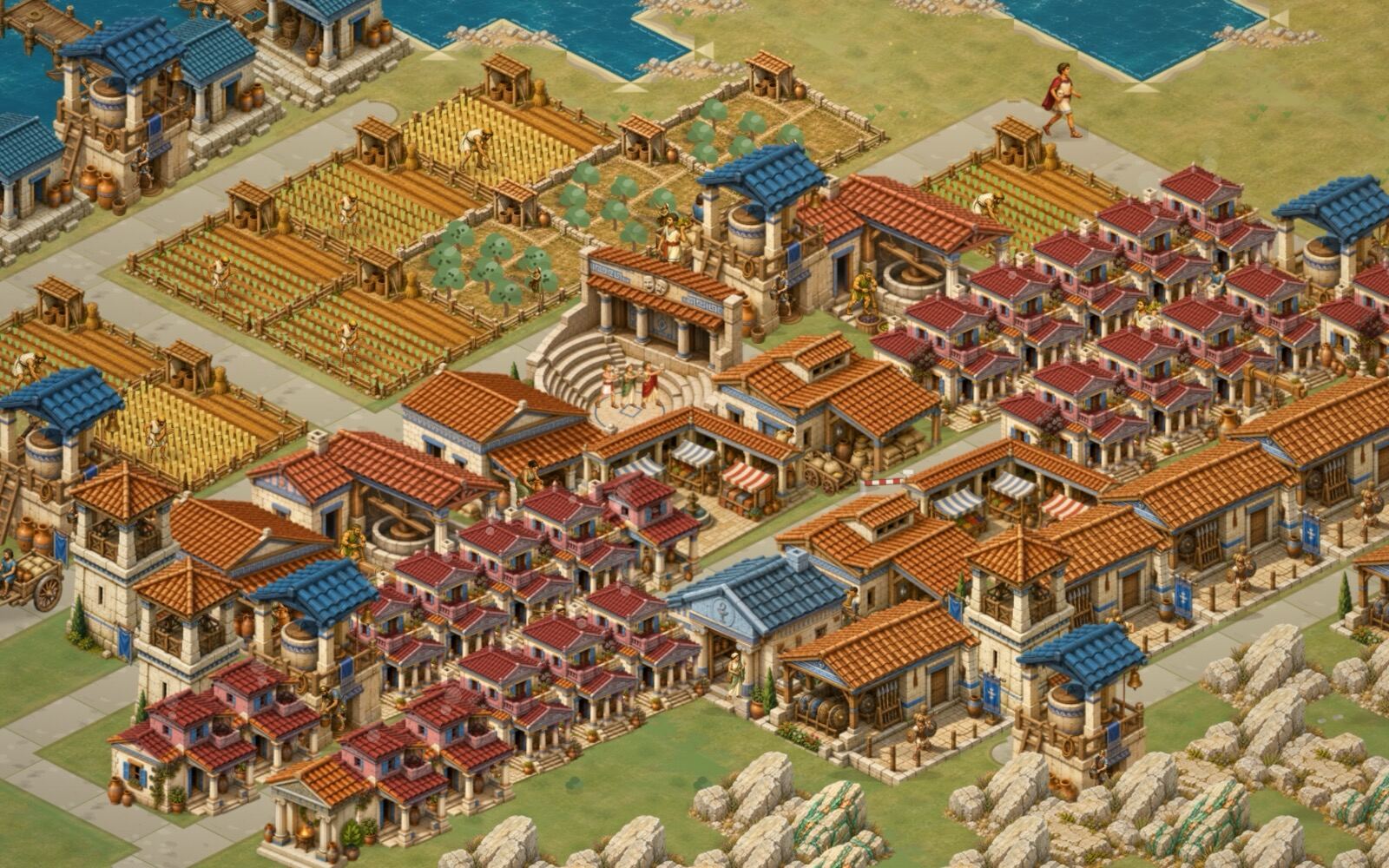
Here is what comes closest today, roughly in order of how close, plus the one arriving in November.
Zeus + Poseidon itself
Start here, because it is still for sale and it still works. The Zeus + Poseidon bundle packages the original with its Poseidon: Master of Atlantis expansion, and it is on both GOG and Steam for under ten dollars (Steam does not sell it in Germany). The GOG release is patched to run on modern Windows without you doing anything clever.
The catch is the one you would expect from a game of this vintage: 800×600 or 1024×768 and nothing else, no proper widescreen without community patches, and an interface that assumes you have a manual. If you played it as a teenager you will be fine within ten minutes. If you never did, the first hour is genuinely rough.
Also worth knowing
Zeus has three close siblings in Sierra's City Building series. If you liked the walker system and want more of it, Pharaoh (1999), Caesar III (1998) and Emperor: Rise of the Middle Kingdom (2002) are the same idea in Egypt, Rome and China. Caesar III is the hardest and most respected of them. Zeus is the friendliest, because by the time they made it Impressions had already sanded down the rough edges on Caesar III and Pharaoh. There is a fuller tour of the family in ancient city builder games, by civilisation.
Pharaoh: A New Era
The closest thing to an official modern Zeus, except it is Egypt. Triskell Interactive rebuilt Pharaoh from the ground up for Dotemu and released it on 15 February 2023. Rock Paper Shotgun called it the definitive version of the original.
It is a remake rather than a sequel, so the systems are the ones you remember, with the resolution, zoom and quality-of-life fixes the originals never got. If your objection to playing Zeus in 2026 is that it looks and handles like 2000, this is the answer to that objection. It just answers it in the wrong country.
Theos: Cities of Myth (out 4 November 2026)
The same team's Greek game, and the nearest thing to a Zeus successor anyone has announced. Triskell Interactive and Dotemu revealed it on 1 June 2026, and it comes out on Steam, for Windows, on 4 November. Engadget reported from a press briefing before the reveal that the team wanted a spiritual successor to Zeus rather than a straight remake; the official material itself never mentions Zeus: Master of Olympus.
What is confirmed reads like a Zeus wish list with two big changes. Each city is dedicated to one of seven patron gods and starts with that god's sanctuary. Walkers carry water, food and services down the streets, but the game drafts each walker's route and you adjust it with patrol flags, instead of hoping the pathfinding behaves. Heroes and famous Greeks (Socrates and Aristotle among them) come to a well-run city, colonies and rival city-states fill a world map, and battles are fought in real time. A free demo with the opening of the Athens adventure is on Steam now, and the price has not been announced. Previews of an early build in June liked the bones and found the route tool fiddly, and nobody outside the studio has played the finished game, so we keep a separate page on everything confirmed about Theos and will update it after launch.
Nebuchadnezzar
Nepos Games released this on 17 February 2021, and it is the most deliberate attempt anyone has made to build a new game in the Impressions mould. Mesopotamia, walkers, supply chains, monument construction you actually lay out brick by brick.
It is a small team's game and it shows in the polish and the campaign length. But the core is right, and it was made by people who clearly loved the same games you did. If you want something new rather than something restored, this is the first place to look.
Augustus and Julius
Two open-source projects that re-implement the Caesar III engine. Julius aims to reproduce the original faithfully with modern resolutions and a better interface. Augustus builds on that and adds gameplay changes the community had wanted for twenty years, roadblocks among them.
Both need the original Caesar III assets, so you have to own the game. That is a fair trade for what you get: the 1998 design running properly on a 2026 monitor, with an active project behind it. The Zeus equivalent, an open-source engine called eZeus, has existed since 2021 but is still in beta, needs your Zeus and Poseidon files, and offers official downloads for Windows only (it builds on Linux and macOS from source), so it is not yet the way most people play; a Julius-grade port remains a recurring wish in the community. The whole engine-and-remake landscape is mapped in the Impressions city builders, ranked.
Citadelum
Rome rather than Greece, but the closest thing on sale to Zeus's gods. Abylight released it on PC on 17 October 2024, then on Nintendo Switch 2 in January 2026, and on PlayStation 5 and Xbox Series X|S in March, which matters if you came here looking for something like Zeus on a console. It is rated Very Positive on Steam. Roman gods, Jupiter, Mars and Ceres among them, want temples, festivals and sacrifices. A favoured god comes down to walk the map and help, and a neglected one punishes the city, sometimes because you were busy pleasing another. Plebeians work, patricians pay the taxes, and your legions fight automatic battles out on a world map.
Two things will strike a Zeus player. Services and markets reach houses through a coverage area around each building rather than walkers on a route, so the particular puzzle Zeus is remembered for is not there. And TheGamer's reviewer found that every map settles into much the same build order. It is a good gods-and-city game rather than a walker game.
Polismos and Builders of Greece
Two smaller Greek city builders reached Steam in 2024. Neither comes from a big studio, and what follows is drawn from their developers' own descriptions and from reviews.
Polismos (Composition GS, December 2024) is the more interesting of the two for a Zeus player. Its developer's own diary points Impressions fans at the world map: more than 150 historical Greek cities around the Aegean, any of which you can take as your home, with the rest run by the computer as trading partners, allies and threats. Inside the walls you deal with families rather than individual citizens, each with a trait that changes how it takes your policies, and you decide which goods the city promises to supply. It is a small game with a small following, Mostly Positive on Steam from around sixty reviews, and in English only.
Builders of Greece (BLUM Entertainment with Strategy Labs, the studio behind Builders of Egypt, published by Games Operators and PlayWay) spent more than a year in early access and launched in full on 6 May 2025. It is a polis builder of production chains and taxes, with citizen classes, research, trade and raids, and the 1.0 update added gods including Demeter, Hephaestus, Hades and Ares. Early-access reviews were hard on its bugs and its tutorial, and its Steam rating sits at Mixed. It is the more conventional of the two, and we would read its recent reviews before buying.
What about the browser games?
Search for ancient Greek city building and you will hit Grepolis and Ikariam near the top. Both are still running, both have large player bases, and both are worth being clear about: they are multiplayer strategy MMOs with build timers, alliances and other people raiding you. Grepolis is InnoGames, Ikariam is Gameforge, and the loop is closer to Travian than to Zeus.
They are good at what they do. They are not what someone means when they say they miss Zeus. Nobody misses waiting four hours for a barracks. We went through the whole browser category in more detail in city builder games you can play in a browser, including where the genuinely good ones hide.
Cities of the Aegean
This is our game, so treat what follows accordingly.
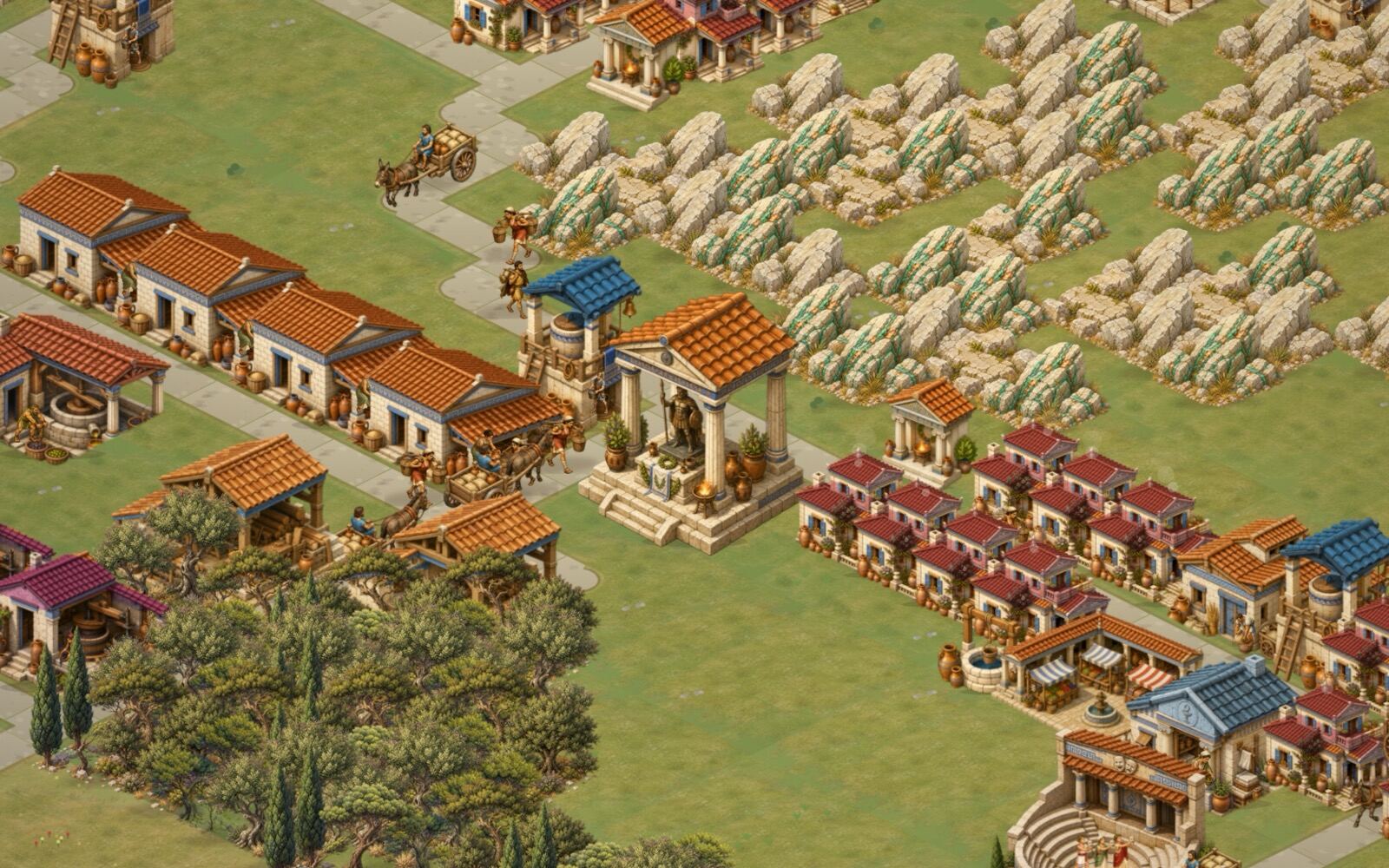
We built it because we wanted the Zeus loop in a browser tab, with no launcher, no install and no build timers. You found a polis on an island or coast, lay roads, and the walkers do the rest: farm carts hauling wheat to granaries, agora vendors carrying food out to the hungriest houses and feeding the rest on the way back. Houses evolve from huts to great estates as water, food, oil and fleece reach them. The failure mode is the Zeus failure mode, a district starving beside a full granary because the market coverage does not reach it.
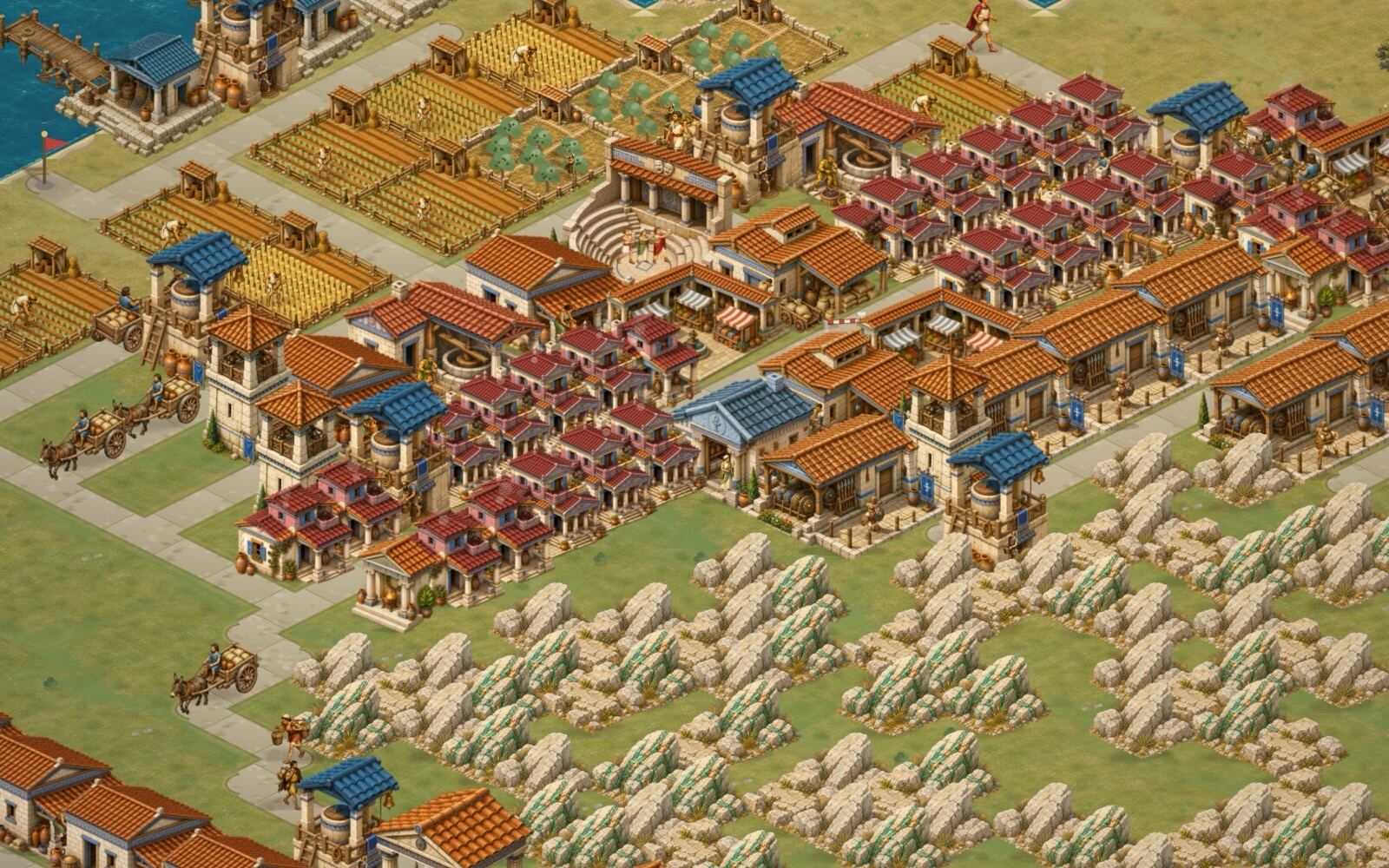
Some things are ours rather than borrowed. The year runs in four Mediterranean seasons, so summer is the dead season and wheat nearly stops, which means banking a granary surplus is a real strategic problem rather than a background number. Six rival cities sit on an Aegean map, trade with you, demand tribute, and fight each other, so a neighbour you ignored for thirty years can turn up having swallowed two others. You can open trade routes, import grain by ship, send gifts, or raise hoplites and march.
The myth layer is here too, which is the part of Zeus people describe most fondly. Gods answer temples and walk the streets themselves: Hades slows sickness and defends the city, Ares drills your hoplites faster and patrols the streets himself. Monsters come for you, a Cyclops flattening houses until a hero is called up to break it. There is a story campaign as well as the sandbox, and a war for the Aegean either way.
It runs in the browser. No download, no account, no launcher.
The first fifteen minutes are free, then €4.99 + VAT once, forever.
Questions people ask
Is there a remake of Zeus: Master of Olympus?
No official one. The nearest thing is Theos: Cities of Myth, a new Greek city builder from the team that remade Pharaoh, out on Steam on 4 November 2026. Fans also have eZeus, an open-source engine in beta that runs the original game from your own Zeus and Poseidon files. Zeus itself is still sold as Zeus + Poseidon.
Is there a game like Zeus on Switch or PlayStation?
Zeus itself is PC only. The closest console option is Citadelum, a Roman city builder with gods, festivals and temples, which reached Nintendo Switch 2 in January 2026 and PlayStation 5 and Xbox Series X|S in March. It handles services by coverage area rather than walkers, so it feels looser than Zeus, but the gods matter in a way few other builders manage.
What is the closest game to Zeus: Master of Olympus?
Pharaoh: A New Era, for the same walker design with modern resolutions and an interface that respects your time; it is Egyptian rather than Greek. For Greece and gods specifically, wait for the Theos reviews on 4 November or play the Zeus + Poseidon bundle again. Our own browser game is the closest you can play in a tab tonight, and we would say that.
Is Zeus: Master of Olympus on Steam?
Yes, as the Zeus + Poseidon bundle, which includes the expansion, and on GOG as well. Steam does not sell it in Germany. Our guide to playing Zeus: Master of Olympus today covers which store to pick, Windows 11, Mac and the widescreen fix.
The short version
If you want Zeus, buy Zeus. It is ten dollars and it still holds up. If you want that design with modern handling, play Pharaoh: A New Era and accept Egypt. If you want something new in the same tradition, play Nebuchadnezzar. If it is the gods you miss more than the walkers, try Citadelum. If you want to test whether the itch is real before spending anything, open ours in a tab.
What nobody has made yet is a full modern remake of Zeus with the gods and heroes intact. Given that people still search for one every month, that is a strange gap in the market. The nearest thing is Theos: Cities of Myth from Dotemu and Triskell Interactive, widely described as a spiritual successor rather than a remake, from the team behind Pharaoh: A New Era and out on PC through Steam on 4 November 2026, with a free demo up now. We track it on our Theos: Cities of Myth page. Until it lands, the gap stands. We keep a closer eye on the original in Zeus: Master of Olympus in 2026, including where to buy it and how to make it widescreen.