City builders with combat
Most city builders treat war as an obligation. A few make it the reason the city has a shape at all, and the difference shows up in the first ten minutes of a siege.
There is a test worth applying to any city builder that claims to have combat, and it is not whether the fighting is fun. It is this: does the threat of it change where you put things?
By that test most of the genre fails, and often the best games fail hardest. Caesar III put building and fighting on one map, which was the right instinct, and then gave you legions that are fiddly to command and rarely worth the attention they ask for. Zeus: Master of Olympus scored 87 on Metacritic and was criticised specifically for its war layer. Anno 1800 has real combat, but only at sea: there is no land warfare at all, so your island's layout is untouched by the question of who might land on it. In each case the city and the war are two systems sharing a screen.
That is not a scandal. Combat is expensive to build, it draws players who want a different game, and a builder that adds it badly is worse than one that leaves it out. A handful of games fuse the two halves anyway, part town and part battlefield, and the city builder RTS is what you get when it works. What follows is a survey of who did what, sorted by how load-bearing the fighting turns out to be.
Where war is genuinely load-bearing
These are the city builder war games where the fighting earns its keep. Not all of them are deep tactically. What they share is that the threat reaches back into the build.
Stronghold, and its long series
The founding example. Firefly Studios was set up in August 1999 by Simon Bradbury, David Lester and Eric Ouellette, who had met at Impressions Games, and Stronghold arrived in 2001 with the genre's cleanest answer: make the fortification and the settlement the same object. Your walls are not a layer over the town, they are the town's outline. Where you put the granary decides how long a siege you can sit out. Where you put the gatehouse decides where the enemy comes.
The series has kept going for twenty-five years, and Firefly is still shipping: Stronghold Crusader: Definitive Edition landed on 15 July 2025 with new AI opponents, units and campaigns. It is worth playing not because the combat is deep — it is not, particularly — but because the economy and the defence are one problem instead of two.
They Are Billions
Numantian Games released the campaign version on 18 June 2019, and it is the purest expression of the idea in the genre. A real-time strategy game with pause, in which the enemy is a swarm of infected numbering in the millions and your only real weapon is the shape of your colony.
Every wall segment, every tower, every chokepoint is a build-order decision with an economic cost, and the failure state is total: one infected unit through a gap and the whole map cascades. You cannot separate the building from the fighting here even if you want to, which is exactly the point.
Diplomacy is Not an Option
Door 407 kept it in early access from February 2022 and released version 1.0 on 4 October 2024. The name is the design document. It is a medieval builder whose sieges are absurd in scale, and the entire economy exists to be converted into wall, tower and archer before the next wave arrives. It is more tower defence than town, and it is honest about that.
Farthest Frontier
Crate Entertainment, better known for Grim Dawn, put this into early access on 9 August 2022 and took it to 1.0 on 23 October 2025. It sits in the middle of the field: a survival-flavoured medieval town builder where disease, starvation, weather and raiders all press on you, and where walls, soldiers and siege weapons are one of several things you build against the wilderness rather than the only thing. The raids are real and they will burn your outlying farms, but the town is still shaped mainly by terrain and food.
Manor Lords
The most-watched entry in this category, and the one to be most careful about. Slavic Magic's medieval builder passed four million copies sold on 27 August 2026, announced alongside Major Update 8, and it is still in early access more than two years after launch, with no locked 1.0 date.
The combat is a genuine tactical layer rather than an auto-resolve: drafted militia, a hired retinue and mercenaries, with formations, flanking, morale and fatigue all in play against bandit camps and rival lords. Major Update 6 in March 2026 made terrain matter, so hills, rivers and forest cover now change how a fight goes.
The honest note is that this is the least finished part of a game that is not finished. Battles are atmospheric and not yet strategically complete; cavalry and siege remain on the roadmap to 1.0. If you are buying Manor Lords for the war, buy it later. If you are buying it for the settlement and the land, it is already excellent, and we go into it further in medieval city builder games.
Conflict without an army
Frostpunk 2 (11 bit studios, 20 September 2024) belongs in this article even though you never click a soldier. The conflict is political: communities and factions form whether you want them or not, they hold incompatible ideas about what the city is for, and the pressure comes from votes, fervour and the risk of losing the room rather than from anything landing on your border.
It counts because it passes the test. The threat changes what you build and where, and it cannot be solved by walling it out. If what you actually want from "city builder with combat" is stakes rather than units, start here.
The ones with no enemy, and why that is fine
Two of the best builders of recent years have no combat whatsoever, and both are stronger for it.
Against the Storm (Eremite Games, 1.0 on 8 December 2023) makes the weather the opponent. Each settlement is a run against the rain on a timer, and the tension comes from scarcity, hostility in the forest and the clock, with nothing to fight and nothing to garrison. Timberborn (Mechanistry, 1.0 on 12 March 2026) does the same with drought: beavers, vertical building, water physics and terraforming, and no enemy at all beyond the dry season you can see coming.
The reason to name them in an article about combat is that they are the control group. Both are tense, both are hard, and neither has a unit. So when a builder does add war, the question is not whether it needed one. It is whether the war is doing work the drought could not.
The Impressions answer: walls and walkers
The old Sierra city builders sit awkwardly in this ranking and deserve their own paragraph. Caesar III, Pharaoh, Zeus and Emperor all had wars, and the tactical command in all four is the weakest system in each game. What they got right is structural: the fighting happens on the same isometric map as everything else, so an invasion is a thing walking through your streets past your actual buildings, not an abstraction resolved elsewhere.
That single decision is why people still remember the sieges from a 1998 game. It is also the decision we borrowed. There is a full ranking of that family in the Impressions Games city builders, ranked, and a shorter argument about the best of them in games like Caesar III.
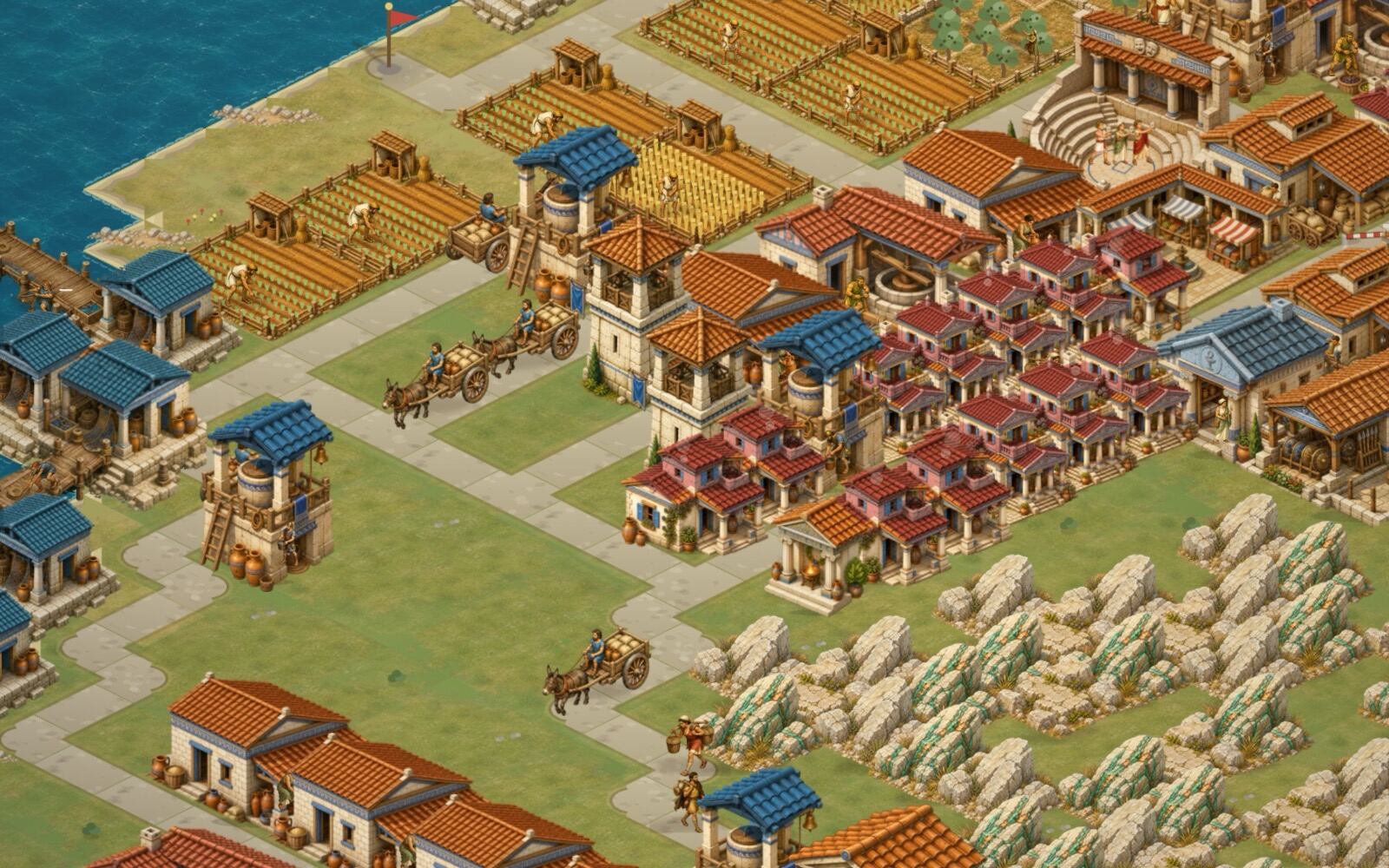
Cities of the Aegean
This is our game, so weigh what follows accordingly. We built the war system to pass our own test, and here is what that meant in practice.
A raid does not appear at a fixed spot. Ships pick a beach the party can actually reach, so every open shore on your island is a possible landing and towers hugging the obvious approach guard only the obvious approach. The party then comes ashore across a spread of sand and musters there for a week or two of game time before it marches, which is the window everything else hangs off.
While it musters you can pay the captain to turn the fleet around. The quote is read live off the men still standing, and it is not a strategy so much as a decision about this particular morning. The rule we ended up with after play-testing is that the parley closes at first blood: the moment a tower, a company or a god kills one of them, the price goes to zero and the whole party marches early. Buying a war party is a choice you make instead of fighting, never a discount you earn by shooting at it first.
Defence is built, not bought. City walls drag out as a line, and wherever the line crosses one of your own roads it lays a gatehouse instead of a curtain — open to your carts, your shepherds and your own companies, shut to everything hostile. A wall tile takes about three times as long to pull down as an ordinary roof, so a circuit buys time rather than immunity. Watchtowers need a garrison and a road, and you can see whether they have one: a staffed tower has an archer on the walkway who turns, draws and looses, and an unstaffed one has an empty parapet.
And the tower is not safe for having shot first. Fell a man and roughly six of the nearest raiders peel off and come for that tower specifically, keeping their original objective in their back pocket for when it falls. That is the counter to funnelling every raid down one lined corridor, and it means a tower line costs you towers.
On top of that sit guard companies mustered out of a barracks and commanded directly, whose dead do not come back without retraining, an Armorsmith that turns bronze into panoploi and drills faster recruits, and expeditions that sail off the map to make a rival your vassal. Six rivals trade, feud and conquer each other whether you take part or not, and vassals you conquer keep drilling, resent you, and rise if your conduct slips.
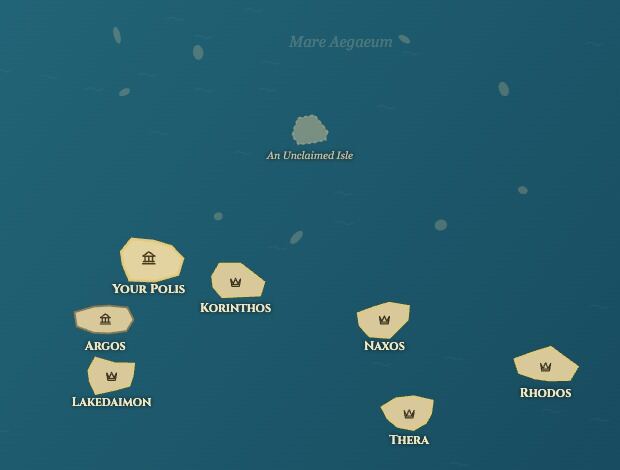
The end of the ladder is the Endless Tide. Chart the Sea of Storms and you may light a standing trial, after which waves of sea-peoples come ashore forever, each one larger than the last. The first wave is a hundred men landing on two beaches at once; it grows about a tenth each time, up to four hundred men across as many as six shores, with fifty quiet days between waves to mend your walls. It buys no building and no trade route. It exists so that a finished city has something left to be afraid of, and you can stand it down at any point.
The honest limits: this is a small browser game, not a real-time strategy game. Companies are blunt instruments, the standing-orders doctrine posts them and nothing more clever than that, and if you want unit micro at the level of Age of Empires you want a different genre entirely. What we can promise is that the war changes the city: where the roads run, where the gates are, how much wheat is banked before the sailing season, and whether the treasury can afford a parley.
Raiders land on your beach, not on a menu. Walls, gates, towers and a home guard, in a browser tab.
The first fifteen minutes are free, then €4.99 + VAT once, forever.
The short version
- You want the fortification to be the city. Stronghold, or Firefly's 2025 Crusader: Definitive Edition.
- You want the build order to be a defence plan. They Are Billions, or Diplomacy is Not an Option if you want it louder.
- You want tactical battles beside a real settlement. Manor Lords, with the early-access caveat.
- You want stakes without units. Frostpunk 2.
- You want the classic walls-and-walkers version. Caesar III through Augustus, or Zeus.
- You want it in a browser tab tonight. Ours.
Further reading: the best city builder games ranks the field without the military filter, and colony sim games covers the survival end of it, where the enemy is usually the weather.