Ancient city builder games, by civilisation
Ancient settings suit city builders better than modern ones, for a reason that has nothing to do with aesthetics. Here is the genre sorted by where it is set, and what each setting does to the game underneath.
Start with the reason. A modern city builder has to simulate things players cannot see and do not intuit: zoning law, land value, commuter flows, an economy that runs on abstractions. An ancient one gets to simulate things any player understands within seconds. Grain. Water. A cart on a road. Whether the man carrying bread reaches the house before the family in it gives up and leaves.
That legibility is why the ancient-world builders from the late nineties still hold up, and why people keep coming back to them.
Rome
The deepest shelf, and the one with the best single game on it.
Caesar III (Impressions Games, 1998) is the one that set the pattern. Roads, walkers, immigration driven by housing desirability, and a failure state that is nearly always your own layout rather than bad luck. It is harder than its successors and less forgiving about market coverage. It is also the game most of the genre's later designers were trying to answer.
Augustus and Julius are open-source re-implementations of the Caesar III engine. Julius reproduces the original with modern resolutions and interface fixes. Augustus goes further and adds changes the community wanted for two decades, including roadblocks. Both need the original game's assets, so you have to own Caesar III to use them. If you are going to play Caesar III in 2026, play it through one of these. If you have already worn it out, our list of games like Caesar III picks up from there.
Caesar IV (2006) moved the series to 3D and split opinion. It is prettier and the systems are more forgiving. Whether that is an improvement depends entirely on whether you liked being punished.
Egypt
Pharaoh (Impressions, 1999) took the Caesar III engine to the Nile and added the flood cycle, which turned out to matter a great deal. Suddenly the map had a clock. Your farms produced on a rhythm set by the river rather than continuously, and planning around that rhythm became the game.
Pharaoh: A New Era (Triskell Interactive for Dotemu, released 15 February 2023) is a full remake. Same systems, rebuilt art, modern resolution and zoom, and the interface fixes the original never received. Rock Paper Shotgun called it the definitive version. It is the easiest entry point into this whole family of games for anyone who did not play them at the time.
Children of the Nile (Tilted Mill, 2004) is the odd one out and worth knowing about. Tilted Mill was founded by people who had worked at Impressions, and they used it to try something more ambitious: individually simulated citizens with their own needs and households, rather than anonymous walkers on a route. It is fascinating and it is also fiddlier. Try it second, not first.
Mesopotamia
Nebuchadnezzar (Nepos Games, 17 February 2021) is the most serious modern attempt at a new game in the Impressions tradition rather than a restoration of an old one. Walkers, supply chains, and monuments you lay out block by block instead of watching a progress bar fill.
It is a small team's work and the campaign is shorter than the classics it descends from. The core design is sound, and it is the clearest evidence that the genre can still produce new games rather than only remasters.
China
Emperor: Rise of the Middle Kingdom (2002) was the last of the Impressions city builders. It added feng shui as a placement constraint, which sounds like a gimmick and works better than it sounds: it gives every building a positional relationship to terrain and to other buildings, so layout carries more weight.
Greece
Here is where the shelf gets thin, which is odd given that Greece is the setting most people picture when they think about ancient cities. It has only started to fill again since 2024.
Zeus: Master of Olympus (Impressions, 2000) is the one everyone means. It is the friendliest game in the family, because by 2000 Impressions had made Caesar III and Pharaoh and learned what frustrated people, and it added a mythological layer nothing else in the genre has matched: gods who visit your city, heroes you house and equip, monsters that need killing. It is still sold as the Zeus + Poseidon bundle on GOG and Steam for under ten dollars, and the GOG release runs on modern Windows without any effort. Our guide to playing Zeus: Master of Olympus today covers the patches worth applying, and the Poseidon expansion guide covers what the Atlantis half adds.
For years after that the Greek list mostly stopped. Grepolis and Ikariam are Greek-themed and still running, but they are multiplayer strategy MMOs with build timers and raids rather than city builders in this sense. Zeus has never had an official remake, and the nearest thing to a Greek Augustus is eZeus, an open-source re-implementation that plays the original adventures from your own copy of the game and is still in beta.
The newcomers are all on Steam, for Windows. Polismos (Composition GS, December 2024) is an indie polis builder with more than 150 historical Greek cities to choose from, Athens and Sparta among them, and computer-run neighbours to trade with, ally with or fight. Builders of Greece (BLUM Entertainment and Strategy Labs, the studio behind Builders of Egypt, out of early access since May 2025) is a production-chain polis builder whose Steam reviews are Mixed. And Theos: Cities of Myth (Triskell Interactive for Dotemu, due on 4 November 2026) is the one Zeus players are watching: a Greek city builder from the makers of Pharaoh: A New Era, with each city dedicated to one of seven gods and walker routes you adjust with patrol flags. We keep a page on everything confirmed about Theos.
People notice. "Games like Zeus: Master of Olympus" is searched every month, twenty-six years after release, and until now the honest answer usually had to be "play Zeus, or play something Egyptian". We went through that question properly in games like Zeus: Master of Olympus.
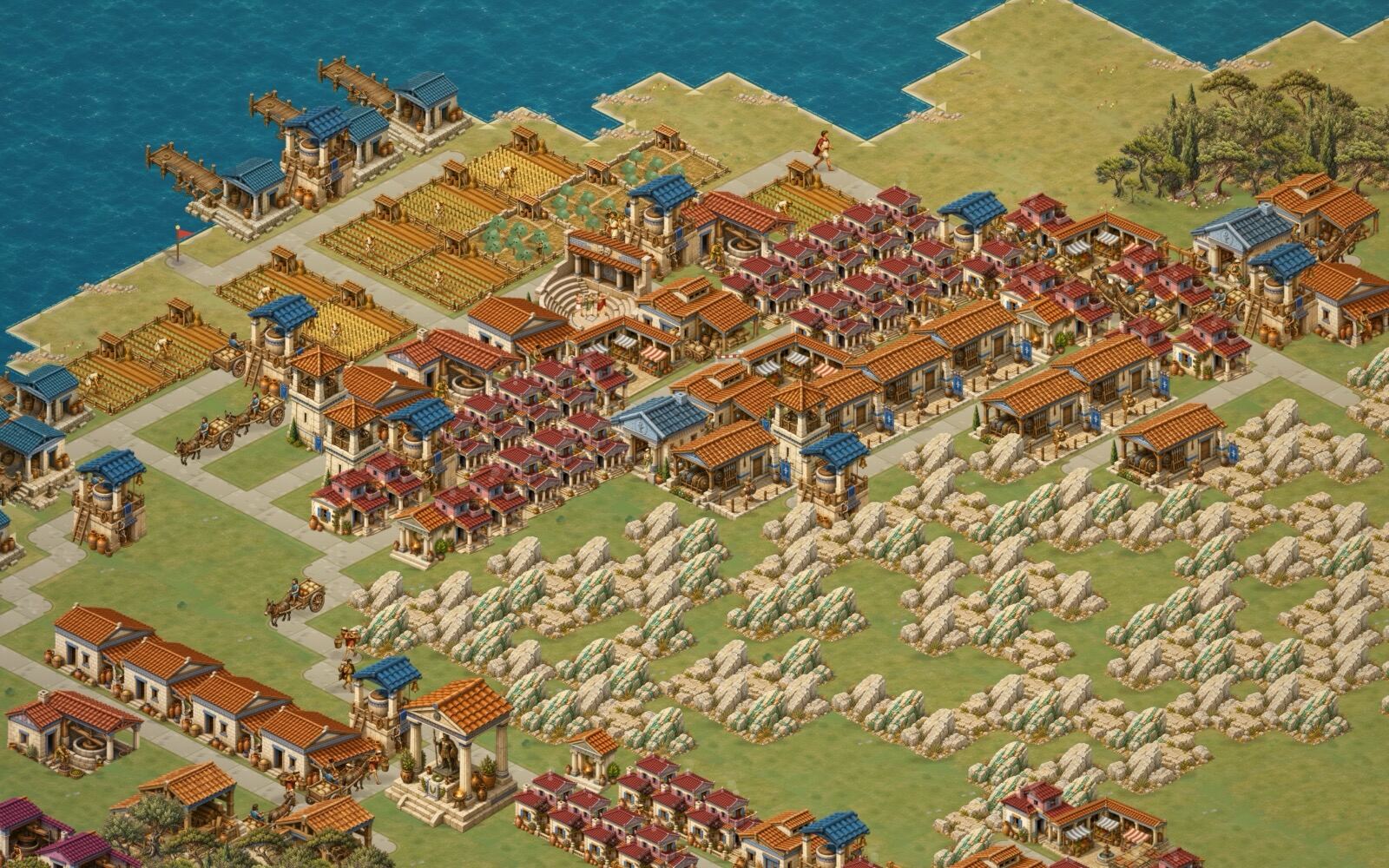
Cities of the Aegean
This is ours, so weigh it accordingly. We built it because of the gap described above.
It is an ancient Greek city builder that runs in a browser tab. You found a polis on an island or coast, lay roads, and the simulation runs on walkers in the Impressions manner: farm carts to granaries, agora vendors carrying food out along the roads to houses, and no other way for food to reach a home. Houses climb from huts to great estates as water, food, olive oil and fleece reach them, and slide back down when a district loses its market coverage.
Two things are ours rather than inherited. The first is the Mediterranean year: four seasons, with summer as the dead season when wheat nearly stops growing and winter closing the sea to all shipping. Farms that carried you through spring will not carry you through July, so banking a surplus is a planning problem rather than a background number. Fishing wharves work all year, which makes the coast strategically different from the inland meadows.
The second is the Aegean itself. Six rival cities sit on a chart you can open at any time. They trade with you at their own prices, demand tribute, raid you when relations sour, and fight one another whether or not you are involved. A neighbour you ignored for thirty game years can arrive having annexed two others. You can open trade routes, import grain by ship when your own harvest fails, send gifts, or raise hoplites and take a city by force.
And the mythological layer is here, as Greece is owed. Gods answer temples and then walk the streets in person, monsters come down on the city and have to be met by a named hero, and there is a story campaign running alongside the sandbox.
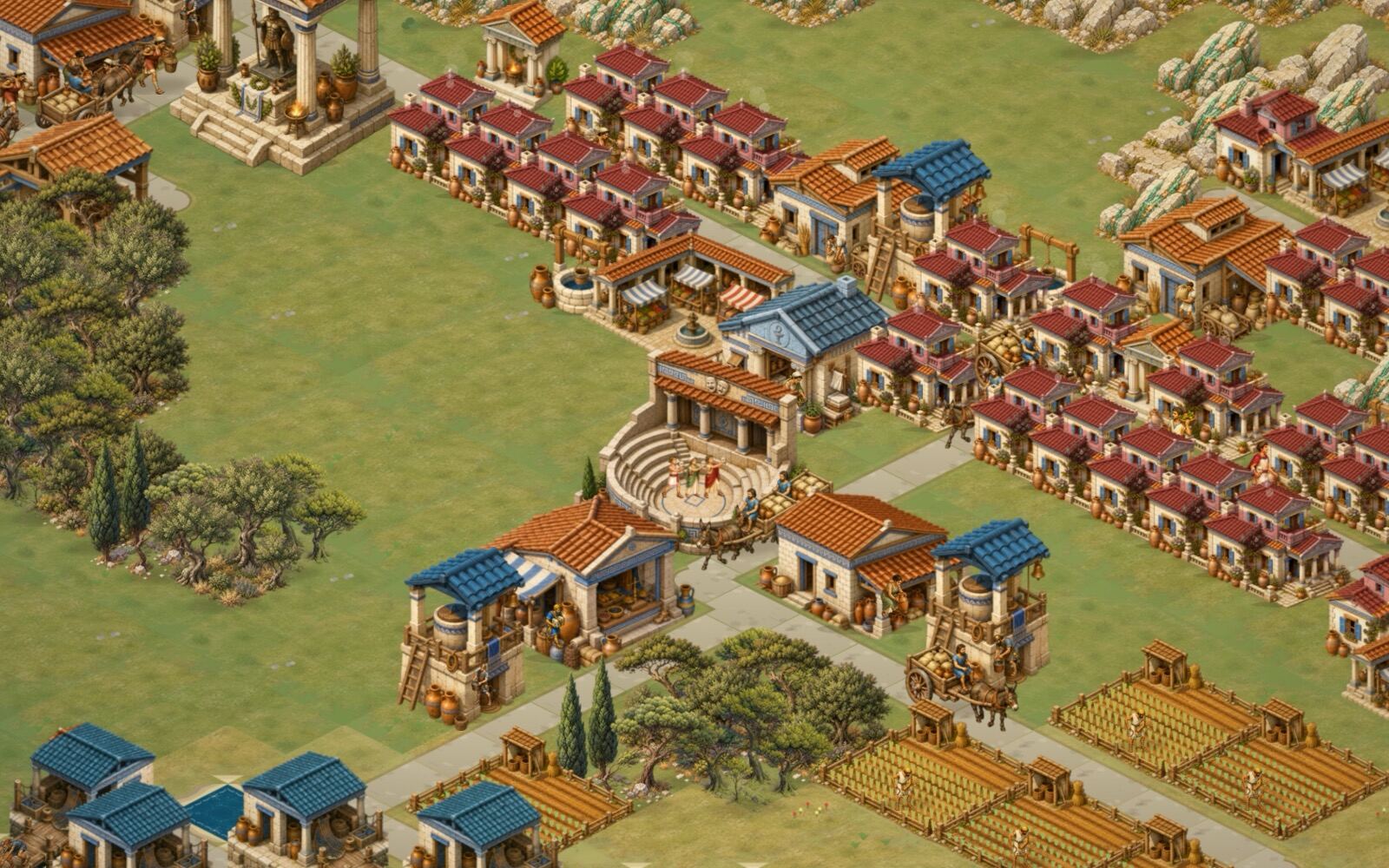
Ancient Greece in a browser tab. No download, no account to start.
The first fifteen minutes are free, then €4.99 + VAT once, forever.
Where to start
If you have never played one of these: Pharaoh: A New Era, because it is the same design with none of the 1999 friction.
If you played them at the time and want the real thing: Caesar III through Augustus, or the Zeus + Poseidon bundle.
If you want something made recently by people who love the same games: Nebuchadnezzar.
If you want Greece specifically, and you want it running in a browser tab tonight: that one is ours, and the first fifteen minutes cost nothing.