Multiplayer city builder games that actually work
Search for a multiplayer city builder and you get lists padded with games that are not city builders and city builders that are not multiplayer. The category really is that small, and the reasons it is small are more interesting than the lists.
City builders resist multiplayer at the level of the code, not at the level of the design. That is the part most recommendation articles skip, and it explains almost everything about which games managed it and how they had to compromise to get there.
Why there are so few
A city builder is a simulation of thousands of small agents making independent decisions every tick. A cart chooses a warehouse. A citizen chooses a job. A fire spreads to whichever roof happens to be nearest. Nothing about that is expensive on one machine. The trouble starts when two machines have to agree on all of it, forever, without drifting apart.
The standard answer is deterministic lockstep, which is what Factorio uses. Rather than sending the state of the world across the network, the game sends only player inputs and trusts every machine to simulate the identical outcome from them, sixty times a second. It works beautifully until one machine computes one value slightly differently, at which point the client desynchronises, disconnects, and has to pull down the whole game state to file a report. Factorio's own documentation is frank that mods, multithreading and floating-point drift are all live hazards, and Factorio is a game about belts and inserters running on a rigid grid. A city builder has messier agents and far more of them.
Then there is the clock. City builders are played at triple speed while you wait for a harvest and paused while you plan a district. Neither of those survives a shared session. Ubisoft's solution in Anno 117 was simply to remove speed controls in multiplayer, which is the honest engineering answer and still a real loss.
Session length is the third problem, and it is social rather than technical. A city is a fifteen hour object. Co-op means scheduling fifteen hours with another adult, or accepting that the city only advances when both of you are free. Real-time strategy solved multiplayer decades ago partly because a match of Age of Empires is over in twenty-five minutes and everybody starts from nothing. Add the fact that in a shared city anybody can bulldoze anything, and the genre's appeal, which is total authorship of one place, starts to work against the mode.
Retrofitting is close to impossible, which is why so many answers to the question sound the same. Raise it on the Workers & Resources: Soviet Republic forums and you get the standing reply that multiplayer has to be designed in from the first day, and that adding it to a finished simulation means writing the game again. Colossal Order gave a politer version of it about Cities: Skylines II in a 2023 question-and-answer session: adding multiplayer would take resources away from the core experience. That question is now moot in an unhappy way, because in November 2025 Colossal Order announced it was parting with Paradox after more than fifteen years, with Paradox's own Iceflake Studios taking over the game from 2026.
The cautionary tale everyone still remembers is SimCity in 2013, which built its whole design around shared regions and required an internet connection to play at all. The servers failed at launch, Maxis insisted for months that an offline mode was not technically possible, and then shipped one in Update 10 in March 2014. The lesson the genre took from it was not that multiplayer is bad. It was that multiplayer must never be the price of admission.
The co-op tier: real, and mostly recent
Anno 117: Pax Romana is the best of them, and it is not close. Ubisoft released it on 13 November 2025, and up to four human players can govern a single shared empire, pooling money, resources and territory, with one player running Latium while another runs Albion. The main campaign is playable co-operatively with up to three friends, which no previous Anno allowed. Competitive play supports up to four parties, human or AI, with alliances and naval war between them, and mixed team setups on top of that. Cross-platform play is supported.
The caveats are worth knowing before you buy it for a friend. There are no speed controls in multiplayer. There is no in-game chat, so you supply your own voice call. The save lives in the cloud and keeps only the most recent state, so any participant can carry the empire on alone and re-invite the others later, which is convenient and also means there is one authoritative timeline rather than a save each.
Tropico 6 (Limbic Entertainment for Kalypso, 2019) supports four players on one map, each running their own island, free to trade with each other or declare war. It is the oldest entry here that still works out of the box, and the simulation underneath is lighter than Anno's, which is part of why it could be done at all.
Kingdoms Reborn is the one built for multiplayer from the start: up to eighteen players on a shared world map, co-operative or competitive, medieval, with the walker-ish supply logic that fans of the genre want. The honesty note is the important one. It entered Early Access on 2 November 2020, its store page has for some time carried an estimate of a full release around mid 2025, and as of August 2026 it is still in Early Access. Reviews stay strong, around 89 per cent positive across roughly four and a half thousand of them, but six years is six years.
The mod tier, which is where most of it actually lives
Timberborn left Early Access on 12 March 2026 with no multiplayer, and the community built it anyway. BeaverBuddies is a free mod that puts players on the same map at the same time, each with their own camera and interface, the way Factorio or Stardew Valley handle it, and it has been kept current through the 1.0 release. It is a mod rather than a feature, so it carries the usual terms: it can lag behind a patch, and support is a Discord rather than a publisher.
Cities: Skylines has CSM, an open-source client-server mod that has been in development for years and was still being updated in March 2026. It synchronises most things, though not the movement of individual people and vehicles, which tells you how much simulation state a city builder generates. A sibling project, CS2M, is doing the same work for Cities: Skylines II and is earlier along.
Workers & Resources has a community multiplayer mod for up to four players with build syncing and an admin panel, which requires a mod loader and a virtual LAN to run. That is a fair summary of the state of the art: where the developers said no, someone spent a year of evenings saying yes anyway.
None of this is a criticism, since unofficial multiplayer is often the good stuff. It just means the answer to "can my friend and I play this" is usually "yes, after twenty minutes of setup".
The shared-world tier
Eco deserves its own bracket. It is not a city builder in the isometric, road-and-walker sense, but it is the most genuinely multiplayer civilisation game running: a server full of players building an industrial society together against an ecological budget and a meteor on a deadline, with a real economy, real pollution and actual laws that players write and vote on. Strange Loop Games shipped Update 14 on 6 August 2026 with pollution and recycling systems. If what you want from multiplayer is other people making decisions that constrain you, this is the one.
The colony sim neighbourhood is worth a look for the same reason, and we went through it in colony sim games. The design constraints there are close cousins of the ones described above.
The browser MMO tier, and what it really is
Search any variation of online city builder and the top results will be Grepolis, Ikariam and Forge of Empires. All three are alive and being updated in 2026, which is genuinely impressive. Ikariam launched in February 2008 under Gameforge, Grepolis in December 2009 under InnoGames, and Forge of Empires on 17 April 2012, also InnoGames. Gameforge still merges Ikariam servers to keep worlds busy, and Grepolis ran its World Masters tournament in August 2026.
Be clear about what they are. They are timer games. You queue a building, it completes in four hours, or you spend premium currency to skip the wait. The city is mostly a menu with a painting behind it, and the actual game is alliance politics, coordinated attacks and farming inactive neighbours. The multiplayer is completely real, and much sharper than anything on the co-op list. The city building is not. If you arrived from Zeus or Caesar III wanting a shared version of that, these will disappoint you in a specific and predictable way. We covered the category, including the good parts, in city builder games you can play in a browser.
The case for asynchronous
Look back over the list and the thing that breaks every real-time attempt is not the network. It is the shared clock. Determinism is hard because both simulations must run at once. Speed controls have to go because both players are inside the same tick. Sessions have to be scheduled because a paused city is a stalled game.
Take the shared clock away and the problems dissolve. Two cities, two separate simulations, each advancing when its owner is actually playing, with hostile and friendly acts passed between them as messages. Nobody desynchronises, because nobody is synchronised. You keep your pause button. The cost is that you cannot stand in the same street together, which for a genre about authorship is a smaller loss than it sounds.
Cities of the Aegean: Rival Archons
This is our game, so treat what follows accordingly.
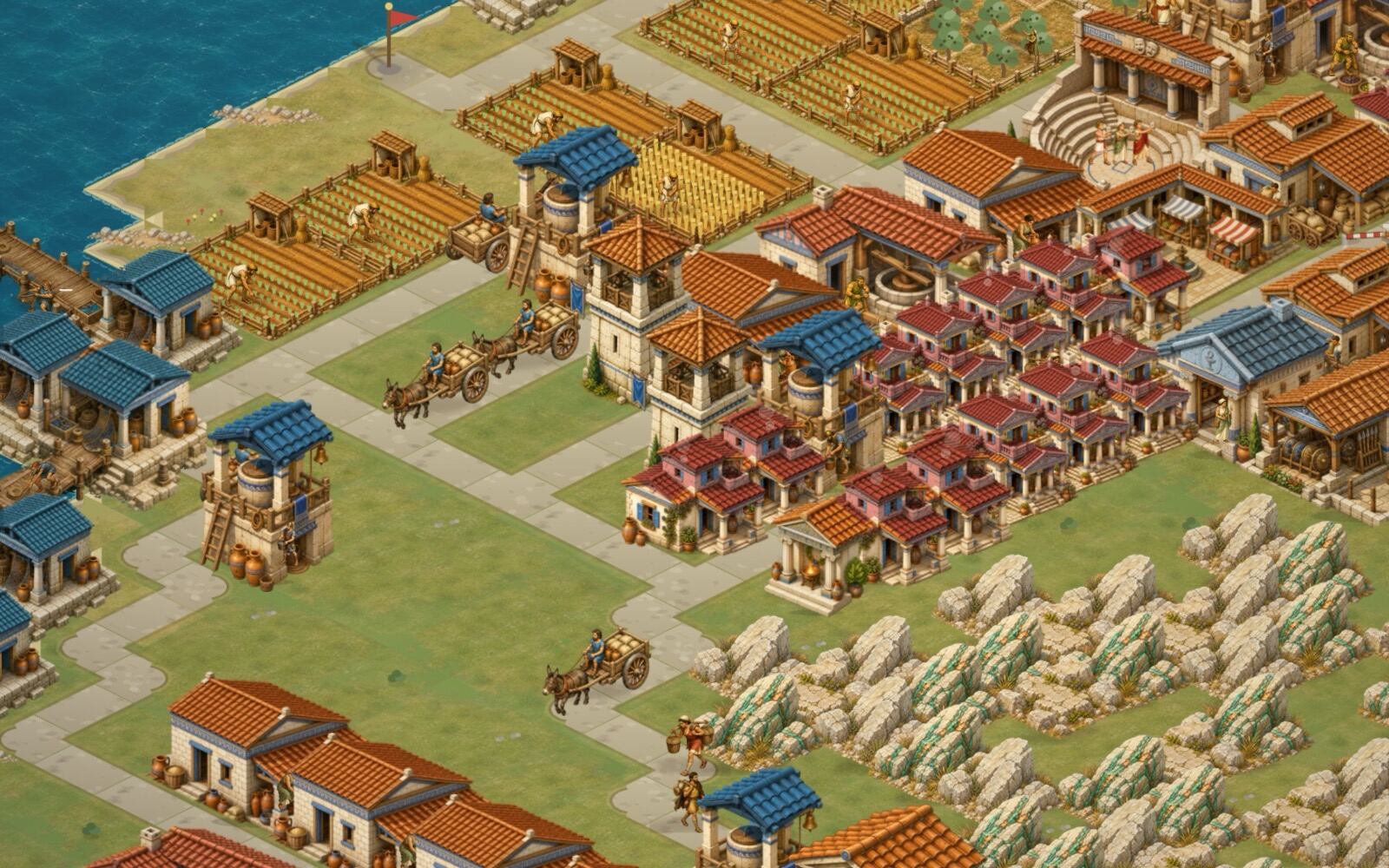
Cities of the Aegean is an ancient Greek city builder in the Impressions tradition, walkers and roads and granaries, which runs in a browser tab. Its multiplayer mode, Rival Archons, is the asynchronous design described above, and it exists because we could not honestly build the other kind.
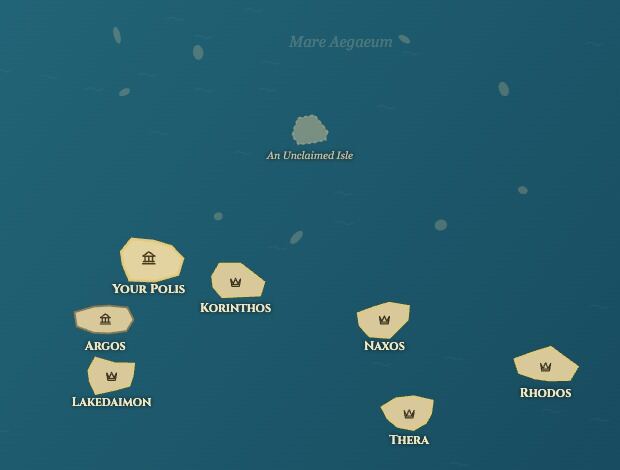
Two players found cities on the same island from an invite code. The opponent appears on your Aegean chart as another power, beside the six AI rivals who are still there trading, feuding and conquering each other while you fight. You can open a trade route to them and buy their surplus at their own asking price. You can send gifts. You can demand tribute with a deadline, and if it lapses your next raid carries a bonus for the insult. You can put hoplites on ships, and those raiders come ashore on your opponent's real beach and muster there before they march, which their towers and home guard get to answer. A full conquest expedition ends the match.
The clock is a chess clock made of game days rather than real hours. Each side gets an equal budget: Blitz is two years, roughly twenty-five minutes of play each, Standard is four years, Epic is eight and runs closer to a hundred minutes a side. Days burn only while your simulation is actually running, so nobody wins by having more free evenings. When both budgets are spent, score decides it: population, house levels, treasury, working temples, vassals taken. A builder and a warmonger can both win, which took some tuning to get right.
The limits are structural and we would rather state them than have you find them. There is no server running your city while you sleep, so nothing can happen to you offline. Hostile acts queue up and arrive inside your own simulation the next time you play, which means nobody ever logs in to a city that burned down on Tuesday. The client is authoritative, so matches are invite-by-code between people who know each other and there is no ranked ladder, and there will not be one on this foundation. It is one against one. It is not co-op, and two people cannot build the same city.
There is also a lighter kind of competition for people who do not want a war with a friend. The Games of Delos is a weekly challenge where every player in the world gets the identical island for one week, plays a capped number of years, and posts a single score to a leaderboard. It is the fairest comparison a city builder can offer, since the seed, the shore and the calendar are the same for everyone. Alongside it, the Hall of Cities lets a player publish a finished city that anyone can walk through, read the stockpiles of, and leave a laurel at. Touring costs nothing and changes nothing. The Games of Delos and Rival Archons are part of the full game; the Hall is open to everyone.
Rival Archons: found a city, send a friend the code, and settle it on the Aegean. It runs in the browser. No download, no account, no launcher.
The first fifteen minutes are free, then €4.99 + VAT once, forever.
The short version
If you want two people building one settlement together tonight, buy Anno 117: Pax Romana and accept losing the speed controls. If you want four players on separate islands trading and squabbling, Tropico 6 still does that well. If you want a proper competitive city builder and can live with a long Early Access, Kingdoms Reborn is the one built for it. If you already own Timberborn or Cities: Skylines, the mods are free and better than their reputation. If you want other people to be the actual difficulty, play Eco. If you want a browser tab and alliance warfare with build timers attached, the MMOs are there and they are honest about what they are.
And if the thing you actually miss is a friend across the sea rather than a friend across the desk, asynchronous is the format that survives contact with a real week. Ours is one attempt at it; we would happily see three more.
Further reading: the best city builder games for the wider field, city builders with combat if the war part is what interests you, and games like Zeus: Master of Olympus for the single-player tradition all of this grew out of.