The best medieval city builder games
The medieval shelf is the busiest it has ever been, which is good news and also makes choosing harder. The games on it are pulling in three different directions, and most recommendation lists never say which.
Before the individual games, the three directions, because they explain nearly every disappointed review you will read.
The first is the castle lineage, descended from Stronghold. The economy exists to feed an army and stock a keep; the payoff is a siege. Buildings are things you place so that later you can survive being attacked in an interesting way.
The second is the subsistence lineage, descended from Banished. There is often no enemy at all. The winter is the enemy, and the drama is a food graph. These games are the quietest and the cruellest.
The third is the manor lineage, which is the newest and the reason this category exploded. No grid, no zoning, plots of land laid out along a road as they actually were, and a simulation that cares where the ox is standing. Manor Lords and Foundation are both here and they are not the same game at all.
Almost every argument about a medieval builder comes from someone wanting one lineage and being handed another.
Manor Lords
The one that made this a category again. Grzegorz Styczeń, working as Slavic Magic, built it largely alone over several years, and it went into Steam early access on 26 April 2024 as the most-wishlisted game on the platform. It peaked at just under 160,000 concurrent players in its first day. On 27 August 2026 the publisher, Hooded Horse, announced it had passed four million copies sold.
What it does better than anything else is land. You do not zone a residential district; you drag out burgage plots along a road, each with a back garden whose depth you decide, and the depth determines what the family can keep there. Fields are drawn as irregular shapes across the terrain and rotated on a crop cycle. Oxen actually walk the timber to the site. The camera drops to ground level and the whole thing holds up down there, which very few builders can claim.
It is still in early access in August 2026, and that matters. The development has been steady rather than fast: Major Update #8 landed this month with a new Wide Valley map, cows and calves, oats, cider, mead, and cheese made at a new Cheesemonger from milk and salt. It also rebuilt construction, splitting buildings into basic and advanced tiers, adding a Construction Yard whose assigned professional builders raise build speed by half, and putting oxen to work hauling timber in bulk. Livestock now need feeding through winter or they die.
That is a substantial update. It is also, after more than two years, an update about cheese. The roadmap to 1.0 is public but carries no date, and the two features people most want, deeper diplomacy and real castle building, are still ahead of it. The combat, meanwhile, remains the weakest part: the battles are handsome and tactically thin, and the game is much better in the hours between them.
Buy it if the land simulation is what you want. Wait if you want a finished campaign.
Foundation
Polymorph Games spent six years in open alpha and early access before releasing Foundation 1.0 on 31 January 2025, and the long wait produced the most relaxed game in this list. There is no grid. You paint zones with a brush, drop monuments whose towers and wings you assemble yourself, and villagers thread paths between them that you did not draw.
The result is closer to gardening than to management. Its one real strategic decision is which of three estates to favour, labour, clergy or kingdom, because influence spent pleasing one makes progress with the others harder, and each opens a different set of monuments and trades. Nothing here will erase you for a bad winter. Foundation's critics are not wrong that the challenge is mild and that the mid-game can stall once the production chains are running.
Polymorph has kept working on it. A free quality of life update arrived in November 2025, and the first paid expansion, Harvest Festival, was announced in April 2026 with a reveal trailer this month. It adds animal husbandry, orchards, cider and a festival hosted at the tavern. It had not shipped at the time of writing.
Banished
Luke Hodorowicz released Banished on 18 February 2014, alone, and twelve years later it is still the reference point for the whole survival end of the genre. A wagon of exiles arrives in a valley. Nobody attacks you. Nobody ever will. You will still lose towns.
What makes it endure is the honesty of the failure. Every citizen is a person with a job, an age and a lifespan, and a town can die from a demographic mistake made twenty years earlier: you built too fast, everyone was born in the same decade, and now they all get old in the same decade and there are no adults left to work the fields. No event caused it. You did.
It shows its age in the interface and in the shallow tech tree, and the base game has never received a sequel. The Colonial Charter mod remains the standard answer to that, and it is a large answer. If you have never played Banished and any of this appeals, start here before you spend thirty euros on something newer.
Farthest Frontier
Crate Entertainment made Grim Dawn, which is not the background you would expect, and then made the most demanding survival builder currently in the genre. It left early access on 23 October 2025 having already sold over 1.2 million copies during three years of development.
Farthest Frontier is Banished with teeth added in every direction. Soil fertility depletes and has to be managed with crop rotation and fallow years. Water can be dirty. People get dysentery, and then they get it from each other. Raiders arrive on a schedule you can see and are still difficult. It is the only game here where the agricultural simulation is genuinely a system you must learn rather than a theme.
Crate has not stopped. Version 1.1 in April 2026 added a gridless build mode, which is a striking thing to add after release, along with a Guided Journey for new players and tools for managing many buildings at once. The difficulty remains the honest warning: the tutorial is better than it used to be and the early game will still humble you.
Going Medieval
Foxy Voxel launched this into early access on 1 June 2021 and released 1.0 on 17 March 2026, after selling more than a million copies along the way. The full release added Renown, grand objectives that give a campaign an ending, and a long tail of new roles and buildings.
It belongs on this list with an asterisk, because it is really a colony sim wearing medieval clothes. You have a handful of named settlers with moods, skills and grudges rather than a population statistic, and the building is fully three-dimensional: cellars, upper floors, a keep you dig into a hillside. If that sounds more appealing than laying out a town, the honest recommendation is to read the colony sim guide instead, because that is the shelf you actually want.
The Stronghold series
Firefly Studios have spent the last few years remastering their own back catalogue rather than extending it, and the results are the best versions of these games that have existed. Stronghold: Definitive Edition arrived on 7 November 2023 and Stronghold Crusader: Definitive Edition on 15 July 2025, the latter with new AI opponents, new units, larger maps, extra missions and co-operative multiplayer, rebuilt from the original artwork with several of the original developers and voice actors involved.
The design is from 2001 and it is not hiding. Your economy is a machine for producing bread, ale, weapons and men-at-arms, and the point of it is the castle you draw around it and the siege that comes for the castle. Nothing else in this list gives you the pleasure of a good gatehouse. Nothing else in this list has an economy this thin, either. Come for the walls, and go elsewhere if you want the town to be interesting on its own. We wrote about that trade-off in more detail in city builders with combat.
Crusader is the one most people mean, and the one with the endlessly replayable skirmish trail. The original is the one with the better campaign.
Kingdoms and Castles
Lion Shield's game came out on 20 July 2017 after a crowdfunding round that raised over $108,000 against a $15,000 goal, and it remains the gentlest medieval builder worth recommending. You build a town, a wall goes around it, vikings land and dragons turn up. It runs on almost anything, it is cheap, and a session lasts an evening rather than a month.
Reviewers were fair about the limits at the time: it is markedly less complex than the games around it, and once you understand the loop it does not have another one waiting. That is the point of it. As a first medieval builder for someone who has bounced off Manor Lords, or for a younger player, it has no real competition.
Norland
Long Jaunt and Hooded Horse put Norland into early access on 18 July 2024, and it is the strangest thing on this shelf. You do not play a town. You play a noble family, with named lords who have opinions about each other, marry, plot, drink, go mad and occasionally murder someone. The settlement underneath is a medieval colony sim, but the simulation the game cares about is the household at the top of it.
It is rough, and the developers are open that it is. The published roadmap for the second half of 2026 is about depth rather than polish: a unified event director in the manner of RimWorld's storyteller, a rebuilt world map, and internal politics that let you climb inside an existing kingdom as a vassal instead of always founding your own. Worth watching. Not yet worth recommending to someone who wants a city builder.
Bellwright
Donkey Crew's Bellwright went into early access on 23 April 2024 and passed a million copies by March 2026, with console versions following in June. It is a survival RPG first: you stand in the world in third person, swing the axe yourself, and recruit villagers who then run the settlement while you go and fight a war of rebellion.
Judge it as a city builder and it will disappoint you, because the town is a base rather than a subject. Judge it as the medieval game where you are a person rather than a cursor and it is doing something nothing else here attempts. The December 2025 update added trade caravans between outposts and a rebuilt fortification system, which suggests the settlement half is being taken more seriously over time.
Dawn of Man
Adjacent rather than medieval, and included because people who like this shelf usually like it. Madruga Works released Dawn of Man on 1 March 2019, and it runs your settlement from the Stone Age through to the Iron Age across thousands of years. The hunting is the best part: mammoths and aurochs on a migration route, brought down by a group of people who might not all come back.
The late eras thin out, and the game is more forgiving than Farthest Frontier by a wide margin. As a first survival builder it is a kinder door than Banished.
Games like Manor Lords, specifically
This is the search people actually make, so here is the direct answer, sorted by which part of Manor Lords you are chasing.
For the organic, gridless town and the pleasure of a settlement that looks hand-grown: Foundation. It is finished, it is calmer, and it is the closest visual and structural cousin.
For the survival pressure and the sense that the land is an opponent: Farthest Frontier, then Banished. Farthest Frontier is what Manor Lords would be if the farming were the whole game.
For the medieval warfare: Stronghold Crusader: Definitive Edition, and accept that the town is a supply depot. Manor Lords' combat is the part least likely to be fixed by waiting. If the battles matter more to you than the bread, our games like Age of Empires list is the better starting point.
For the lord rather than the ledger: Norland, if you can tolerate early access twice over.
There is no game that gives you all of it, which is why Manor Lords sold four million copies while unfinished.
What the medieval shelf tells you about the rest of the genre
Ten entries above, two of which only just qualify, and that is with the list already trimmed. Any of them will give you a decent week.
Now try the same exercise one civilisation earlier. The ancient world produced the games this entire genre is descended from, and its shelf in 2026 is close to bare. Rome has Caesar III and its open-source revivals. Egypt has Pharaoh and a good 2023 remake of it. Greece has Zeus: Master of Olympus, released in the year 2000, and after that essentially nothing. No remake, no successor, no open-source engine rebuild. We laid out the whole thin shelf in ancient city builder games, by civilisation, and went through the specific Zeus question in games like Zeus: Master of Olympus.
The medieval category has a crowd because Manor Lords proved there was money in it. The ancient category has a gap for no better reason than that nobody has walked into it.
Cities of the Aegean
This one is ours, so weigh it accordingly, and it is not medieval. It is the Greek entry on the empty shelf described above.
It is an ancient Greek city builder that runs in a browser tab, built on walkers in the Impressions tradition rather than on plots and land use. You lay a road, put a building beside it, and a person comes out and walks: farm carts hauling wheat to granaries, agora vendors carrying food out to the houses along their route, which is the only way food reaches a home. Houses climb from huts to great estates as water, food, olive oil and fleece reach them, and slide back down when a district loses its coverage.
The survival pressure that the Banished lineage gets from winter, we get from summer. The year runs in four Mediterranean seasons and summer is the dead season, when wheat nearly stops and the city eats what you banked in spring. Winter closes the sea to shipping, so a trade route is not a year-round solution either. Fire and sickness are real and are answered by a Fire Watch and an Infirmary rather than by a warning popup.
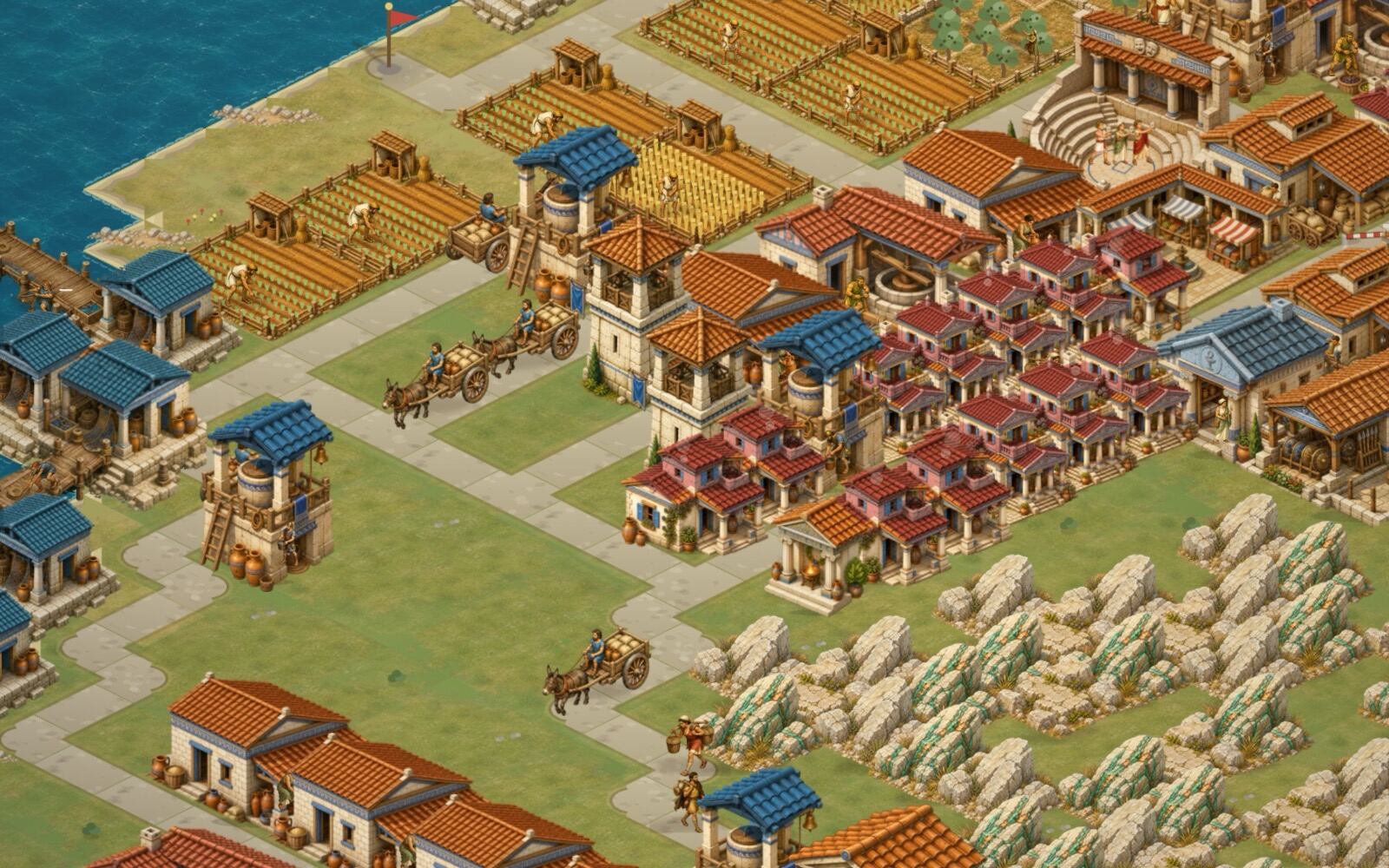
Six rival cities sit on a world chart. They trade with you at their own prices, demand tribute, raid you when relations sour, and conquer each other whether or not you are involved, so a neighbour you ignored for thirty years can arrive having swallowed two others. You can raise hoplites and march, ring the city with walls and towers, or buy the raid off. And because it is Greece, the gods answer their temples and walk the streets in person, monsters come down on the city, and a hero has to be called up to meet them.
It runs in the browser. No download, no account, no launcher.
The first fifteen minutes are free, then €4.99 + VAT once, forever.
The short version
If you want the best-looking medieval town and can live with early access: Manor Lords.
If you want to be beaten by farmland: Farthest Frontier, or Banished if you would rather be beaten by a classic.
If you want a finished, peaceful town to grow: Foundation.
If you want a castle and a siege: Stronghold Crusader: Definitive Edition.
If you want individual people with names and problems: Going Medieval or Norland, and read the colony sim guide first. A broader survey of the genre, medieval and otherwise, lives in the best city builder games.