The Impressions Games city builders, ranked
One studio, one engine, four games in four years, and then it stopped. The Impressions city builders set a template that nothing since has replaced, and the whole family is still on sale in 2026 for less than the price of a sandwich each.
Impressions Games was founded in 1989 by David Lester and worked out of Cambridge, Massachusetts. Lester sold it to Sierra On-Line in 1995, and the studio then passed with the rest of Sierra through Cendant and into Vivendi Universal. In 1998 it was the most profitable division of Havas Interactive, roughly twenty million dollars in net profit for the period, ahead of Blizzard Entertainment. In April 2004 Vivendi closed most of its development studios and Impressions was one of them.
Between those two dates it shipped the run of games this article is about. The earlier Caesar (1992) and Caesar II (1995) belong to the studio's history but not really to this lineage: they split the province map from the city map and simulated at a distance. The family proper begins in 1998, when the studio rebuilt everything around one idea.
What the ranking is actually measuring
The idea is the walker. You lay a road, you put a building beside it, and a person comes out and walks. Whatever they pass, they serve. A prefect walks and the houses on his route stop burning down. A market trader walks and the houses on hers get fed. Nothing is delivered by an invisible hand and no service is a global number, so every function in your city has a geography, and every failure has an address you can go and look at.
David Lester's own account of the change was that the team wanted to add a sense of randomness to the city. What they got was something stranger and better: a simulation you debug by watching. When a district in one of these games starves, the fix is never to build more granaries. It is to follow the cart driver and find out where he turns left. So the ranking below is about how much each game understood its own central mechanic, and how well the result reads twenty-odd years on.
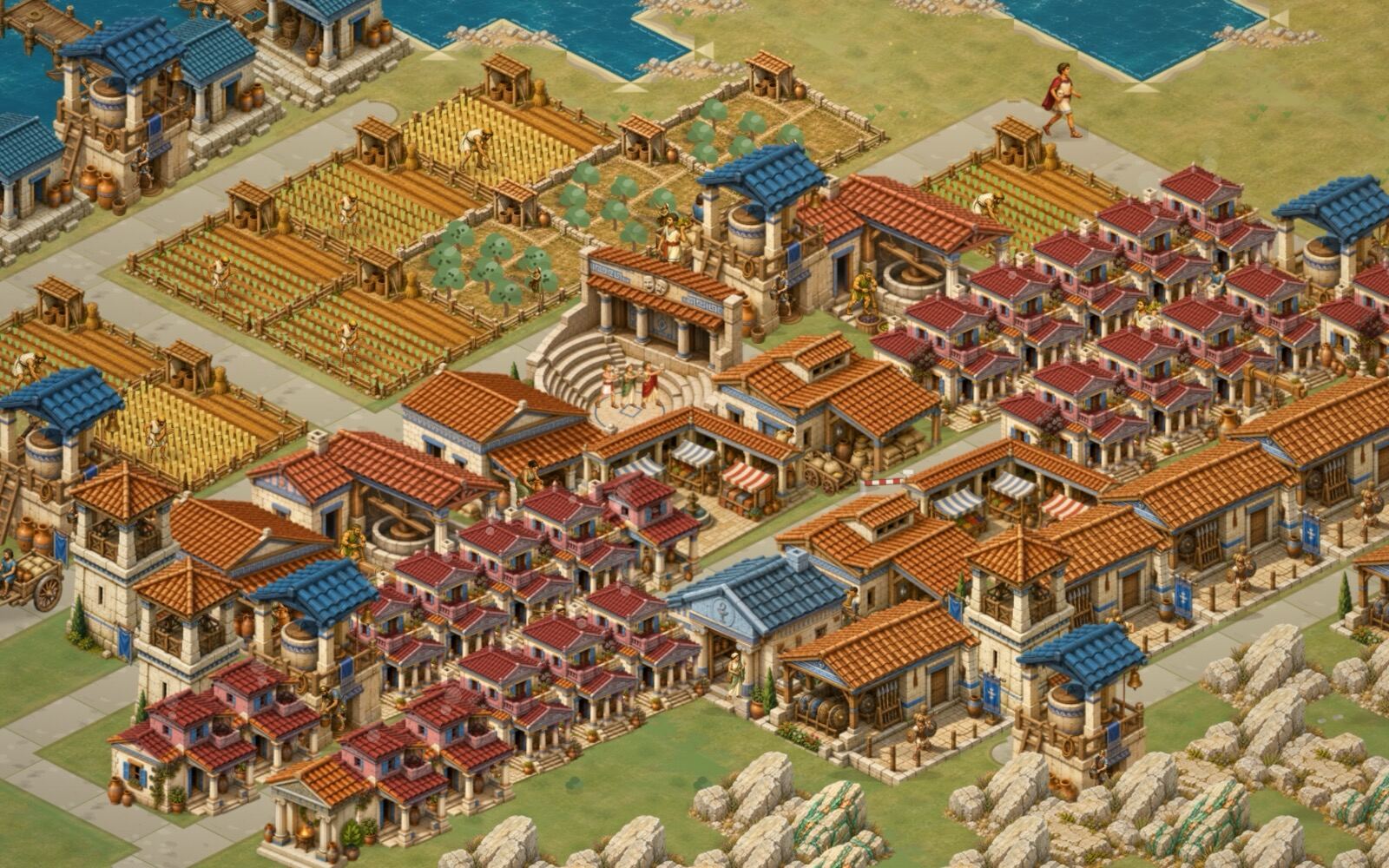
Fifth: Caesar IV (2006)
Caesar IV is the odd one out, and the reasons are worth stating plainly rather than treating it as a black sheep.
It was not made by Impressions. It could not have been: the studio had been shut for two years by the time it shipped on 26 September 2006. It was made by Tilted Mill Entertainment, founded in 2002 by Impressions' lead designer and general manager Chris Beatrice, business manager Peter Haffenreffer and designer Jeff Fiske, and published by Sierra. So the people are broadly the right people, working four years later on a different engine, for a company with different pressures.
The engine is the real break. Caesar IV moved to full 3D with a free camera, and let you place buildings and roads at forty-five degrees to the grid. That sounds like a small liberty and it is not: the fixed isometric grid was the thing that made the older games legible at a glance. A city you can rotate is a city you have to re-read every time you move.
Reception settled at 74 on Metacritic, which is a fair summary of the argument. Reviewers liked the volume of content and the look, and complained about crashes, interface friction, lag and repetition. It is more forgiving than Caesar III, and whether that is an improvement depends entirely on whether you thought the punishment was the point.
How to play it today: Caesar IV is on both Steam and GOG, patched to 1.2, and it installs and runs without ceremony. There is no community engine for it and there does not need to be. If you have never played any of these games, do not start here.
Fourth: Emperor: Rise of the Middle Kingdom (2002)
The last one, and the most under-discussed. Emperor shipped on 10 September 2002 in North America and 11 October in the UK, developed by BreakAway Games together with Impressions and published by Sierra. BreakAway had already built the Cleopatra expansion for Pharaoh, so the hands were experienced ones. It landed at 77 on Metacritic with IGN at 8.8, which is a good score for a game most people have never installed.
It added two things of substance. The first is feng shui: building placement now has an auspicious and an inauspicious version, shown to you as a green or yellow footprint before you commit, and getting it wrong drags on your city's rating and on how much good your homages to heroes do. Players are split on it to this day, and both camps are right. It stops you reusing the same district stamp on every map, and it also penalises you for putting a needed building where the space actually is.
The second is a religious layer that is genuinely its own: offerings to ancestral heroes and figures drawn from Chinese philosophy, Daoism and Buddhism, warding off disasters or buying benefits. Add monument construction on the scale of Great Wall sections and canals, and the first multiplayer mode the series ever had, and it is not a thin sequel.
It ranks fourth because the most common review line at the time was that there was little difference between it and the previous Impressions games, and that line has not softened. It is the game to play when you have played the other three and want more.
How to play it today: this one is awkward. Emperor is not on Steam, and has not been, apparently for rights reasons. GOG has it DRM-free for a little over five euros, frequently halved in a sale, with Windows 10 and 11 listed as supported. There is no open-source engine for it, so what GOG sells you is what you get.
Third: Pharaoh + Cleopatra (1999)
Pharaoh arrived in November 1999, thirteen months after Caesar III, from the same studio and the same publisher, on the same engine. On paper that is a reskin. In practice it is the entry that proved the formula could carry a second civilisation, and it did it by giving the map a clock.
The Nile floods. Floodplain farming is enormously productive and only in season, irrigation ditches raise fertility, and the flood cycle turns the year into a rhythm you plan around instead of a flat background. Everything downstream of that decision is better for it. Pharaoh also added hunting, naval combat with transports and warships, and monument construction, which is the part people remember: a pyramid is not a progress bar, it is a worksite your own labourers crawl over for years.
The expansion, Cleopatra: Queen of the Nile, was built by BreakAway Games and released in July 2000, carrying the campaign into the Hellenistic period. It is bundled with the base game everywhere it is sold and there is no reason to play without it.
It ranks below Zeus for one reason: it is the least forgiving game in the family after Caesar III without being as sharply designed. The commodity chains are long, the housing demands are wide, and a lot of the difficulty comes from bookkeeping rather than from geography. That is a matter of taste, and plenty of people would put it first.
How to play it today: more options here than anywhere else in the family. Pharaoh + Cleopatra is on GOG at around nine euros list and on Steam at €9.99, both DRM-light or DRM-free and both running on modern Windows.
There is also Pharaoh: A New Era, the full remake by Triskell Interactive for Dotemu, released on 15 February 2023 with rebuilt art, modern resolutions and the interface repairs the original never got. Critics liked it. Players were harder on it at launch, which had real bugs, including save corruption and monuments that stalled with every requirement met. Triskell has patched it steadily since, update 1.5.0 added a mission editor, and it now sits at Mostly Positive on Steam across more than five thousand reviews. In 2026 it is a good game with a bad first year behind it.
On the open-source side, two projects are working on Pharaoh and neither is finished. Ozymandias began as a Pharaoh fork of the Julius and Augustus engines and is now being rebuilt in Godot; Akhenaten continues the original C++ line and will load your Pharaoh saves and play the early campaign missions. Both need the original game files, both ship unstable builds rather than releases, and neither is at the standard Caesar III enjoys.
Second: Zeus: Master of Olympus + Poseidon (2000 and 2001)
Zeus shipped on 16 October 2000 in North America and 17 November in Europe, and it is the friendliest game the studio ever made. Metacritic 87, IGN 9.1, Eurogamer 9. Two years of watching people bounce off Caesar III and Pharaoh went into it, and the result is the entry we point newcomers at.
The streamlining is real and specific. Ordinary housing wants one food type plus fleece and olive oil, rather than Pharaoh's two foods and pottery and beer and linen. The campaign stopped being a chronological tour of unrelated cities and became one parent city built across many missions, with colonies founded to supply what the homeland lacks. Worship was reorganised around sanctuaries to the twelve Olympians, each of them buying you a service.
And then the part nobody else has matched. The gods are not a modifier. They arrive, walk your streets and do things, and so do the monsters, which function as the game's natural disasters, and so do the heroes you house and equip in order to kill them. It is the only game in the family where the setting is load-bearing rather than decorative. We wrote about the whole appeal at length in games like Zeus: Master of Olympus.
It is second rather than first because the simplification has a cost. The economy asks less of you than Caesar III's does, the campaign is gentler throughout, and the war layer was the weakest part of the game at release and remains so. Zeus is the better time. Caesar III is the better machine.
Poseidon: Master of Atlantis followed on 25 June 2001, adding the Atlantis material and an adventure editor, and is bundled with the base game in every edition sold today.
How to play it today: the Zeus + Poseidon bundle is on GOG at around nine euros and on Steam at €9.99, published now by Activision, who ended up with the Sierra catalogue. The GOG release carries their preservation marking with Windows 10 and 11 validated, so it installs and runs.
There is now an open-source engine, which there was not two years ago. eZeus is a reimplementation that reads your original Zeus and Poseidon files and plays the original adventures, with optional extras including an alternative walker system and the ability to build two cities at once. Be clear-eyed about it: the author says outright it is not an exact copy, only English and Polish game files are supported because of font glyphs, and prebuilt binaries are Windows-only, so Linux and macOS mean compiling it yourself. A fork called Olympus adds interface conveniences on top. This is a much younger effort than Augustus and not yet the default way to play Zeus. It is, though, the first time the answer to "is anyone rebuilding Zeus" has been yes.
First: Caesar III (1998)
Released 30 September 1998 for Windows and the following June for Mac, and still the reference point the genre is measured against.
Caesar III is where the walker arrived, and it is also where combat and city building were finally put on one map instead of two, which sounds like a UI decision and is actually the reason the sieges land. Everything else in the family is a variation on what this game settled: water and food and religion and entertainment and health as separate walking services, housing that climbs and falls as those services reach it, and a career mode that forks between peaceful assignments with strict victory conditions and military ones that will burn your city down.
It sold about 150,000 copies in its first month and passed 400,000 worldwide by January 1999; Lester has put the lifetime figure at roughly 2.5 million. PC Zone gave it 92, PC Gamer UK 87 per cent, IGN 8.7. GameSpot's 7.9 is the outlier and reads oddly now.
What holds up is the discipline. Caesar III is stingy in a way modern builders are not: labour is scarce, the map is small, and the difference between a working district and a dying one is frequently one road tile. What does not hold up is the combat, which is fiddly and never quite worth the attention it demands — a complaint that follows the whole family and one we have opinions about in city builders with combat.
How to play it today: buy it, then play it through a community engine.
The original is €5.99 on Steam and similar on GOG, and it does technically run. It is also 640×480 with an interface built for a manual you no longer have. Augustus is the answer: an open-source reimplementation that reads your original game files and gives you widescreen, zoom, roadblocks, market special orders, a global labour pool, partial warehouse storage and raised game limits, with builds for Windows, Linux, macOS, Switch, Vita and Android. Your Caesar 3 install needs patching to 1.0.1.0, and one caveat is worth knowing: Augustus loads older saves, but its own will not open in Caesar 3 or Julius, so the migration runs one way. Julius is the stricter sibling, the same porting work with no gameplay changes at all. Our fuller argument for both is in games like Caesar III.
Where the people went, and where the design went
The family ended in 2002 and the studio ended in 2004, but the staff list scattered into places worth tracing.
Chris Beatrice, Peter Haffenreffer and Jeff Fiske founded Tilted Mill in 2002 and made Immortal Cities: Children of the Nile (November 2004, published by Myelin Media) before Caesar IV. Simon Bradbury, David Lester and Eric Ouellette, who had met at Impressions, founded Firefly Studios in August 1999 and made Stronghold in 2001 — which is why the castle economy in that series feels like a cousin of this one, and why Firefly is still shipping, with Stronghold Crusader: Definitive Edition arriving on 15 July 2025.
The design itself went two ways. One is preservation: Julius and Augustus for Caesar III, Ozymandias and Akhenaten for Pharaoh, eZeus for Zeus, plus Dotemu's official Pharaoh remake. The other is continuation, and it is much thinner. Nebuchadnezzar (Nepos Games, 17 February 2021) is the most serious new game in the tradition: Mesopotamia, walkers, real supply chains, and monuments you lay out block by block instead of watching a bar fill. It is small and its interface asks more of you than it should, and it is made by people who obviously loved the same games you did.
That is a short list for a design this influential, which is the whole reason we are here.
Cities of the Aegean
This is our game, so weigh what follows accordingly.
We built it because we wanted the Impressions loop in a browser tab with no launcher and no install. Roads carry walkers, walkers carry goods, coverage is geographic. Farm carts haul wheat to granaries, agora vendors carry food out to houses (no household ever fetches its own), and houses climb from huts to great estates as water, food, oil and fleece reach them — then fall back down when a chain breaks. The signature failure is the Caesar III failure: a district starving beside a full granary because nothing walks to it.
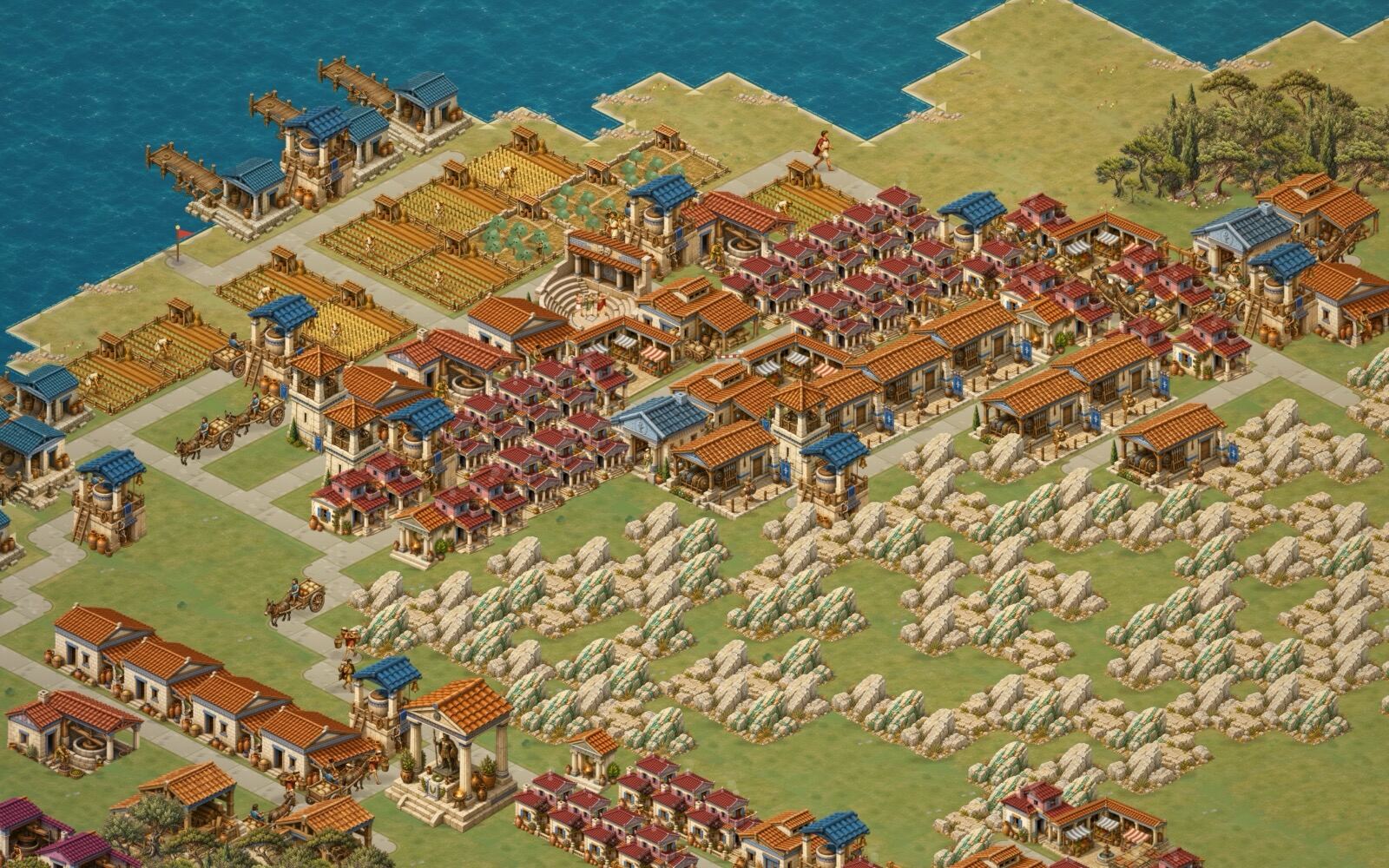
Some of it is ours rather than borrowed. The year runs in four Mediterranean seasons and summer is the dead season, so banking a surplus is a real strategic problem rather than a background number. Six rival cities sit on an Aegean chart, trade at their own prices, demand tribute, and fight each other whether or not you are involved. Gods walk the streets when their temples are honoured, monsters come for you, and heroes are called up to answer them.
What you should know before clicking: it runs on your machine rather than a server, there are no timers, and it is smaller than any boxed game above. If you want a hundred hours of campaign, Augustus and Pharaoh: A New Era are the honest answers.
It runs in the browser. No download, no account, no launcher.
The first fifteen minutes are free, then €4.99 + VAT once, forever.
The short version
- Never played any of them. Zeus + Poseidon, about nine euros, on Steam or GOG.
- Want the best of them. Caesar III on GOG or Steam, played through Augustus.
- Want 1998 untouched. Same purchase, played through Julius.
- Want the modern remake. Pharaoh: A New Era, with the caveat that its first year was rough.
- Want the one you skipped. Emperor: Rise of the Middle Kingdom, GOG only.
- Want the sequel nobody agrees about. Caesar IV, Steam or GOG.
- Want something new in the tradition. Nebuchadnezzar, or ours in a tab.
Further reading: ancient city builder games by civilisation covers Rome, Egypt, Mesopotamia, China and Greece in more depth, Zeus: Master of Olympus is a closer look at the one we owe the most to, and the best city builder games puts this family next to everything else worth your evening.