Poseidon: Master of Atlantis, the Master of Olympus expansion explained
Both stores that sell Zeus: Master of Olympus today include its 2001 expansion, so buy Zeus now and you get Poseidon: Master of Atlantis with it. This guide covers what the expansion adds, how its Atlantis differs from Zeus's Greece, which order to play its six adventures in, and whether it deserves your evenings.
Poseidon: Master of Atlantis came out in North America on 25 June 2001, eight months after Zeus, and scored 84 on Metacritic. Impressions Games made it as an expansion that needed Zeus installed. It takes the game to Atlantis, drawn from Plato's account, with a second people to play and an economy of their own, and it put the adventure editor in the box, which had already been a free download. Today it comes with the base game: Steam sells the pair as Zeus + Poseidon and GOG as Zeus + Poseidon (Acropolis), one install at $9.99 in the US when we checked on 20 October 2026. Which store to choose, and how to make it run well on a modern PC, is covered in our Zeus: Master of Olympus guide. This page is about the expansion itself.
What Poseidon: Master of Atlantis adds
Most of what is new belongs to the Atlanteans, the second people the expansion introduces. The two Greek adventures keep the old economy, though Proteus and Bellerophon brings in Hera, Bellerophon and the Chimera.
| Addition | What you get |
|---|---|
| Adventures | Six: four played as Atlanteans, two as Greeks. A seventh, Rich Man's Blues, was a separate download. |
| A second people | The Atlanteans, whose houses advance on science instead of culture, with spearmen, charioteers and archers on land and frigates at sea. |
| Science buildings | Bibliotheke, Laboratory, Observatory and Museum, plus a University and an Inventors' Workshop for training. |
| Gods | Hera, with the Orchard of Hera, and Atlas, with the Pillar of Atlas, for fourteen in all. |
| Heroes | Atalanta and Bellerophon, for eight in all. |
| Monsters | The Sphinx, the Chimera, the Harpies and Echidna. |
| Materials | Orichalc, mined and then refined; black marble, from its own quarry; oranges, grown in orchards and traded. |
| Hippodrome | A race track you lay out yourself, which earns drachmas every month. |
| Pyramids | Atlantean monuments of marble and orichalc, raised by artisans. |
| Adventure editor | In the box, for building your own scenarios. |
The Atlantis campaign: how it plays differently from Greece
The biggest change is what makes a house grow. In the four Atlantean adventures, houses advance on access to science instead of culture. The Bibliotheke sends out scholars and the Laboratory sends out inventors, who train at an Inventors' Workshop; the Observatory and the Museum send out astronomers and curators, who train at a University. A working Museum also gives the whole city a bonus, as a Stadium does in Greek adventures. The house names stay the same (Homestead, Tenement, Townhouse and Residence all turn up as Atlantean goals), so the block planning in our Zeus housing blocks guide still applies, with science venues in the middle of the block where the culture venues would go.
Do not expect a neat one-for-one swap. The sources disagree even on the simplest version of it: GameVortex's review has the Bibliotheke standing in for the gymnasium, while Zeus Heaven's points table scores it like the podium. Treat the four science buildings as a set and plan for all of them.
The army and the supply chain change as well. Atlantean elite houses supply spearmen and charioteers where Greek ones supply hoplites and horsemen, common housing turns out archers, and the fleet is frigates rather than triremes. Orichalc is mined, refined and spent on pyramids and on the Citadel of Poseidon, which Zeus Heaven describes as the Atlantean form of Poseidon's sanctuary (Greek cities raise the Promontory of Poseidon instead). Black marble comes from a quarry of its own.
Then there are the two big building projects. The hippodrome is a race track you lay out yourself. It pays drachmas every month, more the longer you build it, though a very long one breeds unrest. Pyramids are raised by artisans from marble and orichalc, and Zeus Heaven's list of them runs from the Modest Pyramid through Monuments to the Sky and shrines to individual gods up to the Pyramid of the Pantheon and the Temple of Olympus. GameVortex's review adds that they make the land around them more attractive.
Room is tight in places. Impressions' official walkthrough for Birth of Atlantis describes a central island inside two rings of land, names fitting enough housing onto so little ground as the main challenge, and advises building as little as possible on the inner ring: the last episode wants a hippodrome there, and the walkthrough rates it the hardest goal of that final episode. The walkthrough for Life in the Mediterranean says much the same about building room in its home city, Lixus.
The two Greek adventures play by the old rules: Greek culture buildings, hoplites, horsemen and triremes, and no science buildings at all.
The new gods, heroes and monsters
Hera's sanctuary is the Orchard of Hera, which arrives with its own orange trees. She is also the one god who can stop Zeus, which matters in a game where an angry Zeus smashes buildings. Atlas has the Pillar of Atlas, and his blessing speeds up work on a sanctuary or a pyramid; in Life in the Mediterranean he also sets the quest to widen the strait, which only Hercules can do. Zeus Heaven's sanctuary guide covers the rest, tempers included: an angry Hera turns people into cows, and an angry Atlas turns them to stone.
The two new heroes split the four new monsters between them. As in the base game, a hero comes only once you have built a Hero's Hall and met its list of goods and conditions. In Proteus and Bellerophon, Impressions' walkthrough has Bellerophon asking for 24 amphorae of wine, 24 bars of bronze and 15 horses.
| Monster | God it serves | Hero who defeats it |
|---|---|---|
| Sphinx | Hera | Atalanta |
| Chimera | Atlas | Bellerophon |
| Harpies | None | Atalanta |
| Echidna | None | Bellerophon |
If the monsters are what drew you in, our guide to Greek mythology games covers other games built on the same stories.
The six adventures, in a sensible play order
Play them in the order Impressions listed them. Birth of Atlantis teaches the Atlantean economy from scratch, and Two Worlds Collide, which Impressions' own walkthrough calls "a very difficult Adventure", belongs at the end. The one change worth considering is moving Proteus and Bellerophon to the front: it introduces Hera and Bellerophon under the Greek rules you already know, so you meet the new myths before the new economy.
| # | Adventure | Played as | Episodes | What to expect |
|---|---|---|---|---|
| 1 | Birth of Atlantis | Atlanteans | 9 | You build Atlantis itself on a central island ringed by land. Room is the problem, so build as little as you can on the inner ring: the last episode wants a hippodrome there. |
| 2 | Enlightenment in the West | Atlanteans | 7 | A transatlantic trading adventure. You found three colonies, chosen from four, and the walkthrough suggests taking Copan or Biminis first. |
| 3 | Life in the Mediterranean | Atlanteans | 6 | Cramped Lixus, Atlas's quest to widen the strait with Hercules, colonies at Saqqara and Syracuse, and a plague to finish. |
| 4 | Atlantis Reborn | Atlanteans | 8 | Rebuilding Atlantis with money short at the start, then conquest after conquest: Carthage, Argos, Memphis and Mycenae among them. |
| 5 | Proteus and Bellerophon | Greeks | 7 | Greek rules, a Sanctuary to Hera, and a Chimera at large well before Bellerophon can be summoned. |
| 6 | Two Worlds Collide | Greeks | 8 | A Greek war against Atlantis that ends with Zeus's retribution and the fall of Atlantis. Save it for last. |
There is also a seventh adventure, Rich Man's Blues. Sierra Help's pages describe it as a download-only extra for Poseidon owners, played from the Custom Adventures menu, and Zeus Heaven hosts a fan walkthrough of it. We could not confirm whether today's Steam and GOG builds include it, so do not count on it.
Is Poseidon worth it?
As a purchase the question has gone away, because both stores sell it with Zeus. As a use of your time, yes, once you have had your fill of Greece. Critics scored it 84 on Metacritic, three points behind Zeus, and it adds a second campaign's worth of play (six adventures, about 45 episodes by our count) with an economy that makes you rethink housing, materials and the army.
Two caveats. War was the part of Zeus that critics liked least, and Poseidon does not avoid it: Atlantis Reborn and Two Worlds Collide hand you long lists of cities to conquer. And on a modern PC the hippodrome's crowd animates far too fast, which no patch fixes. Neither is a reason to skip the expansion.
Before or after the Greek campaign?
After. The Atlantean adventures change what makes a house grow, what your soldiers are and what your workshops need, all at once, and Zeus already has a steep first hour. Play the Greek adventures until you can lay out a city without thinking about it, which is the same advice our Zeus: Master of Olympus guide gives, then sail for Atlantis. If you want a halfway step, start Poseidon with Proteus and Bellerophon, which keeps the Greek rules.
Poseidon cheats
The expansion uses the same cheat box as Zeus: press Ctrl + Alt +
C during play, then type the code exactly as printed, capitals and spaces included.
Sierra Help and Gameswelt file a few codes under Poseidon, among them Seasick, which
multiplies the fish in your granaries tenfold, and our
Zeus: Master of Olympus cheats page has the
full table, including the spellings that sources disagree on.
Cities of the Aegean, a Greek city builder in a browser tab
Our game, so read this with the appropriate scepticism.
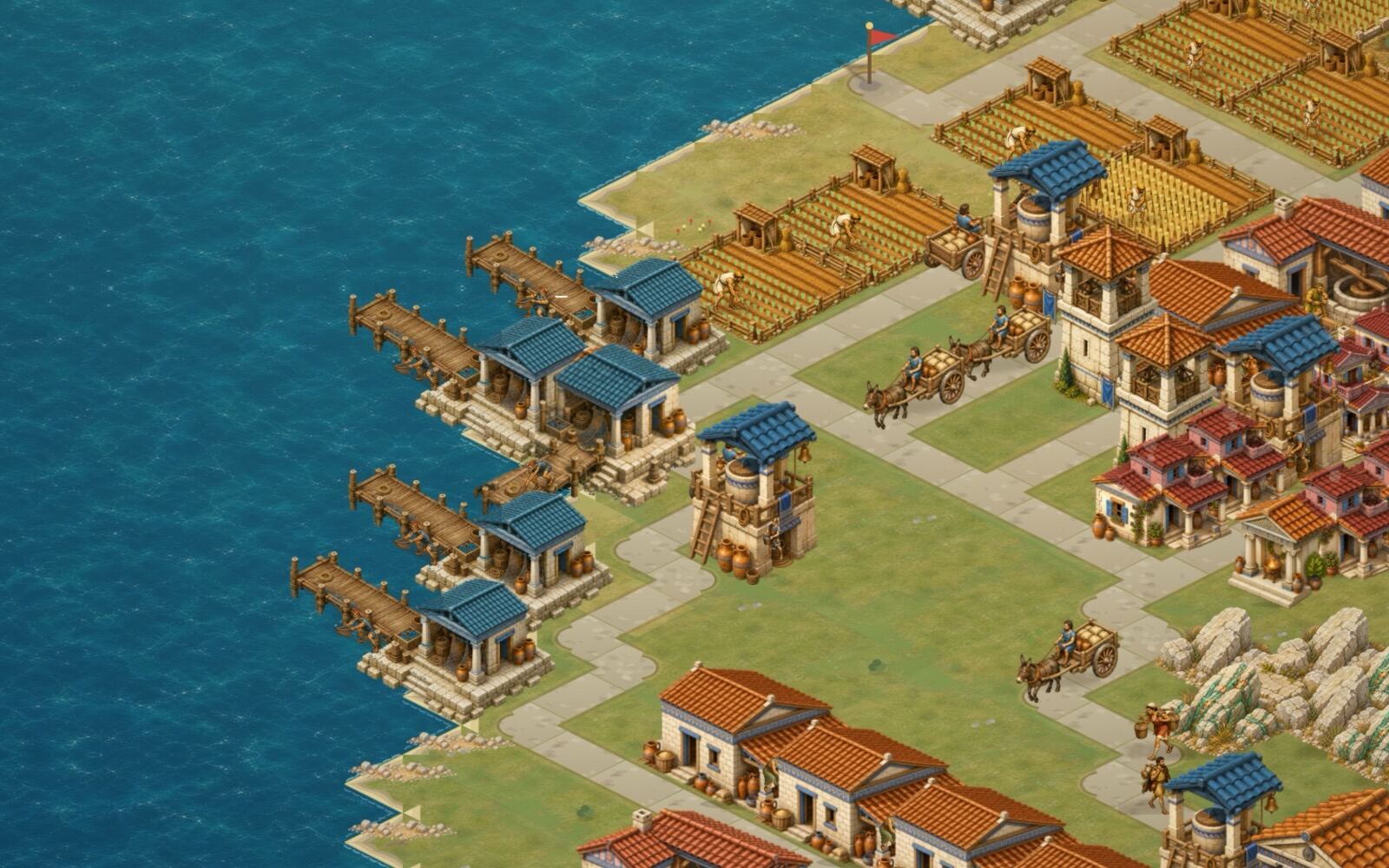
We built Cities of the Aegean because we wanted the Zeus loop without an install, a launcher or a compatibility layer, and it runs in a browser tab. You found a polis on an Aegean shore and lay roads, and walkers do the work: farm carts haul wheat to granaries, and agora vendors carry food out to the houses they pass. Houses climb from huts to great estates as water, food, olive oil and fleece reach them, and slide back when a supply breaks. The characteristic failure is the Zeus one, a district starving beside a full granary because nobody walks that far.
Poseidon has a temple, one of eight for the Olympians, and his has to touch the sea. Like the others it goes up as a construction site that porters keep supplied with timber, marble and bronze sculptures, and once it is finished and staffed his favour makes the fishing wharves haul more. He also walks your streets with his trident, closing with raiders and driving monsters out of the city. His temple arms an invocation too, the Sea's Wrath: pay the silver, point at the water or the sand beside it, and the sea takes raiders off the beach, after which he will not answer again for more than a month.
Monsters arrive from the middle of the third year, a Minotaur first, then a Cyclops, a Gorgon and the Hydra, and the answer is a hero summoned through a Hero Shrine, as it was in Zeus. Around that runs a four-season year in which summer is the dead season, and six rival cities that trade, feud and conquer each other.
There is no Atlantis in it, and it is small next to a studio production. You get the same walker grammar in a tab, with nothing to install and nothing to configure. For the wider field, our list of games like Zeus: Master of Olympus covers the alternatives, ours included.
It runs in a browser tab. No download, no account, no launcher.
The first fifteen minutes are free, then €4.99 + VAT once, forever.
Questions people ask
When was Poseidon: Master of Atlantis released?
In North America on 25 June 2001, about eight months after Zeus: Master of Olympus. Sources disagree on the European date, so we will not print one. It scored 84 on Metacritic. It was an expansion that needed Zeus installed, which no longer matters: Steam and GOG sell the two together as one install.
Do you need to buy Poseidon separately?
No. Steam sells the pair as Zeus + Poseidon and GOG as Zeus + Poseidon (Acropolis), and both install the base game and the expansion together. On 20 October 2026 each cost $9.99 in the US; Steam does not sell it in Germany. Our Zeus: Master of Olympus guide covers which store to pick and how to set it up.
How many adventures does Poseidon have?
Six. Four are played as Atlanteans (Birth of Atlantis, Enlightenment in the West, Life in the Mediterranean and Atlantis Reborn) and two as Greeks (Proteus and Bellerophon, Two Worlds Collide). By our count of Impressions' official walkthroughs they hold about 45 episodes. A seventh adventure, Rich Man's Blues, was a separate download, and we could not confirm that today's builds include it.
What new gods, heroes and monsters does Poseidon add?
Two gods, Hera and Atlas, which makes fourteen in all. Two heroes, Atalanta and Bellerophon. Four monsters: the Sphinx, which serves Hera; the Chimera, which serves Atlas; and the Harpies and Echidna, which serve no god. Atalanta is the hero for the Sphinx and the Harpies, and Bellerophon for the Chimera and Echidna.
Is there a Poseidon walkthrough?
Yes, and an official one. Impressions wrote walkthroughs for all six adventures, and Zeus Heaven still hosts them on its Poseidon walkthroughs page, beside fan guides such as Mouse's View and one for Rich Man's Blues. Each lists the goals episode by episode, so it works as a checklist even if you would rather find the tactics yourself.
Can you play Poseidon on Windows 10 or 11?
Yes. GOG lists the Zeus + Poseidon install as verified on Windows 10 and 11, and Steam's stated requirements stop at Windows 10. On a modern PC the gods are slow to appear and act, which a free fan patch fixes, and widescreen needs the free Resolution Customiser. Our Zeus guide walks through both.
The short version
Finish the Greek campaign first. Then play Poseidon's adventures in the order Impressions listed them, moving Proteus and Bellerophon up if you want the new gods before the new economy, leaving Atlantis's inner ring empty for the hippodrome and keeping Two Worlds Collide for last. And if you finish both campaigns and want something new, Theos: Cities of Myth, a Greek city builder from the team behind Pharaoh: A New Era, comes out on Steam on 4 November 2026.