Theos: Cities of Myth, everything confirmed so far
Twenty-six years after Zeus: Master of Olympus, the team that remade Pharaoh is releasing a Greek city builder plainly cut from the same cloth. Theos: Cities of Myth comes out on 4 November. This page keeps what the developers have confirmed apart from what previews have reported, and says plainly where nothing is known yet.
| Theos at a glance | What is confirmed |
|---|---|
| Developer | Triskell Interactive, the French studio behind Pharaoh: A New Era |
| Publisher | Dotemu |
| Release date | 4 November 2026 |
| Platforms | Windows PC, on Steam. Nothing else announced |
| Price | Not announced yet |
| Demo | Free on Steam since 13 October 2026, Windows only |
| Players | Single-player |
| Modes | Adventure and Sandbox |
| Patron gods | Seven: Zeus, Athena, Hermes, Ares, Poseidon, Hera and Dionysus |
| Languages | English with full audio, plus French, German, Spanish, Polish, Russian, Ukrainian, and Simplified and Traditional Chinese |
What Theos: Cities of Myth is
A single-player city builder set in a version of ancient Greece where history and myth share the map. You found a polis, dedicate it to one of seven gods and raise that god's sanctuary first: Dotemu describes the sanctuary as the seat of the god's power and the hub the rest of the city grows around. From there it is the loop Zeus players know. Lay roads, house people, feed and water them, give them the culture and entertainment that let their homes improve, and keep the god's demands met, because divine anger is part of the design.
The wider map is where Dotemu says Theos goes beyond its inspirations. You found colonies, trade with rival city-states that grow and react to what you do, make alliances or raise armies, and fight real-time battles to defend your land or take theirs. A well-run city with a contented god also draws legendary heroes, whom you send on quests taken from the myths, and famous Greeks: Dotemu's August announcement names Socrates and Aristotle. The publisher's one-line pitch is "a modern homage to the greatest city builders released in the aughts", and none of the official material names which ones.
Who makes it: the Pharaoh: A New Era team
Triskell Interactive is a French studio founded in 2014. Its first two games were its own, Lethis: Path of Progress (2015) and Lethis: Daring Discoverers (2017), steampunk city builders it published itself. Then it rebuilt Impressions' Pharaoh from the ground up for Dotemu, and Pharaoh: A New Era came out on 15 February 2023 with the original systems, new art, modern resolutions and the interface fixes the 1999 game never got.
That remake is the best evidence of what to expect. Its launch was bumpy, and Triskell kept patching it through 2023, adding a mission editor that October. On Steam it now sits at Mostly Positive, roughly three reviews in four favourable out of about 5,400 across all languages when we checked. Dotemu, the publisher, is a French company best known for reviving old favourites such as Streets of Rage 4 and Teenage Mutant Ninja Turtles: Shredder's Revenge, and it says the building tools from Pharaoh: A New Era carry over into Theos.
Release date, platforms and price
Theos: Cities of Myth comes out on 4 November 2026 on Steam. Dotemu revealed the game on 1 June 2026 at the MIX Summer Game Showcase, with only the year as a window, and announced the exact date on 23 September with a release-date trailer.
The platform answer is short. Steam lists Windows only, with no Mac or Linux build, and every Dotemu press release we have read says PC. No PlayStation, Xbox or Switch version has been announced, and Dotemu's own page for the game lists Steam as its only store. Triskell's last game, Pharaoh: A New Era, is also Windows-only on Steam. None of that rules out console versions one day, but nothing announced points to one at launch.
There is no price yet. As of 20 October the Steam page shows no price and no pre-purchase option, and Dotemu has not announced one. We will add it here when it is public rather than guess.
| PC requirements | Minimum | Recommended |
|---|---|---|
| Windows | 10, 64-bit | 11, 64-bit |
| Processor | Intel Core i5-6600K or AMD Ryzen 5 1500X | Intel Core i5-8600K or AMD Ryzen 5 2500X |
| Memory | 12 GB | 16 GB |
| Graphics | GeForce GTX 1070 or Radeon RX Vega 56 (8 GB) | GeForce RTX 3070 (8 GB) or Radeon RX 6800 XT (12 GB, as Steam lists it) |
| Storage | 8 GB | 8 GB |
| Target | 1080p, low settings, 30 fps with FSR | 1080p, high settings, 60 fps with DLSS or FSR |
Those numbers are well above what the genre's old hands might expect, and they fit what the previews describe: 3D buildings rather than painted sprites. If your machine is an older laptop, run the demo before you spend anything.
Is there a Theos demo?
Yes. A free Theos demo went up on Steam on 13 October 2026, and it is part of Steam Next Fest, which runs from 19 to 26 October. After a tutorial it gives you the first three missions of the Athens adventure, in which you rule Athens under Athena and found the colony of Miletus under Dionysus, so you meet two very different patrons. Like the full game it is Windows only.
A hotfix on 16 October dealt with two crashes, and the demo's own Steam reviews were Mixed on a small sample (27 of them) when we looked. Dotemu has not said whether the demo stays up after the festival, so if you want to judge the route system before 4 November, do it this week.
What has been shown so far
Confirmed by Triskell and Dotemu
Seven patrons, one per city. Each city belongs to a single god, and the choice shapes how it develops. The Steam page sketches the seven: Zeus for a grand metropolis, Athena for a city of culture, Hermes for trade, Ares for military power, Poseidon for fleets and far-off colonies, Hera for fertility in the fields and the households, and Dionysus for a city that never stops celebrating. Pleasing your patron brings blessings, heroes and famous figures. Neglecting it brings wrath.
Walkers, with routes you can edit. This is the headline change, set out in Triskell's walker devlog of 24 June on the Steam news page. Service buildings send out walkers for water and food, for fire, crime, disease and building upkeep, and for culture such as philosophy and art, and a house is served when one walks past it. Place such a building and the game generates a route at once. You can then edit it by planting patrol flags along the road, and the walkers go from flag to flag by the shortest way, with the editor showing how far they can go, counting the walk home. Service buildings placed next to one that already has a route adopt it automatically, so you are not redrawing the same patrol for every water carrier, firefighter and maintenance crew, and the interface marks any building left without a route. Emergencies skip the system: a fire summons firefighters from the nearest station, who run straight to it.
Adventure and Sandbox. An August devlog splits the game in two. Each Adventure is built around one god and unlocks buildings chapter by chapter as you meet that god's requests. Other cities appear on the world map as the goals get harder, colonies are founded in chapters of their own (you can switch between capital and colony whenever you like), and particular heroes and great figures join at fixed points. The Athens adventure even has its own decorative reward, a Minotaur statue. Sandbox opens every building, city, hero and great figure from the start, randomises world events, and lets you pick the god that suits the resources on your chosen map.
Reported from previews of an early build (June 2026)
Journalists played an early, unfinished build around the reveal, and their reports are useful as long as you remember the date. IGN's preview found that food and water are physically carried to each house rather than handed out by a radius, and that grain travels from farm to granary to a grocer, who takes one of four slots on the central agora, before it reaches homes. Farms are a small puzzle of their own: each needs three plots in three different shapes, rather like Tetris pieces, fitted onto awkward patches of fertile land. Under Athena, IGN reported, philosophy schools also produce culture, and the podiums that broadcast philosophy double as guard posts. The same preview described 3D buildings with 2D townsfolk, some placeholder art and some pathing bugs.
Engadget's preview was blunter about the routes. In that build the game routed the first buildings for you but did not update the routes as new housing went up, so the reporter kept redrawing them, and the editor did not show how far a walker could reach. Triskell's devlog three weeks later describes a length display and shared routes, so the demo is the place to see whether those complaints still stand. COGconnected, for its part, reported one-off real-time battles in which you choose your units and heroes beforehand, and a map editor that was not in the build it played.
Is Theos a remake of Zeus: Master of Olympus?
No. It is an original game under its own name, not a remake, and none of the official material we have read, from the Steam page to Dotemu's press releases, names Zeus: Master of Olympus. The Zeus connection on record comes from one report: Engadget wrote on 1 June that, at a Dotemu press briefing before the reveal, the Triskell team said they wanted to make a spiritual successor to Zeus rather than a direct remake. That is Engadget's paraphrase, not a quote, and the "spiritual successor" label you will see everywhere else is the press repeating it.
Zeus itself is still on sale as Zeus + Poseidon on Steam and GOG, and it still runs; our guide to playing Zeus: Master of Olympus today covers how. The fan-made eZeus project re-implements the original game's engine, but it needs your own copy of Zeus and Poseidon and is still in beta. As for the name, theos is simply the ancient Greek word for a god, so there is no character called Theos to look up.
Theos vs Zeus: how they compare
A proper verdict has to wait for the finished game, but the confirmed facts already show where the two part ways.
| Zeus: Master of Olympus | Theos: Cities of Myth | |
|---|---|---|
| Made by | Impressions Games, published by Sierra | Triskell Interactive, published by Dotemu |
| Released | October 2000; the Poseidon expansion in June 2001 | 4 November 2026 |
| Runs on | Windows, through GOG and Steam; no Mac version | Windows, through Steam; nothing else announced |
| Price | $9.99 on Steam as Zeus + Poseidon | Not announced |
| Gods | Twelve, with Hera and Atlas added by Poseidon; sanctuaries to several in one city | Seven patrons; each city is dedicated to one |
| Walkers | Leave their building and follow the roads; you steer them with your street plan | Routes generated for you, then edited with patrol flags, with a visible length limit |
| Myth | Monsters arrive as disasters; a hero you house and equip is the reliable answer | Heroes sent on quests from the myths; figures such as Socrates; monsters not described |
| War | Armies and fleets; beaten rivals become vassals | Armies and real-time battles; rivals' colonies can be taken |
| Modes | Story adventures, a sandbox mode and an adventure editor | Adventure and Sandbox; a map editor reported by one preview |
| Look | 2D isometric sprites | 3D buildings with 2D townsfolk (preview reports) |
The walker change is the one that matters most. In Zeus a walker leaves its building and wanders the roads, and the skill of the game is laying out streets so that it reaches the houses you need. The failure that teaches you, a district starving beside a full granary, is the thing people remember. Theos keeps walkers and coverage but lets you edit every route, which should remove the frustration and may remove some of the puzzle with it. Whether it feels like freedom or like paperwork is the question the demo answers best.
The gods are the second difference. Zeus let one city hold sanctuaries to several Olympians, and the gods themselves turned up and walked the streets. Theos asks you to commit each city to one patron and builds the city's character around that choice. The third is monsters. In Zeus they are the natural disasters, and a hero is the reliable cure. Theos's announcements talk about heroes on mythic quests and about divine wrath, but nothing official so far describes a creature loose in your streets, so that is an open question rather than a missing feature.
War is the one area where Theos plainly promises more. Combat was the weakest part of Zeus in 2000, and Dotemu presents real-time battles and the trade empire as its main additions to the classic formula.
What is still unknown
- The price, and whether there will be a launch discount or more than one edition.
- Anything beyond Windows. No Mac, Linux, PlayStation, Xbox or Switch version has been announced, and Valve has not yet rated the game for Steam Deck.
- How big the campaign is. Dotemu promises dozens of hours across the adventures and the sandbox, but we have not seen a count of the adventures.
- Monsters. Whether creatures from the myths threaten your city the way they do in Zeus.
- Whether the routing works. The June previews found the route tools fiddly, and only the finished game will settle it.
- Editors and mods. One preview says a map editor exists; nothing official has been said about mod support.
- Life after launch. No expansion or roadmap has been announced.
What to play while you wait
The demo, first, because it is free and it is the only way to judge the route system for yourself before 4 November.
Then Zeus. Zeus + Poseidon costs $9.99 on Steam and GOG (Steam does not sell it in Germany), runs on modern Windows and is still the best version of this idea there is. The Zeus guide covers the widescreen patch and what to buy, and our guide to Poseidon: Master of Atlantis covers the expansion's Atlantean campaign. If you want to see how Triskell treats a classic, Pharaoh: A New Era is the obvious homework, and it sits in its family tree in our ranking of the Impressions city builders. For everything else in the same vein, from Nebuchadnezzar to the new Greek builders on Steam, see games like Zeus: Master of Olympus.
Cities of the Aegean, if you want to build tonight
Our game, so read this with the appropriate scepticism.
We built Cities of the Aegean because we wanted the Zeus loop without an install, a launcher or a compatibility layer, and it runs in a browser tab. You found a polis on an Aegean shore and lay roads, and walkers do the work: farm carts haul wheat to granaries, and agora vendors carry food out to the houses on their round. Houses climb from huts to estates as water, food, olive oil and fleece reach them, and slide back when a supply breaks. The characteristic failure is the Zeus one, a district starving beside a full granary because nobody walks that far.
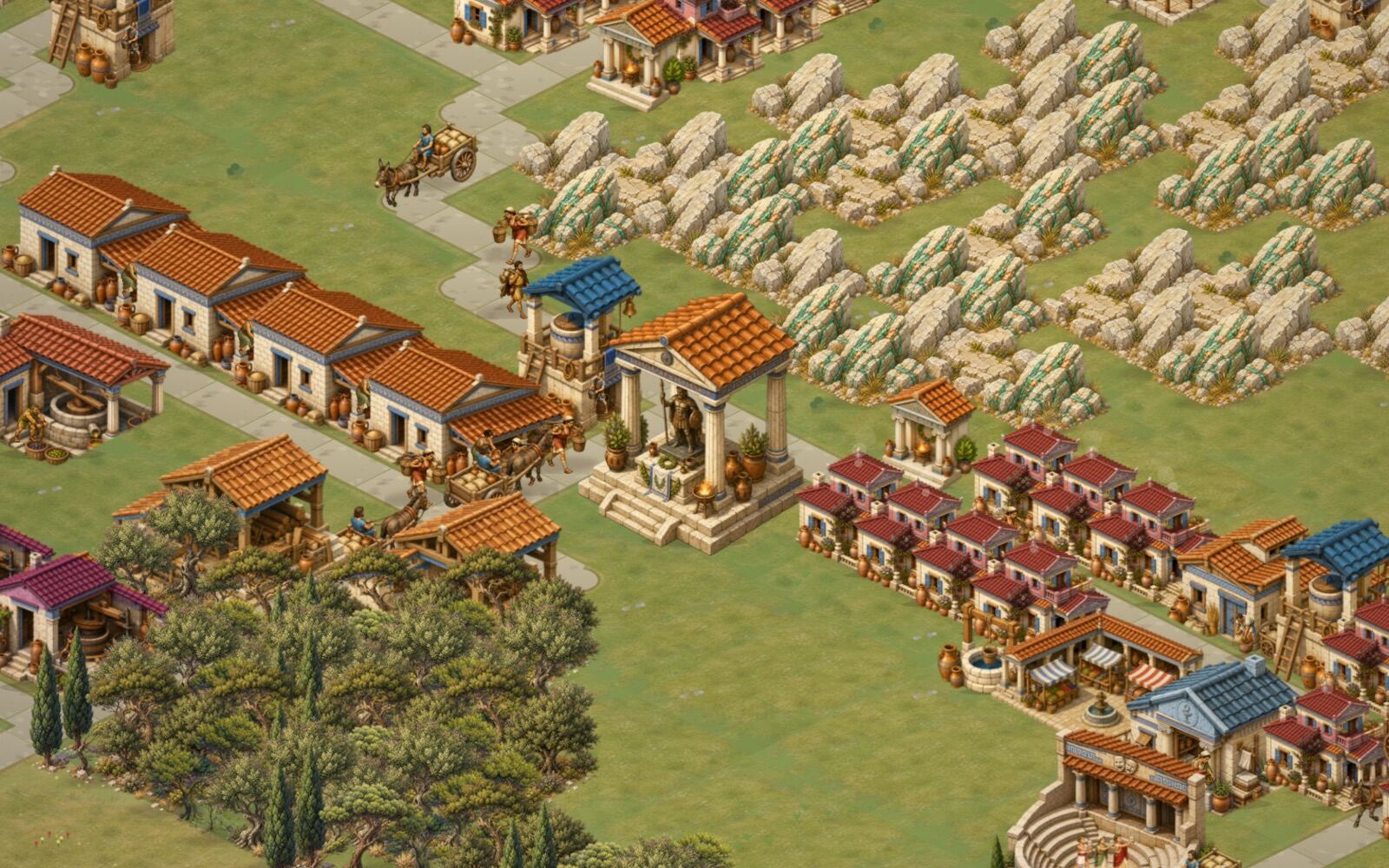
Where Theos lets you edit each walker's route, ours leaves the walking to the walkers: a vendor heads for the hungriest house within reach and feeds the rest on the way back, and roadblocks are how you fence a market district. Eight Olympians have temples, each raised as a supplied construction site, and once one is finished and staffed its god walks your streets and fights for you. From the third year, once the city has grown, the monsters start to arrive, a Minotaur first, and the answer is a hero from a Hero Shrine, as it was in Zeus. Around that runs a four-season year in which summer is the dead season, and six rival cities that trade, demand tribute and conquer each other.
It is not a remake, and it is a small team's game next to a studio production like Theos. What it offers is the same walker grammar in a tab, with nothing to install and nothing to configure.
It runs in the browser. No download, no account, no launcher.
The first fifteen minutes are free, then €4.99 + VAT once, forever.
Questions people ask
When does Theos: Cities of Myth come out?
Theos: Cities of Myth releases on 4 November 2026 on Steam, for Windows PC. Dotemu announced the date on 23 September 2026 with a release-date trailer, after revealing the game on 1 June with only the year attached. A free demo has been on Steam since 13 October, so you can play the opening missions of the Athens adventure before launch day.
What platforms is Theos on? Is it coming to PS5 or Switch?
Windows PC only, through Steam. The Steam page lists no Mac or Linux build, and Dotemu has not announced a PlayStation 5, Xbox or Nintendo Switch version; its own page for the game links only to Steam. Triskell's previous game, Pharaoh: A New Era, is also Windows-only on Steam, so do not count on a console release at launch.
Is Theos a remake of Zeus: Master of Olympus?
No. It is an original game under its own name, not a remake. Engadget reported in June that the team behind it wanted a spiritual successor to Zeus rather than a direct remake, and the design points that way: walkers, a sanctuary for your god, colonies and heroes. The official store page and press releases never mention Zeus: Master of Olympus, and Zeus itself is still sold as Zeus + Poseidon.
Is there a Theos demo?
Yes. A free demo has been on Steam since 13 October 2026 and is part of Steam Next Fest, from 19 to 26 October. After a tutorial it covers the first three missions of the Athens adventure, with Athena and Dionysus as patrons, and like the full game it runs on Windows only. Dotemu has not said whether the demo stays available after the festival.
Will Theos be on Mac?
Not as announced. Steam lists Theos for Windows only, with no macOS requirements, and Dotemu has not mentioned a Mac version. Mac owners would need a Windows compatibility layer, and nobody can say yet how well a game with these graphics requirements will run that way. For what it is worth, Zeus has no Mac version either.
How much will Theos: Cities of Myth cost?
It has not been announced. As of 20 October 2026 the Steam page shows no price and no pre-purchase option, and neither Dotemu nor Triskell has announced one. Check the store page nearer 4 November; we will add the figure here as soon as it is public rather than repeat a guess.
Who is Theos in Greek mythology?
Nobody, strictly. Theos (θεός) is simply the ancient Greek word for "a god", not the name of a particular deity, which is why the game can use it as a title. Each city in Theos: Cities of Myth is built around one patron from the Greek pantheon, seven in all: the demo pairs Athens with Athena and the colony of Miletus with Dionysus.
The short version
Theos: Cities of Myth is real, it is a Windows game on Steam, and it lands on 4 November 2026. It is the nearest thing to a Zeus successor on the horizon, a new game rather than a remake: from the team that remade Pharaoh, with walker routes you adjust flag by flag and cities built around a single patron god. The price, consoles and a Mac version are all unannounced. Play the demo while it is up, then decide.