Zeus: Master of Olympus housing blocks, common and elite
A good Zeus city is a set of housing blocks: houses packed around one shared set of services, sealed so the walkers who serve them cannot wander off. Here is what each house level needs, why blocks work, and four classic layouts from the fan galleries.
Need the game itself first? Our guide to playing Zeus: Master of Olympus today covers buying and installing it.
How housing works in Zeus
Zeus has two housing ladders. Common houses start as huts that immigrants build on the plots you lay out, then climb a seven-level ladder as goods and services reach them. Elite houses are a separate building you place yourself, with four levels, and they supply the city's hoplites and horsemen. In the fan sites' plans a common house covers 2×2 tiles, an elite house 4×4.
Houses also fall back when a supply runs out: the manual's examples are an Apartment that loses its oil dropping to a Tenement, and a Townhouse without food falling right back to a Hut.
Common housing levels
| Level | Holds | Needs (cumulative) |
|---|---|---|
| Hut | 8 | A plot on a road; arriving immigrants build it |
| Shack | 16 | Food from an agora |
| Hovel | 24 | + water from a fountain and access to one culture venue |
| Homestead | 32 | + fleece, and adequate appeal |
| Tenement | 40 | + a second culture venue |
| Apartment | 48 | + olive oil, and better appeal |
| Townhouse | 60 | + a third culture venue, and higher appeal |
Zeus Heaven scores culture in points: 15 for each passing podium walker, 20 for a gymnasium, 25 for a theatre and 20 for a stadium, which also adds 10 citywide. On Beginner a Townhouse needs 45, so a podium, a gymnasium and the stadium bonus get there without a theatre.
Elite housing levels
| Level | Holds | Needs (cumulative) | Soldiers it supplies |
|---|---|---|---|
| Residence | 6 | Food, fleece, olive oil, three kinds of culture, high appeal | None |
| Mansion | 10 | + armour from the agora, and more culture | 2 hoplites (spearmen in Atlantis) |
| Manor | 16 | + wine, and more culture | 4 hoplites (or spearmen) |
| Estate | 20 | + horses, and every kind of culture, stadium competitions included | 4 horsemen (charioteers in Atlantis) |
You cannot place an elite house until the city has food, fleece and olive oil in storage (2 food, 1 fleece and 1 oil, per Zeus Heaven and Citadel of Poseidon) and a high-appeal spot near culture. Elite houses also bring their own water, so they never need a fountain.
In Poseidon's Atlantean adventures the house names stay, but houses climb on science (Bibliotheke, Laboratory, Observatory, Museum) instead of culture, with spearmen and charioteers for soldiers. Our Poseidon: Master of Atlantis guide covers the rest.
What a housing block is, and why it works
Citadel of Poseidon describes a housing block as houses grouped to share one set of facilities: agora, culture, water, tax office and the rest. Zeus delivers each service by walker: a water carrier leaves the fountain, a peddler the agora, and each walks a fixed number of tiles before turning back, sooner if a roadblock or a road's end turns them. Houses beyond that reach go unserved.
Roadblocks turn roaming walkers back, so every classic design uses them to keep its walkers at home. Reach sets a block's size:
| Walker | Reach in tiles |
|---|---|
| Water carrier (fountain) | 27 |
| Healer (infirmary) | 27 |
| Tax office clerk | 35 |
| Culture walkers (science walkers in Atlantis) | 35 |
| Peddler (agora) | 44 |
| Maintenance officer | 44 |
| Watchman | 44 |
So a common block needs an agora with food, fleece and oil stalls, a fountain and enough culture venues within reach of every house, plus the tax office, maintenance office and infirmary both common designs below carry. An elite block drops the fountain, adds stalls for armour, wine and horses, and needs every kind of culture, stadium included. The college and drama school, which train the performers, can sit outside, as they do in three of the four designs below.
Four classic housing blocks
Zeus Heaven's block gallery holds about three dozen fan designs. Citadel of Poseidon mirrors all of them as tile-by-tile plans and says most came from a Zeus Heaven forum thread, "My Favorite Housing Blocks". Populations and notes are the galleries' own; footprints and building counts are our reading of those plans.
SenetEr's Common Housing Block: 40 townhouses
Common housing, 18 by 24 tiles including its perimeter road. A ring of houses runs between that road and an inner loop, and the middle of the loop holds the services: an agora with food, fleece and oil stalls, a fountain, an infirmary, a maintenance office, a tax office, a podium, a gymnasium and a theatre, with a monument, two parks and five columns for appeal. Seven more houses stand inside the loop, along one side. Two short link roads, both on one side, join the loop to the perimeter, each with a roadblock, so the service walkers stay inside. Forty townhouses hold 2,400 people; the college and drama school go outside.
| The ring block, simplified | ||||||||||
|---|---|---|---|---|---|---|---|---|---|---|
| R | R | R | R | R | R | R | R | R | R | R |
| R | H | B | H | H | H | H | H | B | H | R |
| R | H | L | L | L | L | L | L | L | H | R |
| R | H | L | S | S | S | S | H | L | H | R |
| R | H | L | L | L | L | L | L | L | H | R |
| R | H | H | H | H | H | H | H | H | H | R |
| R | R | R | R | R | R | R | R | R | R | R |
Eraserhead's 36 Townhouse Block: 36 townhouses
Common housing, about 20 tiles square. One road loop, bent into an L, with houses lining both sides. A monument, gazebos and benches fill the middle; the agora's food, fleece and oil stalls and the fountain run down one side; the theatre and gymnasium fill the corner the loop bends around; the infirmary, podium, tax office and maintenance office line the bottom edge. One road leads out, through two roadblocks. Thirty-six townhouses hold 2,160 people; the college and drama school go outside.
Nero Would's 20 Estate Block: 20 estates
Elite housing, about 22 by 31 tiles. Two parallel avenue-lined roads run its length, with most estates in columns facing them: one outside each road and a double column between, split by two monuments. An agora road across the top carries the elite stalls (two arms vendors, two horse trainers and a wine vendor); a second agora lower down carries food, fleece and oil beside a podium. Two gymnasiums, a theatre, maintenance and tax offices, a third monument and three gazebos complete it, with a roadblock on each of its three exits. Twenty estates hold 400 people and supply 10 companies of horsemen. Zeus Heaven's note says the city needs a stadium connected to the top-left exit, so the gymnasium walkers pass every estate; the college and drama school go outside.
Da Caesar's Elite Housing Block: 17 estates
Elite housing, about 29 tiles square, and self-contained. Its estates sit on both sides of a single road loop, and everything they want is inside: a stadium, theatre, gymnasium and podium, the college and drama school that supply them, one agora with all six stalls an estate draws on (food, fleece, oil, wine, armour and horses), and tax and maintenance offices. The rest is lavish decoration, more than 70 columns, five monuments, four hedge mazes, three fish ponds, a gazebo and four benches, with a roadblock on each of its two exits. Seventeen estates hold 340 people and supply 8.5 companies of horsemen. It uses about half as much space again per estate as Nero Would's, but needs no stadium elsewhere.
To plan your own, Zeus Heaven's Glyphy for Zeus turns a typed grid of characters into a block picture up to 40 by 40 tiles.
Common mistakes
- Loops longer than the shortest walk. Peddlers cover 44 tiles, water carriers and healers only 27, so measure a common block from the fountain and infirmary.
- No roadblocks. The block's walkers wander off to other streets; each design above has at least two.
- A fountain in an elite block. Elite houses bring their own water; neither elite design above has one.
- Skimping on appeal. The upper levels need it, which is why all four designs spend real space on decoration.
How the same idea works in Cities of the Aegean
Our game, so read this with the appropriate scepticism.
Cities of the Aegean is a city builder in the Zeus tradition that runs in a browser tab, and the block idea carries over. Houses climb five rungs, Hut, Cottage, Homestead, Villa and Estate, holding 8, 16, 28, 44 and 60 people. Water and food lift a hut to a cottage and then a homestead. A villa needs olive oil, a shrine or temple within reach and a reasonably handsome street; an estate adds fleece, a theatre and a beautiful neighbourhood. Break a supply and the house slides back, as in Zeus.
Reach is measured along the road: about seven tiles for a well and thirteen for a theatre, while agora vendors walk up to 28 tiles and cannot pass a roadblock, which is how you fence a market district. So half the Zeus habit transfers: a roadblock on each way out keeps the agora's vendors at home, while wells, shrines and theatres serve every house within road reach, roadblock or not.
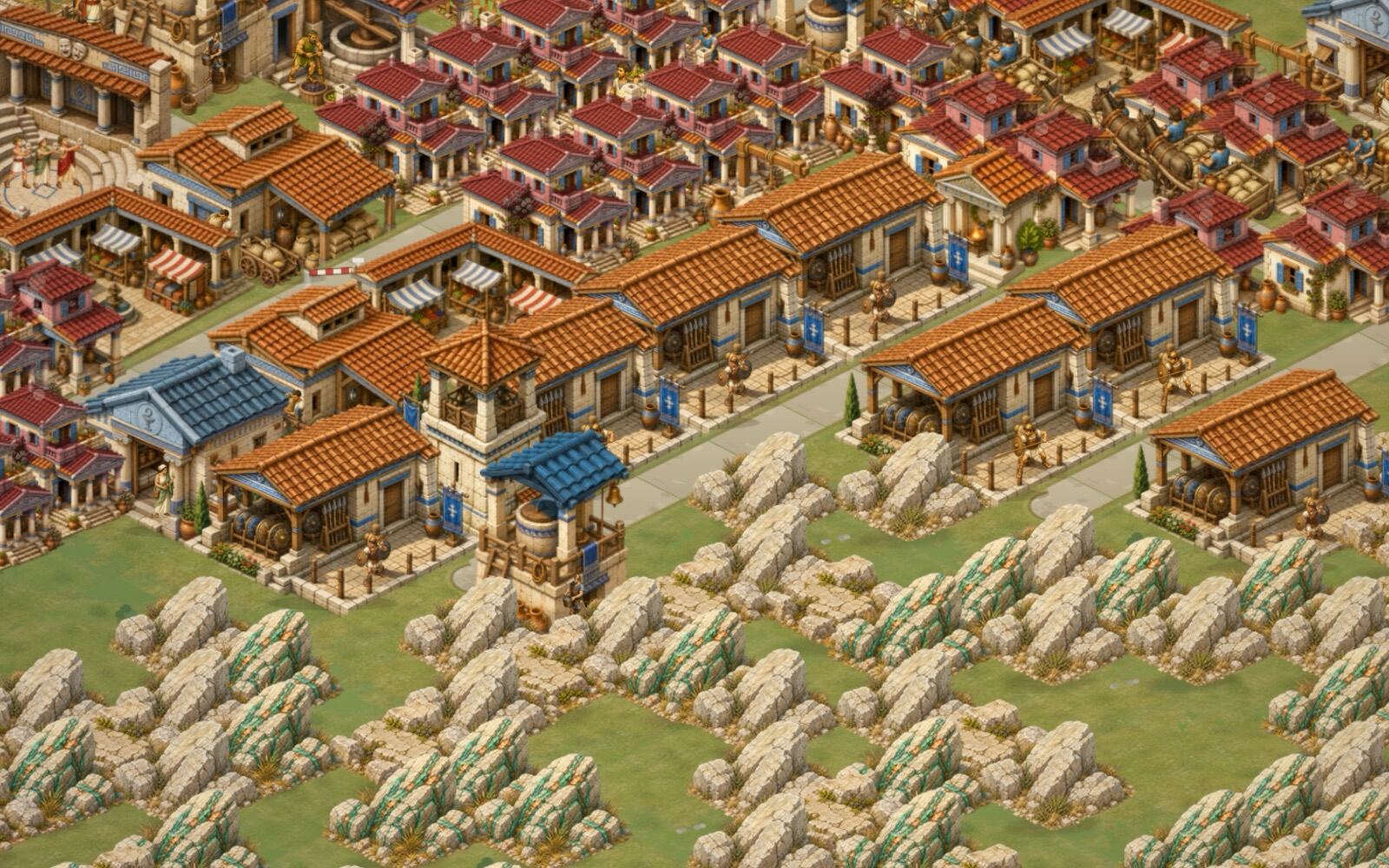
Wine skips the ordinary ladder. It goes to the Great Houses of the city's first families, our version of Zeus's elite housing: a 4×4 house on a beautiful lot that climbs from Walled Villa to Colonnaded Residence as olive oil, rites, Fire Watch wardens, wine, a theatre and physicians reach it. The Archon's Palace above that is bought rather than grown, for 24,000 drachmas, and wants a patron temple. Unlike Zeus's elite houses, it does want a well.
It is a small team's game, not a remake. Our games like Zeus list covers the wider field, and the beginner's guide walks through a first city.
Build your first block in a browser tab. Nothing to install.
The first fifteen minutes are free, then €4.99 + VAT once, forever.
Questions people ask
What is the best housing block in Zeus: Master of Olympus?
That depends on the space you have. For common housing, SenetEr's block holds 40 townhouses (2,400 people) and Eraserhead's 36 (2,160). For elite housing, Nero Would's 20 Estate Block is the more compact, while Da Caesar's 17-estate block brings its own stadium, college and drama school.
How do you get elite housing in Zeus?
Once the city has food, fleece and olive oil in storage, place an elite house on a high-appeal spot near culture. It starts as a Residence, then climbs to Mansion, Manor and Estate as armour, wine and horses arrive from the agora and its culture grows, ending with stadium competitions.
Do elite houses need water in Zeus?
No. Elite houses come with their own water supply, so they never need a fountain, and neither classic elite block above has one. They need food, fleece and olive oil from the start, then armour, wine and horses as they climb, with more culture and high appeal at every level.
How many people live in a Zeus townhouse?
Sixty at full size. The common ladder holds 8, 16, 24, 32, 40, 48 and 60 from Hut to Townhouse, which is why a 40-townhouse block houses 2,400 people. Elite houses hold far fewer: Zeus Heaven gives 6, 10, 16 and 20 from Residence to Estate.
Why do my houses keep devolving in Zeus?
Something they need has stopped arriving. A house drops a level or more when a good runs out or a walker stops reaching it, and losing food can send a Townhouse right back to a Hut. Check the agora's stalls, each walker's reach and whether a roadblock turns someone back early.
The short version
Learn the two ladders. Size every loop to the shortest walker's reach and seal it with roadblocks. Copy SenetEr's or Eraserhead's block first, then move on to estates with Nero Would's or Da Caesar's. Short of drachmas? Our Zeus cheats page has the checked codes.